
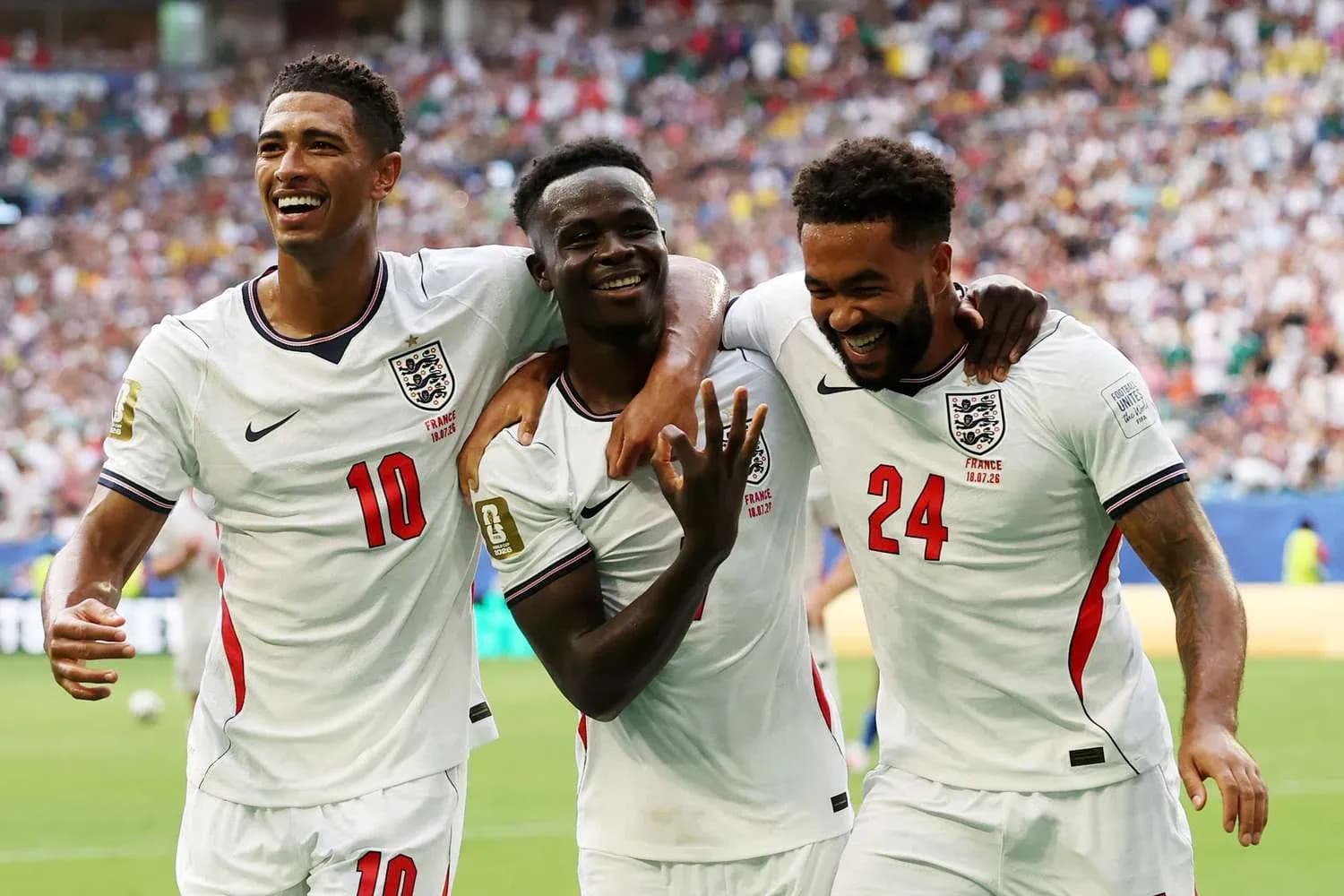
France vs England: Tactical Analysis of the 4-6 Match
France’s 4-6 defeat to England at Hard Rock Stadium, Miami Garden, was a tactical rollercoaster defined by structural collapse, in-game adjustment, and extreme attacking efficiency on both sides. England built a 4-0 half-time lead, then survived a ferocious French response that dragged the contest to 5-4 before a late sixth killed the comeback. Across 90 minutes, possession (54% England, 46% France) and shots (19-19) were broadly level, but the timing of England’s goals and their exploitation of French rest-defence in transition framed the entire tactical story.
First Half
England’s first half was a clinic in vertical, high-efficiency attacking. With 16 of their 19 shots coming inside the box, they consistently accessed central and half-space zones behind France’s midfield. Declan Rice’s early goal at 3' set the tone: a late-arriving midfielder exploiting space in front of the French back line. Ezri Konsa’s strike at 18' from a Rice assist underlined how England used set pieces and second balls to pin France deep and keep their centre-backs occupied.
Bukayo Saka was the key structural weapon. Nominally a midfielder in the lineup, he functioned as an advanced wide playmaker, attacking the channel between Theo Hernández and Maxence Lacroix. His goals at 37' and 45+1', the second from an Eberechi Eze assist, reflected England’s ability to isolate him 1v1 and then flood the box with runners. France’s wide protection was thin: Michael Olise and Désiré Doué started as creative midfielders rather than true ball-winners, leaving the full-backs repeatedly exposed when possession turned over.
France’s first-half issues stemmed from spacing and rest-defence. With Warren Zaïre-Emery and Adrien Rabiot as the central pairing, France tried to build with technical security (445 passes, 91% accuracy) but lacked a true holding presence to screen Rice’s movements or track Saka’s inside drifts. Kylian Mbappé’s high starting positions and Rayan Cherki’s tendency to come inside meant that when France lost the ball, their defensive transition was repeatedly outnumbered. England’s 4-0 half-time lead was less about volume (they had only 11 shots on goal to France’s 9 overall) and more about the quality and clarity of the situations they created.
Half-Time Adjustments
Didier Deschamps’ response at the break was drastic and structural. Four substitutions at 46' – Bradley Barcola (IN) came on for Désiré Doué (OUT), Ousmane Dembélé (IN) came on for Rayan Cherki (OUT), Dayot Upamecano (IN) came on for Ibrahima Konaté (OUT), and Lucas Digne (IN) came on for Theo Hernández (OUT) – effectively reset France’s wide profiles and defensive line. On the England side, Thomas Tuchel simultaneously adjusted his front line as Ollie Watkins (IN) came on for Marcus Rashford (OUT), trading some ball-carrying threat for a more direct reference point.
The tactical impact was immediate. With Dembélé and Barcola providing true width and depth, France’s attack became far more vertical and aggressive. The new wingers pinned England’s full-backs, giving Olise cleaner passing lanes between the lines and isolating Mbappé against the centre-backs. At 48', Mbappé finished from an Olise assist, a move that showcased France’s improved occupation of the final third. Six minutes later, at 54', the roles inverted: Mbappé assisted Barcola, whose run from the flank into the box exploited England’s now deeper and slightly passive defensive block.
Second Half
At 66', Mbappé again combined with Olise to make it 4-3, and the pattern was clear: France were now repeatedly breaking England’s last line through dynamic wide-to-central combinations. England’s midfield, with Rice as the main anchor, struggled to control second balls as France increased tempo and risk. Yet, despite conceding territory, England remained extremely dangerous whenever they managed to progress. Their shot profile – 19 total shots, 11 on goal, 16 inside the box – shows that even under pressure, they engineered high-value chances rather than speculative efforts.
In goal, Mike Maignan (France) faced 11 shots on target and made 5 saves according to France’s statistic of 4 “Goalkeeper Saves” for England’s keeper and 5 for England’s, but critically, the French data shows Maignan’s side allowing 11 on target while recording 4 saves themselves. This underlines how exposed the French defensive unit was in key phases, particularly in the first half and late in transition. Dean Henderson (England), by contrast, made 4 saves from France’s 9 shots on goal. The expected goals data – 2.87 xG for France, 2.58 xG for England – suggests that France, especially after the break, created enough to justify a high scoring output, but England’s finishing and early-game ruthlessness pushed the result beyond the underlying balance.
Tuchel’s in-game management in the second half focused on refreshing energy and reasserting control. At 79', Jude Bellingham (IN) came on for Eberechi Eze (OUT), and Elliot Anderson (IN) came on for Ivan Toney (OUT), adding more ball security and box-to-box presence to resist France’s waves. At 83', Reece James (IN) replaced Jarell Quansah (OUT), a move that shored up the right flank against the now rampant French wide threats. Even so, France continued to push: Ousmane Dembélé’s goal at 90+6', assisted by Dayot Upamecano, was the logical product of relentless wide pressure and second-phase attacking.
Decisive Moments
The decisive moments, however, came from England’s ability to keep scoring under siege. Saka’s penalty at 87' restored a two-goal cushion at 5-3 just as France seemed to be overwhelming the English block. Then, after Dembélé cut it to 5-4, Jude Bellingham’s strike at 90+8' sealed the 6-4 scoreline, capping a counter-attacking sequence that punished France’s ultra-high, late-game positioning.
Statistics and Analysis
Statistically, the match was remarkably even in many core metrics. Both sides finished with 19 total shots; France had 9 on goal to England’s 11. Blocked shots (6 for England, 4 for France) reflect how both defensive units spent long periods protecting their box under pressure. Passing figures were almost symmetrical in efficiency – France completed 405 of 445 passes (91%), England 467 of 515 (91%) – but England’s extra 70 passes and 54% possession indicate slightly greater control phases, particularly in the first half.
The xG figures underline the tactical narrative: France’s 2.87 xG speaks to a sustained, high-quality chance creation drive in the second half, while England’s 2.58 xG, converted into six goals, shows an attack that was both ruthless and well-structured in exploiting French vulnerabilities. Both goalkeepers are credited with 0.05 goals prevented, suggesting that this was less a story of extraordinary shot-stopping and more one of systemic attacking superiority and defensive fragility on both sides.
In tactical terms, England won the 3rd Place Final by front-loading their dominance, using Saka and Rice as structural levers to dismantle France’s initial shape, then surviving a dramatically different, wing-driven French side after Deschamps’ half-time reset. France’s comeback showcased the ceiling of their attacking talent once properly spaced, but their early rest-defence and England’s consistent access to the box ultimately defined a chaotic, high-scoring contest.
Related News
Thomas Tuchel Reflects on England's 10-Man World Cup Triumph and a Surprising Regret

Jude Bellingham Returns to Form with Real Madrid After World Cup Success

Chloe Kelly, Beth Mead & 13 Lionesses Who Must Shine in the Upcoming WSL Season for England’s 2027 World Cup Bid
Barcelona Cancels World Cup Tribute Amid Political Tensions
Messi Breaks Record for Most Penalties Taken and Missed in FIFA World Cup History
FIFA Removes COO Kevin Lamour After Criticism of Infantino’s World Cup Investment Plan