
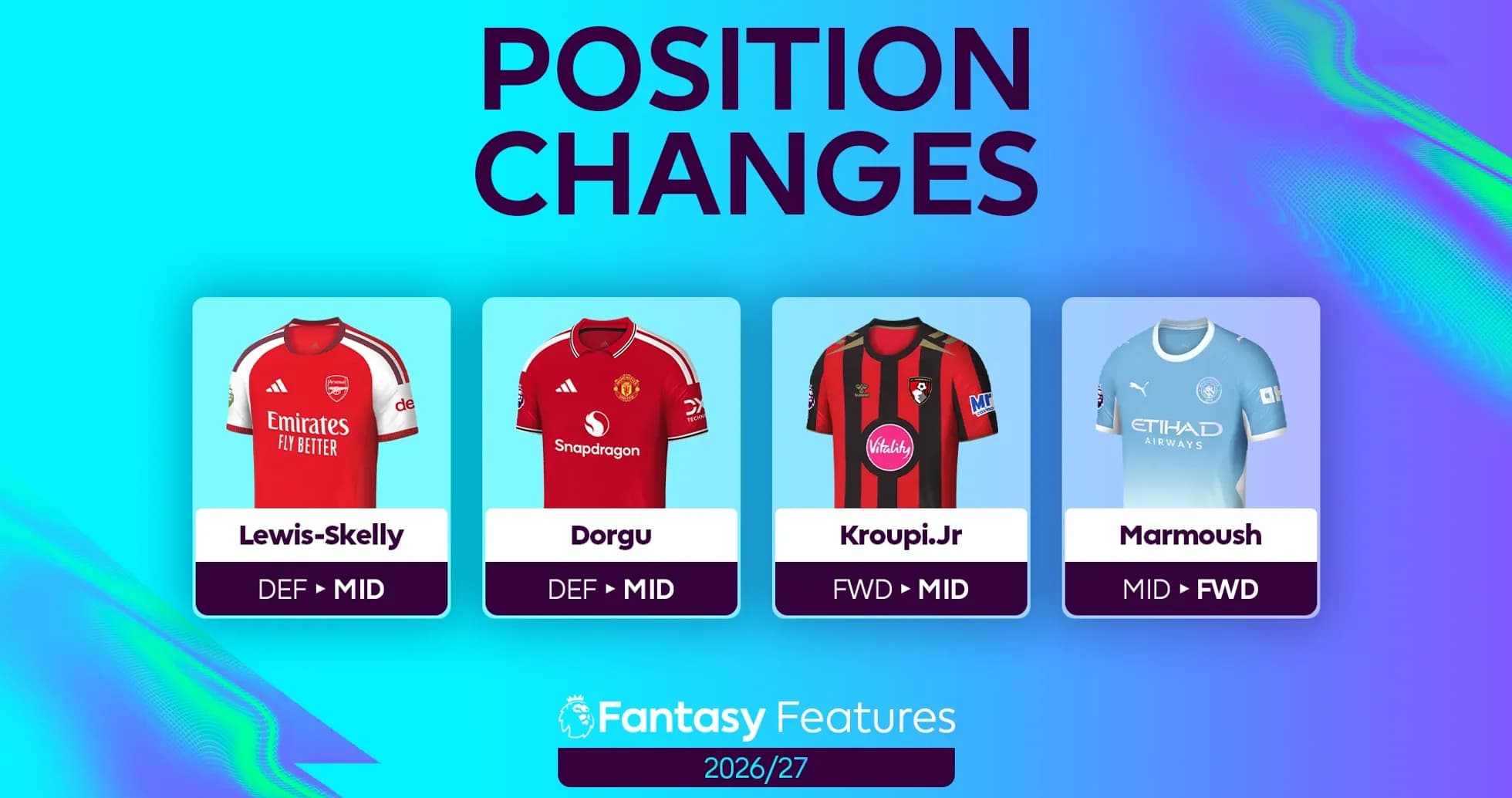
Fantasy Premier League 2026/27: Key Positional Changes
The Fantasy Premier League game board has shifted again. Not with a new chip or scoring rule, but in a way seasoned managers know can be just as powerful: positional reclassifications.
A cluster of emerging names – Junior Kroupi, Patrick Dorgu and Omar Marmoush among them – have been moved on the FPL grid for 2026/27, and the implications for squad building are significant.
Kroupi: From finisher to Fantasy goldmine
Bournemouth’s Junior Kroupi is the headline change. Listed as a forward last season, he now becomes a midfielder – and that instantly sharpens his appeal.
Kroupi didn’t operate as a traditional No 9 in 2025/26. He spent most of his breakout campaign as a No 10, floating behind Evanilson, linking play and attacking the box late. The role suited him brutally well.
Thirteen goals in 33 appearances tell part of the story. The real punch comes in the efficiency: he averaged a goal every 134.0 minutes. Among Bournemouth’s midfield regulars, nobody came close. Across the league’s midfielders, only Antoine Semenyo could match that level of threat among regular starters, and even he lagged behind at 188.2 minutes per goal.
Now, that same output is being scored as a midfielder.
That means an extra point for every goal he scores compared with last season’s classification, and access to clean-sheet points on top. For an attacking No 10 with that level of end product, the reclassification is a gift. If Kroupi sustains anything like his 2025/26 numbers, he shifts from an interesting forward option to a potential cornerstone in midfield.
Dorgu: Carrick’s winger gets a new label
At Manchester United, Patrick Dorgu’s change is more subtle in volume but no less intriguing in impact. He moves from defender to midfielder for 2026/27, a direct reflection of how Michael Carrick used him once he arrived in Gameweek 22.
Dorgu barely featured under the new manager in terms of minutes – just three league starts. But those three starts were loud.
Every time Carrick named him in the XI, Dorgu played as a left winger. Every time, he scored.
He struck against Arsenal. He struck against Manchester City. Against Brighton & Hove Albion, he went one better, delivering a goal and an assist. Small sample, yes. But the attacking data under Carrick puts him right in the conversation with United’s established midfield threats.
Measured against Matheus Cunha and Bryan Mbeumo over that period, Dorgu’s numbers stand up impressively. He fired a shot every 33.2 minutes, the quickest rate of the trio, and matched Cunha’s tally of three big chances – despite logging over 800 minutes fewer than the Brazilian.
As a defender, those attacking returns were explosive when they landed, but hard to trust given the limited minutes. As a midfielder, the scoring ceiling per goal is slightly lower, and he loses clean-sheet points, but the reclassification underlines where United see him: higher up the pitch, closer to the action. If Carrick leans into that and Dorgu’s minutes climb, he instantly becomes a high-upside midfield punt rather than a speculative attacking full-back.
Marmoush: Guardiola’s front man steps into the No 9 bracket
Omar Marmoush heads in the opposite direction. The Manchester City man moves from midfield to forward, a direct nod to how Pep Guardiola used him in his final season in charge.
Guardiola trusted the Egyptian through the middle. Marmoush led the line, stretching defences, linking play and finishing moves. He ended the campaign with three goals and three assists from that advanced role.
As a midfielder, those returns were tidy rather than spectacular. As a forward, the scoring system strips away the clean-sheet bonus and downgrades his goals by a point each, but it also clarifies his role for FPL managers: he is now judged against strikers, not creators.
In a City side that spreads goals and assists across multiple positions, Marmoush’s reclassification raises the bar he has to clear. To compete with premium forwards, he will need either a surge in minutes, a spike in output, or both. The upside is clear if he nails down that central berth in a post-Guardiola City; the margin for error, as a forward, is smaller.
The wider reshuffle
Around those three headline names, the reclassifications sketch out tactical shifts across the league.
Myles Lewis-Skelly (Arsenal), Lamare Bogarde (Aston Villa), Keane Lewis-Potter (Brentford) and Patrick Dorgu all move from defence into midfield, a collective nod to the rise of attack-minded full-backs and wide players being pushed higher up the pitch. Rio Cardines (Crystal Palace), Ryan Sessegnon (Fulham) and Eric Moreira (Nottingham Forest) travel the other way, re-listed as defenders after operating deeper.
At Brighton & Hove Albion, Mats Wieffer drops from midfield into defence, while Georginio Rutter is now a forward rather than a midfielder – two changes that underline how roles have been redrawn on the south coast.
Each of these tweaks matters. Each one shifts the value equation. A defender pushed into midfield can become a bonus magnet; a midfielder turned striker must now justify his place with goals, not just involvement.
And that is the point of days like this in FPL. Before a ball is kicked, the game has already changed. The managers who read these positional lines quickest, who understand what Kroupi in midfield really means, or how Dorgu on the wing alters United’s balance, will be the ones walking into Gameweek 1 with an edge.
The question now is simple: who do you trust to keep their new role when the real football starts?
Related News

Ilia Topuria Accuses Justin Gaethje After UFC Defeat

Tyson Fury vs Anthony Joshua Fight Date and Venue Confirmed
Switzerland Calls Up In-Form Sion Striker Winsley Boteli for Nations League
Bournemouth Secures Historic 2-1 Win Over Real Sociedad in Spain

Portugal Announces Squad for 2026 UEFA Nations League; Cristiano Ronaldo Expected to Play

Raphinha Channels Ronaldo Nazario as Barcelona's Leading Striker After Position Change