
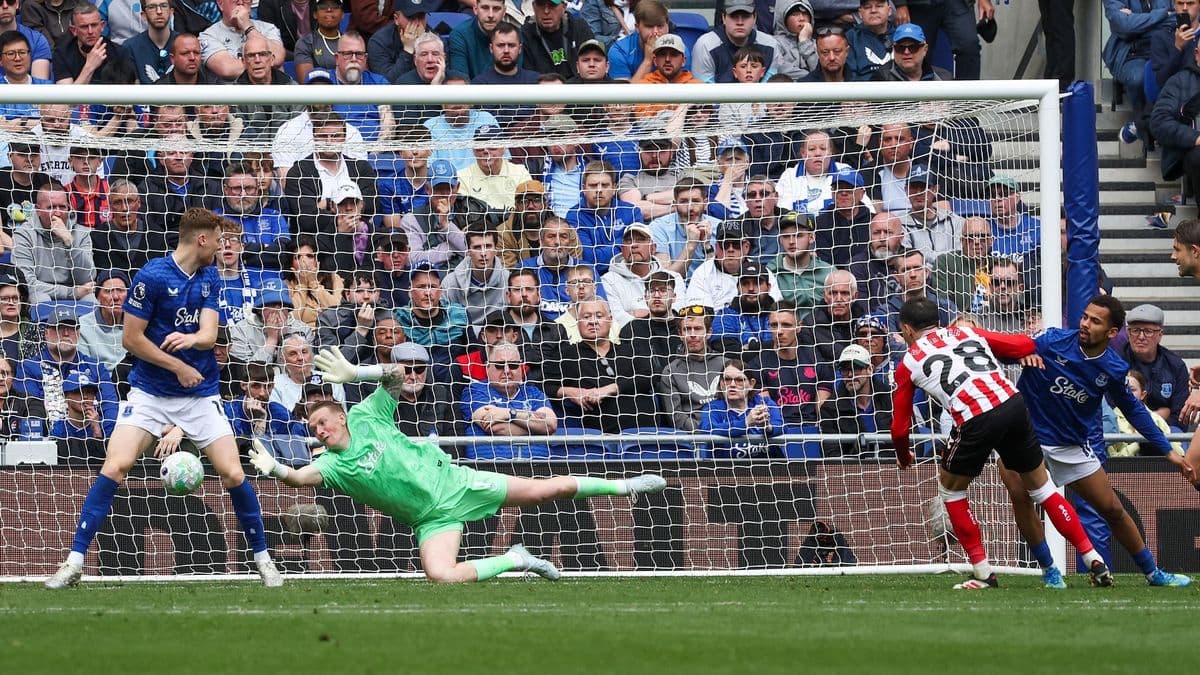
Everton vs Sunderland: Tactical Breakdown of a 3-1 Defeat
On a grey Merseyside afternoon at Hill Dickinson Stadium, a season’s worth of tension condensed into 90 unforgiving minutes. Everton, 12th in the Premier League table on 49 points with a goal difference of -2 (47 scored, 49 conceded in total), saw a 1-0 half-time lead dissolve into a 3-1 defeat against a Sunderland side that arrived ninth with 51 points and a goal difference of -7 (40 for, 47 against in total). Following this result in Round 37, the story was not just the scoreline, but the way the two squads embodied their seasonal identities.
Both coaches trusted a 4-2-3-1, but the shapes told different stories. Leighton Baines’ Everton were built around a double pivot of J. Garner and T. Iroegbunam, with K. Dewsbury-Hall and I. Ndiaye supporting lone striker Beto. Regis Le Bris mirrored the structure, yet Sunderland’s version felt more fluid and aggressive: G. Xhaka and N. Sadiki anchoring, E. Le Fée and T. Hume pushing high from midfield, and B. Brobbey as the reference point up front.
The absences framed the tactical voids. Everton were without J. Branthwaite, J. Grealish and I. Gueye – a trio that, in different ways, would normally harden their spine. Branthwaite’s defensive presence, Grealish’s ball-carrying and creativity, and Gueye’s screening were all missing, forcing Baines to lean heavily on J. Tarkowski, M. Keane and the energy of Iroegbunam to protect J. Pickford. Sunderland, for their part, travelled without D. Ballard (suspended after a red card), S. Moore, R. Mundle and B. Traore. The absence of Ballard, a defender who had contributed 2 goals and 24 successful blocks across 29 appearances, shifted responsibility squarely onto N. Mukiele and O. Alderete at the heart of their back line.
Everton’s season-long numbers hinted at a side always walking a tightrope. At home they averaged 1.4 goals for and 1.4 against, symmetry that spoke to their unpredictability. They had kept 6 home clean sheets but also failed to score in 4 home matches, and their form line of LDDLL heading into this game underlined a late-season wobble. Sunderland’s profile was more split: solid at home, fragile on their travels. Away, they averaged 0.9 goals scored and 1.5 conceded, with 8 defeats in 19 away matches. On paper, this should have been Everton’s opportunity.
For 45 minutes, it looked that way. The hosts’ 4-2-3-1 functioned as intended: Garner stepping out of the double pivot to dictate, Dewsbury-Hall knitting passes between the lines, and Ndiaye floating into pockets that drew Sunderland’s defenders out of shape. With Pickford behind a back four of J. O’Brien, Tarkowski, Keane and V. Mykolenko, Everton controlled territory and tempo, their structure compact enough to choke off Sunderland’s central progression.
Yet the second half exposed the deeper structural fault lines that have defined Everton’s season. Overall they concede 1.3 goals per game in total, and when the game opened up, that fragility resurfaced. Sunderland’s response was orchestrated from the “engine room”: Xhaka and Le Fée gradually seized control of the central corridor. Le Fée, who has 5 goals and 6 assists this Premier League season, began to receive between Everton’s lines, combining with Hume on the right and N. Angulo drifting inside from the left.
The Hunter vs Shield duel emerged between Brobbey and Everton’s central defence. Sunderland’s attack, modest in volume at 1.1 goals per game in total, relies on sharp, vertical movements when the midfield breaks pressure. Once Xhaka started punching passes through Everton’s first line, Brobbey’s physicality and channel runs dragged Keane and Tarkowski into uncomfortable territory. Without Gueye’s ball-winning or Branthwaite’s recovery pace, the “shield” cracked. The 1-0 lead, built on compactness, turned brittle as distances between Everton’s lines grew.
On the flanks, another key battle unfolded. Reinildo Mandava, a defender with 1 assist and known for his aggression – 7 yellow cards and 1 red this season – walked the disciplinary tightrope but gave Sunderland thrust down the left. Opposite him, Everton’s wide creators missed Grealish’s subtlety. Dewsbury-Hall and Ndiaye worked industriously, but when Everton needed someone to carry them up the pitch and win fouls to relieve pressure, the absence of Grealish’s 58 fouls drawn and 6 assists this campaign was stark.
Discipline and mentality also played their part. Everton’s yellow card distribution this season shows a pronounced late-game spike: 20.83% of their yellows arrive between 46-60 minutes and another 20.83% between 76-90. Sunderland’s own bookings peak at 23.38% between 46-60. This fixture followed that pattern: as the second half began, both sides became more stretched, more combative, and Everton, already emotionally frayed by recent form, lost the calm that had underpinned their first-half control.
Within that chaos, Sunderland’s leaders stepped forward. Xhaka, with 1753 completed passes at 83% accuracy this season and 50 tackles, became the metronome and the enforcer. His partner Le Fée, who has already scored 3 penalties but missed 1, showed the blend of risk and incision that defines his game: always looking for the forward lane, even if it meant turnovers earlier in the season. T. Hume, a defender with 64 tackles and 9 yellow cards, pushed high to create overloads, accepting the disciplinary risk to pin Everton’s full-backs back.
By the time the final whistle went, Sunderland had turned an away weakness into a statement of resilience. They had come into the game with only 5 away wins from 19 and a negative away goal difference of -11 (17 scored, 28 conceded on their travels), yet here they outscored an Everton side usually balanced at home. For Everton, the defeat was a distillation of their campaign: competitive overall, capable of bursts of quality, but undermined by thin depth in key positions and a tendency to unravel once the game state turns against them.
From a statistical prognosis perspective, the underlying profiles make the 3-1 Sunderland win feel like an outlier in venue terms but not in structural terms. Everton’s total goals for and against averages (1.3 scored, 1.3 conceded) and Sunderland’s (1.1 scored, 1.3 conceded) both point to fine margins. On this day, Sunderland’s better-developed midfield axis and sharper in-game adaptation overwhelmed an Everton side stripped of its key stabilisers. The xG story, even without explicit numbers, would likely mirror the narrative: Everton front-loaded their threat, Sunderland accumulated theirs, and once momentum shifted, the visitors’ tactical coherence made the difference.
Related News
Bournemouth vs Liverpool Prediction: Key Stats and Betting Tips
Tottenham vs Aston Villa Predicted Lineups: Team News for Premier League Clash
Brighton vs Arsenal: Premier League Clash Preview
Manchester City vs Sunderland: Premier League Clash Preview
Tottenham vs Aston Villa: Early Relegation Battle
Brentford vs Chelsea Predicted Lineups: Team News and Match Insights