
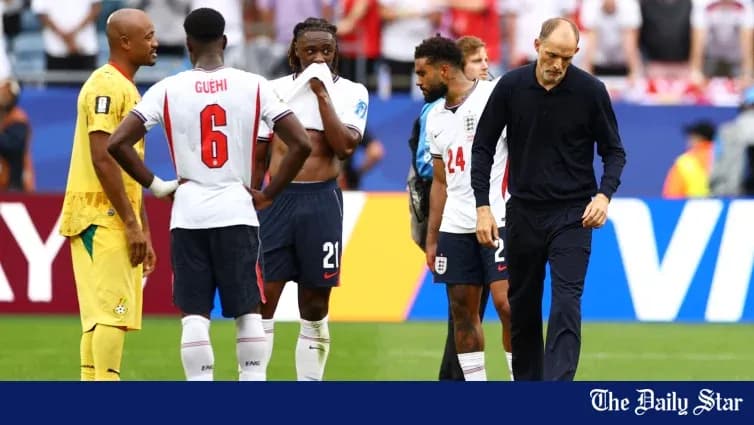
England Held to Draw by Ghana in World Cup Clash
Thomas Tuchel has seen a lot in tournament football, but not many nights like this. England, fresh from a 4-2 statement win over Croatia, spent 90 minutes camped in Ghana’s half, racking up a remarkable 78.8% possession – the highest on record at a World Cup since 1966 for a team that failed to score – and still walked away with only a 0-0 draw and a chorus of groans.
This was dominance without incision. Control without reward.
England Hit a Wall
From the first whistle, the pattern was obvious. White shirts on the ball, black shirts behind it. Ghana retreated into one of the deepest, most stubborn blocks the tournament is likely to see, and they never blinked.
Tuchel, rarely one to hand out compliments lightly, could only salute it.
He called it one of the most physical, determined and disciplined defensive displays he has witnessed from a team without the ball. England probed, recycled, switched play, and then did it all again. Ghana simply refused to move.
Set-piece after set-piece came and went. Corners, wide free kicks, second balls dropping on the edge of the box. Tuchel knew that with this kind of territory and this many dead-ball situations, the game should have been decided. It wasn’t. England, as he admitted, were not clinical enough.
From Flowing Croatia Win to Stalled Ghana Stalemate
The contrast with the Croatia game could hardly have been sharper. That opener had been all forward thrust, combinations, and goals. Four of them. It felt like a statement of intent from a side ready to light up the tournament.
Against Ghana, the same intent hit a concrete wall.
Tuchel recognised the shift and the frustration that followed. When one team has almost all of the ball against a packed defence, when the spaces never quite open and the chances never quite become clear, the spectacle suffers. He did not hide from that. He admitted it was hard to watch at times, even if the tactical battle fascinated the coaches.
Yet he pushed back against the idea that this was a step backwards. He insisted he saw more positives than negatives, even on a night when the scoreboard refused to budge. The message to supporters was clear: stay with us. There is a long road still to travel.
Kane’s Missed Moment
For all Ghana’s resistance, the game still hinged on one instant. Minute 86. The kind of moment Harry Kane usually owns.
Substitute Nico O’Reilly rose to meet a cross and powered a header against the crossbar. The ball looped up, hung for a heartbeat, and dropped perfectly for the England captain. Six yards out. Goal at his mercy. The stadium inhaled.
Kane lashed it over.
Tuchel’s verdict was blunt and generous all at once: 99 times out of 100, Kane scores. This was the one. The miss felt even bigger because it came after so much sterile dominance, so many half-chances that never quite turned into real ones. That was the opening England had been chasing all night. Their finisher, usually ruthless, let it go.
Group Picture Still Favourable
Strip away the emotion and the numbers still favour England. Four points from two games. Unbeaten. All but assured of a place in the knockout rounds. The Croatia win did the heavy lifting; this draw, while exasperating, does not derail the campaign.
Tuchel knows that tournaments are rarely won in the group stage, but they can be shaped there. His team has shown they can dazzle and, on this evidence, they can also grind. What they have not yet shown is the ability to break open a deep, elite-level block when the stakes rise and the space disappears.
That question will not go away.
Next up is Panama on Saturday, the final game of Group L. Qualification is almost in hand. The real issue now is different: after a night of total control and no goal, can England turn possession into something far more valuable when the knockouts begin?
Related News
Raphinha’s Hat-Trick Powers Barcelona to 7-2 Victory Over Racing Santander
Carabao Cup Fourth Round Draw: Liverpool Set to Clash with Chelsea, Arsenal to Face Fleetwood Town
Key Football Matches to Watch in Azerbaijan This Autumn
Raphinha's Hat-Trick Drives Barcelona to 7-2 Triumph Over Racing Santander
Hansi Flick Leads Barcelona to Record-Breaking Seven Wins in a Row
Gavi Reflects on Injury Return as Barcelona Dominate Racing Santander 7-2