
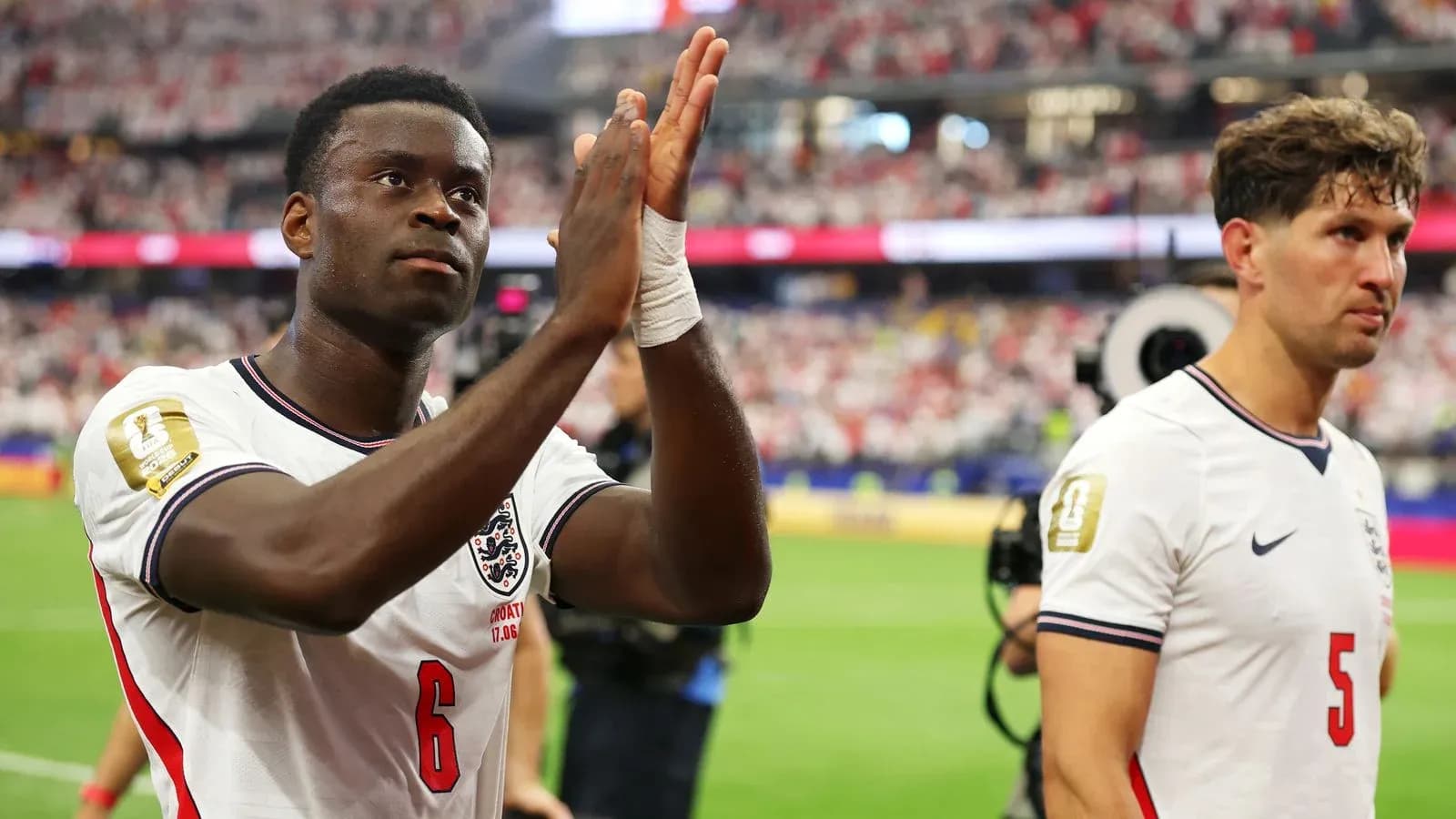
England’s Defensive Dilemma: Tuchel’s Tough Choices
England’s attack roared in Dallas. Their defence whispered.
Thomas Tuchel walked away with three points and a statement win over Croatia, but the questions that trailed his centre-backs out of AT&T Stadium were loud, pointed and entirely predictable.
A partnership under the microscope
The selection of Ezri Konsa alongside John Stones had already raised eyebrows before a ball was kicked. Marc Guehi, outstanding for Manchester City since January, sat on the bench while Tuchel backed the pairing he has leaned on most often in his England tenure.
Forty-five minutes later, Gary Neville gave voice to what many were thinking.
“Is Konsa and Stones a partnership that can win us the World Cup?” he asked on ITV, after watching Stones go to ground in the build-up to Croatia’s first goal and Konsa misjudge a chipped pass before their second. Neville’s warning shot was blunt: Declan Rice and Elliot Anderson, he argued, would have to be “outstanding” to protect a back line that had creaked badly in that opening half.
The errors were not isolated moments. Under Croatia’s aggressive press, both centre-backs looked uncomfortable playing out from deep. Possession was coughed up in areas where England usually purr. The numbers at full-time flattered to deceive.
Stones completed his passes but finished with just one attempted tackle – which failed – and a single clearance in 87 minutes. He won four of seven duels. Konsa’s figures were starker: three wins from eight duels, one from five in the air, no tackles, no interceptions. For a side with ambitions of going all the way, that reads light.
Jamie Carragher did not sugar-coat it on Sky Sports News the next morning. “We probably lack something defensively to go all the way,” he said, pouring a little cold water on the optimism generated by England’s thrilling second-half surge.
The attack had caught fire. The back line had been left smouldering.
Guehi waiting in the wings
This is where Marc Guehi comes in – and where Tuchel’s next big call lies.
Guehi, 25, arrives at this World Cup as a very different player to the one who impressed at the Euros two years ago. Back then, England were built on defensive security and criticised for their lack of attacking edge. Now the script has flipped, and Guehi’s evolution at Manchester City offers Tuchel a way to rebalance the story.
Since his Premier League debut for City in January, Guehi has been among the league’s standouts in both defensive and ball-playing metrics. He ranked 10th for possession won in the defensive third, fourth for interceptions, sixth for forward passes and fifth for passes completed over that spell. That blend of aggression and composure is precisely what England’s back line lacked against Croatia.
His rise has come at a cost to Stones. The City defender, once a guaranteed starter for club and country, simply could not get into Pep Guardiola’s side ahead of Guehi in the run-in. Stones has made it clear he was fit and available, but Guardiola still chose Guehi. That decision hangs over Tuchel’s own selection.
Stones will leave City this summer at the end of his contract, having played just five times for them in 2026. He started only five Premier League games in the past year. City lost four of them.
Tuchel, though, values what Stones brings off the ball as much as on it: experience, leadership, calm under pressure. Those qualities helped earn him a place on the plane. The dilemma is how to use him.
Playing people in their best positions
Against Croatia, Tuchel pushed Stones to the left of the central pairing to keep Konsa on his preferred right side. It was not a total experiment – the combination had a test run against Costa Rica in the final warm-up game – but it went against the grain of Stones’ club career.
Across the past three seasons, Stones has logged just 371 minutes at left centre-back for City, compared with 1,151 on the right. The muscle memory is different, the angles are different, the body shape is different. At this level, those details bite.
Guehi, by contrast, has spent much of his career operating on the left despite being right-footed. He did it regularly at Crystal Palace, often on the left of a back three, and has shown at City he can switch sides when required. He explained the adjustment succinctly back in December: when you switch sides after a long spell on one, “it can throw you off a little bit”.
Tuchel has already seen what a Stones–Guehi partnership can look like. He paired them in England’s first World Cup warm-up against New Zealand, a combination that felt like the likely starting point for this tournament. Recalling Guehi and restoring Stones to his natural right-sided role would be the most logical route to stability.
But logic in tournament football often collides with loyalty.
The Konsa question
Under Tuchel, only Jordan Pickford and Harry Kane have played more minutes for England than Konsa. The Aston Villa defender has become one of the manager’s most trusted lieutenants. Guehi has actually started more games alongside Konsa than alongside Stones in this era.
To drop Konsa after a single World Cup outing – one England still won – would be ruthless. It might also be necessary.
There is a compromise on the table: play all three.
Tuchel has already tested that configuration. Konsa started at right-back with Stones and Guehi in the middle against Wales in October. The shape suited Tuchel’s preference for physically imposing full-backs over the more creative, risk-taking types he has overlooked, such as Trent Alexander-Arnold.
Konsa’s athleticism and defensive instincts make him a natural fit for that role in Tuchel’s eyes. The casualty in that scenario would almost certainly be Reece James.
James impressed against Croatia, especially when he stepped into midfield late on, and he remains Tuchel’s most-used right-back, with five starts in that position. But his injury record cannot be ignored. Before this World Cup, he had not started back-to-back games for Chelsea since March. He has now started two in a row for England, against Costa Rica and Croatia.
Managing James’ workload is a live issue. The obvious game to rest him might be the final group fixture against a weaker Panama side. The problem: England’s qualification and final position in Group L may still be in the balance by then. Tuchel may not have the luxury of rotating heavily.
So the decision sharpens around Ghana on Tuesday. Stick with the Stones–Konsa pairing and trust that the early jitters were just that? Bring Guehi back in and risk unsettling one of his stalwarts? Or roll out the three-man solution and shift the entire dynamic of the right flank?
Tuchel’s World Cup tightrope
This World Cup is already asking Tuchel the hardest question a tournament coach can face: how much faith do you place in the players who got you here when the evidence on the pitch starts to turn?
England’s attack against Croatia hinted at a side capable of blowing teams away. To turn that into a genuine title challenge, Tuchel must now find a defensive blend that can live with the chaos at the other end.
Guehi has the numbers. Stones has the pedigree. Konsa has the manager’s trust.
Ghana will reveal which of those currencies Tuchel values most when the stakes are rising and the margin for error is shrinking fast.
Related News

Raphinha’s Hat-Trick Powers Barcelona to 7-2 Victory Over Racing Santander
Carabao Cup Fourth Round Draw: Liverpool Set to Clash with Chelsea, Arsenal to Face Fleetwood Town
Key Football Matches to Watch in Azerbaijan This Autumn
Raphinha's Hat-Trick Drives Barcelona to 7-2 Triumph Over Racing Santander
Hansi Flick Leads Barcelona to Record-Breaking Seven Wins in a Row
Gavi Reflects on Injury Return as Barcelona Dominate Racing Santander 7-2