
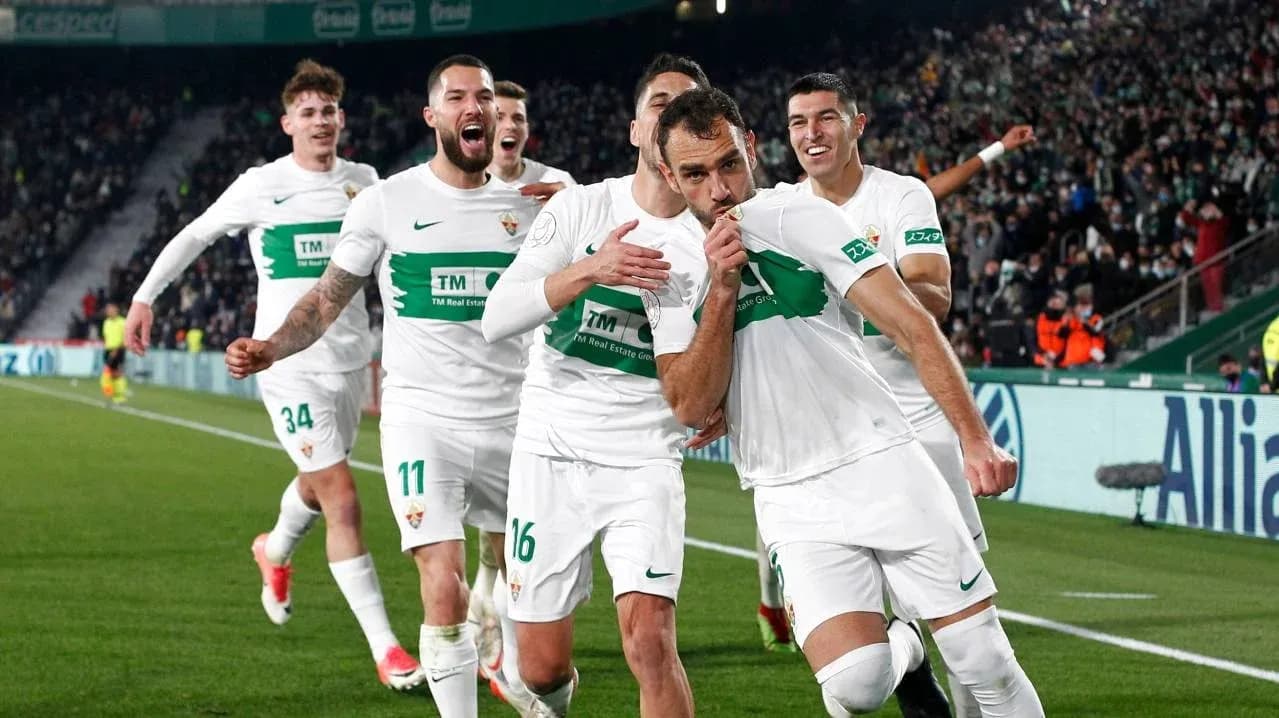
Elche vs Alaves: Tactical Battle Ends in 1–1 Draw
Elche and Alaves shared a 1–1 draw at Estadio Manuel Martínez Valero in Round 35 of La Liga, a contest defined by structural contrast: Elche’s proactive 3-5-2 against Alaves’ deep 5-3-2. Elche controlled territory, possession and volume of shots, while Alaves leaned into compactness, penalty-box defending and fast breaks. The data underlines the tension: Elche had 65% of the ball and 16 shots but trailed on expected goals (1.46 vs 2.14), reflecting Alaves’ ability to engineer clearer chances despite spending long stretches without the ball.
I. Executive Summary
The match settled into a pattern of Elche building patiently from the back and Alaves defending with a low block and wing-back discipline. A second-half penalty converted by T. Martinez and a swift Elche equaliser from A. Rodriguez encapsulated the tactical battle: Alaves dangerous in transition and on direct attacks, Elche using width and rotations in midfield to eventually crack the visitors’ defensive shell. Both goalkeepers were busy, but the xG and shots profile suggests Alaves will feel they left a more valuable away performance with only a point.
II. Scoring Sequence & Disciplinary Log
Card verification: Elche: 3, Alaves: 6, Total: 9.
Full disciplinary log in chronological order:
- 12' Pablo Ibáñez (Alaves) — Foul
- 29' Antonio Blanco (Alaves) — Foul
- 33' Jonny Otto (Alaves) — Foul
- 50' Aleix Febas (Elche) — Foul
- 69' Ibrahim Diabaté (Alaves) — Foul
- 78' Antonio Sivera (Alaves) — Argument
- 88' Grady Diangana (Elche) — Argument
- 88' Abderrahman Rebbach (Alaves) — Argument
- 90+5' John Donald (Elche) — Foul
With no goals in the first half, the break came at 0–0, Elche on top in possession but unable to convert their 14 first-phase box entries into a lead.
The second half opened with an Alaves reshuffle: at 46', D. Suarez (IN) came on for P. Ibanez (OUT), adding more composure in midfield. The visitors struck first at 51', when Alaves earned a penalty and T. Martinez converted from the spot to make it 0–1, perfectly aligned with their game plan of sitting deep and attacking in bursts.
Elche’s response was structural as much as emotional. At 67', they doubled down on width and attacking thrust: Josan (IN) came on for Tete Morente (OUT), and G. Diangana (IN) replaced A. Febas (OUT), turning the right flank into a more direct outlet. Simultaneously, Alaves swapped their scorer at 67', with Yusi (IN) for T. Martinez (OUT), reinforcing the defensive side of their 5-3-2.
The equaliser arrived quickly and through the very pattern Elche had been chasing. In the 72', A. Rodriguez finished a move created by Josan’s impact from the flank, making it 1–1. From there, discipline began to fray as fatigue and pressure mounted. Ibrahim Diabaté’s 69' booking for Foul had already signalled Alaves’ struggle to contain Elche’s midfield rotations; by 78', even goalkeeper Antonio Sivera was booked for Argument, reflecting rising tension.
Late-game management saw further substitutions: at 82', C. Protesoni (IN) for I. Diabate (OUT) and A. Guevara (IN) for J. Guridi (OUT) gave Alaves fresh legs in midfield and attack. Elche answered at 85' with J. Donald (IN) for M. Aguado (OUT) and Buba Sangare (IN) for V. Chust (OUT), subtly shifting their back line and central structure to sustain pressure and guard against counters.
The 88' minute brought twin yellow cards for Argument: Grady Diangana (Elche) and Abderrahman Rebbach (Alaves), emblematic of a contest that had become increasingly fractious. Elche’s final substitution at 89' — H. Fort (IN) for G. Valera (OUT) — was a late attempt to add defensive stability while still pushing from wing-back zones. Alaves’ last change at 90' saw A. Manas (IN) for A. Rebbach (OUT), reinforcing the flank defensively.
Deep into stoppage time, at 90+5', John Donald’s yellow card for Foul underlined Elche’s aggressive, high-line defending to prevent a late Alaves steal. The match closed at 1–1, with the disciplinary profile (6 yellows for Alaves, 3 for Elche) mirroring Alaves’ more reactive, last-ditch defensive posture.
III. Tactical Breakdown & Personnel
Elche: 3-5-2 with territorial control
Eder Sarabia’s 3-5-2 relied on M. Dituro as a high starting-position goalkeeper behind a back three of V. Chust, D. Affengruber and P. Bigas. With 464 passes at 87% accuracy and 65% possession, Elche’s structure was clearly built to circulate and probe. The wing-backs, Tete Morente on the right and G. Valera on the left, provided width, while the central trio of G. Villar, M. Aguado and A. Febas controlled the rhythm and tried to find the forwards between lines.
Elche’s 16 total shots, with 14 inside the box, reveal a strategy focused on working the ball into the area rather than speculative efforts. Yet only 5 shots on goal from that volume indicates that Alaves’ five-man line forced many attempts under pressure or from suboptimal body positions. The 1.46 xG for Elche confirms they reached good zones but not consistently premium chances.
The introduction of Josan and G. Diangana at 67' shifted the dynamic. Josan’s width and crossing directly produced the 72' goal for A. Rodriguez, whose movement between Alaves’ centre-backs was a constant threat. Andre Silva’s presence as a second striker helped pin the back line, but the clearest dividends came once Elche added more dribbling and 1v1 threat out wide. Later, Buba Sangare and H. Fort entered to maintain a back-three-plus-wing-back structure while allowing the midfield to push higher.
Defensively, Elche committed 15 fouls and collected three yellows. Dituro made 3 saves, a modest figure compared to Alaves’ xG of 2.14, suggesting that some of Alaves’ best looks either missed the target or were blocked by the back three before reaching goal. Elche’s "goals prevented" value of 0.81 reflects Dituro’s and the defence’s combined contribution in limiting the damage relative to the quality of chances faced.
Alaves: 5-3-2 low block and transition threat
Quique Sanchez Flores set Alaves in a 5-3-2 with A. Sivera in goal behind a back five of A. Rebbach, V. Parada, N. Tenaglia, Jonny Otto and A. Perez. The midfield trio of P. Ibanez, Antonio Blanco and J. Guridi worked narrow and compact, ceding wide areas by design to protect the central lane. Up front, T. Martinez and I. Diabate were tasked with stretching the play and exploiting transitions.
Despite only 35% possession and 250 passes at 75% accuracy, Alaves produced 12 shots, 11 of them inside the box. Their 2.14 xG underlines the clarity of their chances: fewer attacks, but when they broke through, they reached very dangerous positions. This is consistent with a low-block, counter-attacking model: absorb, then attack quickly into space behind Elche’s advanced wing-backs.
The penalty at 51' for T. Martinez came from exactly this pattern: winning territory quickly, forcing Elche’s back line into emergency defending inside their own area. Subsequent substitutions — D. Suarez for P. Ibanez, Yusi for T. Martinez, C. Protesoni for I. Diabate and A. Guevara for J. Guridi — progressively added fresh legs and more control in midfield, but also slightly reduced their pure transition threat as they tried to manage the lead and then the draw.
Defensively, Alaves’ 13 fouls and 6 yellow cards (four for Foul, two for Argument) highlight the strain of repeated defensive actions and aerial duels under sustained Elche pressure. Antonio Sivera’s 4 saves and a "goals prevented" figure of 0.81 show he was central to preserving the point, especially as Elche increased the tempo after equalising.
IV. The Statistical Verdict
The raw numbers tell a nuanced story. Elche’s 65% possession, 464 passes at 87% accuracy and 16 shots (5 on goal) illustrate a side in control of the ball and territory but not fully converting that dominance into high-quality chances. Their 1.46 xG and single goal align reasonably, suggesting a performance that yielded about what it statistically deserved in attack.
Alaves, conversely, maximised their limited possession. With only 250 passes and 35% of the ball, they still produced 12 shots, 4 on target and an xG of 2.14. That they scored only once points to a slight underperformance in finishing and some critical interventions from Elche’s defence and goalkeeper. Both keepers recorded identical "goals prevented" values (0.81), underlining that this was not a one-sided siege but a match where each side’s goalkeeper had to make meaningful contributions.
Discipline tilted heavily towards Alaves (6 yellows to Elche’s 3), consistent with their role as the defending side absorbing pressure and making more last-ditch interventions. Corners (7–3 to Elche) further confirm territorial dominance for the hosts, while offsides (0 for Elche, 3 for Alaves) show the visitors’ willingness to push the last line in search of breakaway chances.
In tactical terms, Elche’s 3-5-2 achieved control but left them vulnerable to the very transitions Alaves sought. Alaves’ 5-3-2, meanwhile, successfully limited Elche’s shot quality but could not completely shut down the flanks once Josan and Diangana entered. The 1–1 scoreline, when weighed against xG, shot locations and the disciplinary profile, feels like a fair equilibrium between Elche’s territorial authority and Alaves’ efficiency in creating danger.
Related News

LaLiga 2026-27 Season Schedule Released: Kickoff on August 15, Clásico on October 25
Atletico Madrid vs Real Madrid: Head-to-head Stats and Past Meetings
Real Madrid Dominates Rayo Vallecano in La Liga Clash
Atletico Madrid Dominates Real Sociedad 3-0 at Reale Arena
Barcelona Dominates Levante in High-Scoring Clash
Sevilla vs Barcelona Stats: Head-to-Head Record and Past Meetings