
Egypt Advances Past Australia in Tightly Contested Round of 32
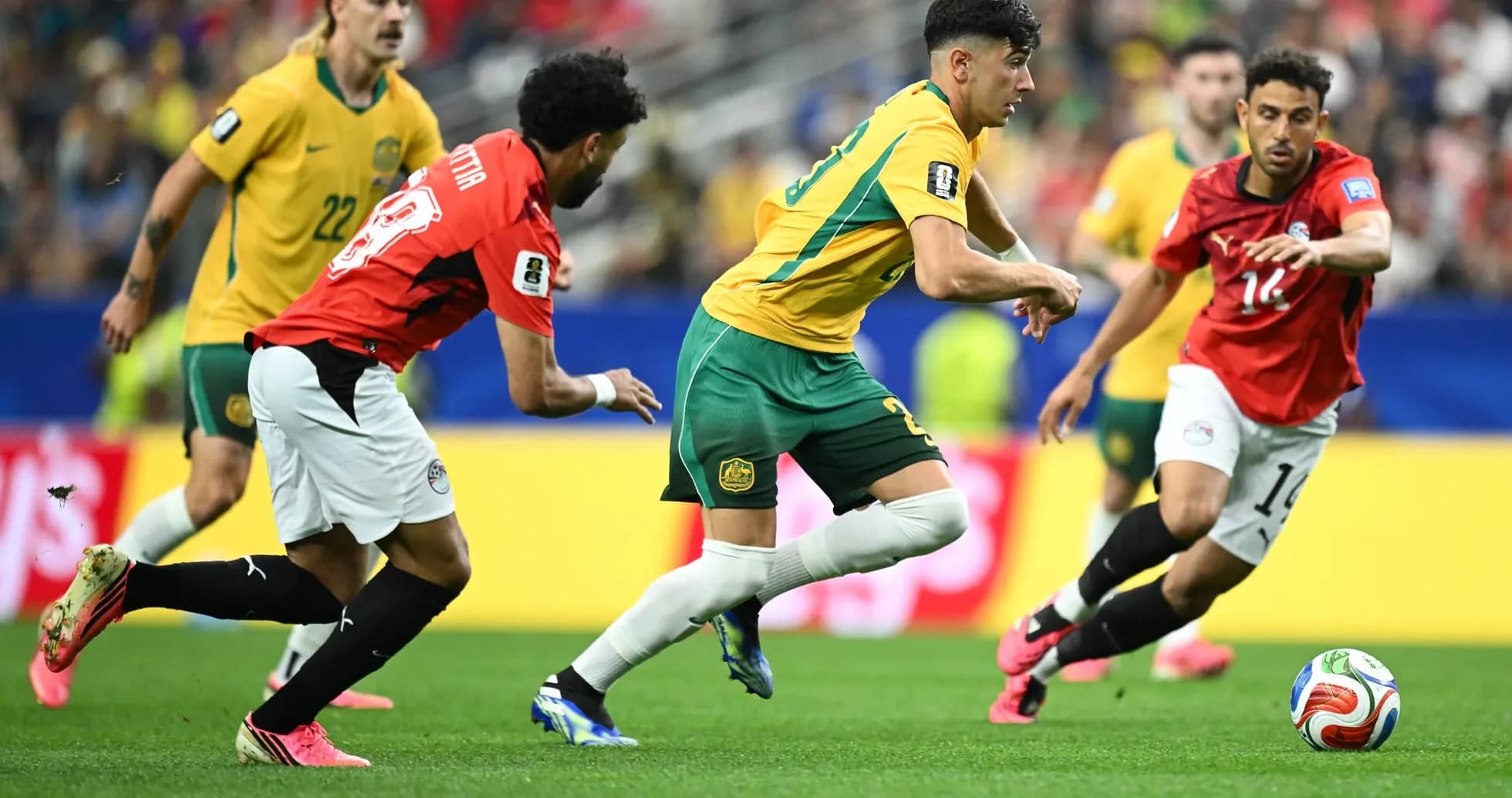
Australia and Egypt produced a tactically tight Round of 32 contest at AT&T Stadium that finished 1-1 after extra time, before Egypt advanced 4-2 on penalties. The underlying structure of the match was clear: Egypt’s 4-4-2, with superior possession and passing volume, tried to control territory and tempo, while Australia’s 3-4-2-1 looked to compress space, block shooting lanes and spring forward through a narrow front three. Over 120 minutes, the statistical profile shows Egypt generating the clearer chances (1.36 xG to 0.87) and more shots on goal, but Australia’s defensive organisation and volume of blocks dragged the tie into a shootout.
Egypt’s early superiority on the ball translated quickly into the scoreboard. In the 13th minute, Emam Ashour timed a forward run from the right side of midfield, finishing a move created by Karim Hafez’s delivery from the left. It was a classic exploitation of Australia’s back three: Egypt stretched the width with Hafez high on the flank, pulling the wide centre-back out and opening a seam for Ashour to arrive from the second line. With Australia’s double pivot occupied by Mohamed Salah and Mostafa Ziko between the lines, Ashour attacked the channel untracked and Egypt’s 4-4-2 morphed into a 4-2-4 in the final third.
Australia’s equaliser on 55 minutes came from a structural pressure point Egypt never fully resolved: defending wide service under Australia’s wing-backs. A ball driven into the box forced Mohamed Hany into a difficult defensive body shape, and his touch diverted the ball past his own goalkeeper for an own goal credited to Australia. It underlined how Australia’s 3-4-2-1, though often penned back, could still create chaos when the wing-backs advanced and the two attacking midfielders, Cristian Volpato and Connor Metcalfe, occupied the half-spaces to pin Egypt’s full-backs.
Discipline tilted slightly against Egypt, who finished with two yellow cards to Australia’s none. Both cautions came in extra time and reflected the physical cost of defending transitions. At 105', Haissem Hassan (Egypt) was booked — Foul — as he tried to halt an Australian break in the channel. Then at 120', Yasser Ibrahim (Egypt) also saw yellow — Foul — as Australia pushed one last time from deep. The timing of those cards illustrated how Egypt’s back line was repeatedly forced into recovery defending against fresh Australian legs.
Tactical Formation
Tony Popovic’s initial 3-4-2-1 for Australia was clearly built around central density. Harry Souttar marshalled the middle of the back three, flanked by Alessandro Circati and Lucas Herrington, with Jordan Bos and Aziz Behich acting as wide midfielders who had to serve simultaneously as wing-backs. In possession, that shape could become a 3-2-5, with Bos and Behich pushing high and Nestory Irankunda leading the line, supported by Volpato and Metcalfe between the lines. But Egypt’s pressing and possession advantage (58% to Australia’s 42%) often forced Australia into a 5-4-1 block, with the two “tens” dropping alongside the double pivot of Jackson Irvine and Aiden O'Neill.
The defensive numbers underline how much work Australia did without the ball. They allowed only 14 total shots but blocked 9 of them — an extremely high share — which speaks to the compactness of the back three and the midfield’s willingness to collapse into the box. Egypt, by contrast, blocked 6 of Australia’s 16 shots, suggesting a more open defensive block that nonetheless limited clean looks on goal: Australia managed just 1 shot on target.
In goal, Patrick Beach (Australia) started and later gave way to Mathew Ryan in a late, penalty-focused change. Across the match, Australia’s goalkeeping unit recorded 3 saves. Given Egypt’s 4 shots on goal, that tally, combined with the single goal conceded, matches the picture of a keeper (or keepers) largely protected by the defensive line but still called upon at key moments. On the other side, Mostafa Shobeir (Egypt) faced only 1 shot on target and made 1 save. The goals prevented metric is negative for both sides (-0.9 each), indicating that the keepers conceded slightly more than the model would expect from the shot quality they faced, but the small volumes make any sweeping judgment difficult.
Possession and Passing
Egypt’s 4-4-2 was possession-heavy and technically secure. They completed 614 of 723 passes (85%), using Hamdy Fathy and Marwan Attia as a central platform, with Ashour and Omar Marmoush stretching the width. The front pair of Salah and Ziko often split to attack the channels, dragging Australia’s outside centre-backs wide and creating pockets for late midfield runners. The 8 shots inside the box show that Egypt were able to penetrate the Australian block, even if the final execution was inconsistent.
Australia’s passing profile — 507 passes, 404 accurate (80%) — reflects a more direct and transitional approach. When they did build, Irvine and O’Neill tried to connect quickly into Volpato and Metcalfe, who then looked to feed Irankunda in depth or combine with the advancing wing-backs. However, the low xG (0.87) and the single shot on target reveal that many of their 10 shots inside the box came from crowded, low-probability positions, often following second balls or half-cleared crosses rather than cleanly constructed moves.
Substitution Patterns
The substitution pattern reinforced the tactical narratives. Early in the second half, Popovic replaced Bos with Kai Trewin at 46', a move that suggested a shift towards greater defensive stability on the flank. Later, the double change at 74' — Mohamed Touré (IN) came on for Nestory Irankunda (OUT) and Ajdin Hrustić (IN) came on for Cristian Volpato (OUT) — injected fresh energy and a different creative profile into the front line, with Hrustić offering more range in distribution from the half-spaces. Awer Mabil (IN) came on for Connor Metcalfe (OUT) at 91', adding direct dribbling on the flank as Australia looked to exploit tired Egyptian legs in transition. Paul Okon-Engstler (IN) replaced Aiden O'Neill (OUT) at the same minute, refreshing the midfield screen.
For Egypt, the 67' double substitution — Hossam Abdelmaguid (IN) came on for Hamdy Fathy (OUT) and Haissem Hassan (IN) came on for Mostafa Ziko (OUT) — subtly rebalanced the side. Abdelmaguid’s introduction added defensive security, while Hassan offered a more vertical threat from the front line, particularly on the counter. Mahmoud Trézéguet (IN) came on for Karim Hafez (OUT) at 80', shifting Marmoush’s role and giving Egypt a more direct wide runner on the left. In extra time, Hamza Abdelkarim (IN) came on for Omar Marmoush (OUT) at 106', and Mahmoud Saber (IN) replaced Marwan Attia (OUT) at 120', ensuring fresh legs for the final minutes and the impending shootout.
Statistical Overview
Statistically, Egypt’s edge is clear: more possession, higher pass completion, more shots on goal (4 to 1), and a higher xG (1.36 to 0.87). Their 7 corners to Australia’s 4 also reflect territorial dominance. Yet Australia’s defensive metrics — especially the 9 blocked shots and disciplined fouling (12 fouls, 0 cards) — show a side that executed a low-block game plan with commitment and structure. The goals prevented figures hint that neither goalkeeping unit overperformed the models, so the draw over 120 minutes aligns broadly with the quality of chances created, even if Egypt’s marginal superiority ultimately expressed itself only in the penalty shootout.
Related News
Thomas Tuchel Reflects on England's 10-Man World Cup Triumph and a Surprising Regret

Robert Moreno Takes Over as Interim South Korea Coach After World Cup Setback

Jude Bellingham Returns to Form with Real Madrid After World Cup Success

Chloe Kelly, Beth Mead & 13 Lionesses Who Must Shine in the Upcoming WSL Season for England’s 2027 World Cup Bid
Barcelona Cancels World Cup Tribute Amid Political Tensions
Messi Breaks Record for Most Penalties Taken and Missed in FIFA World Cup History