
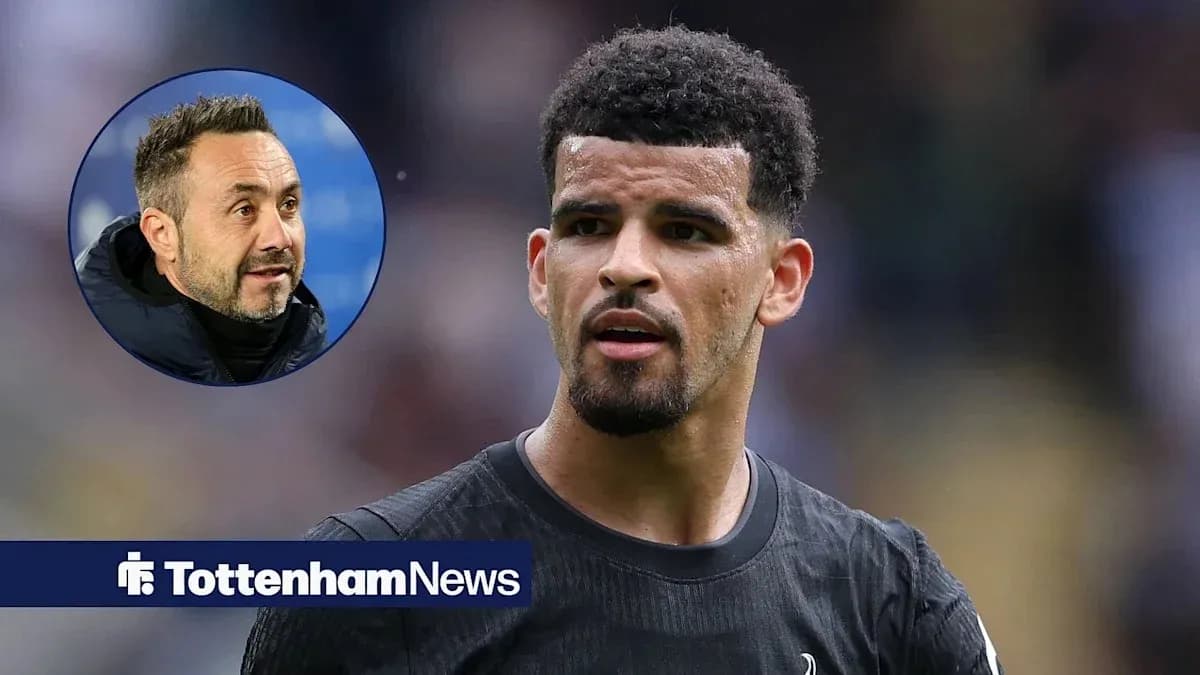
Dominic Solanke: A Crucial Season Ahead for Tottenham
Dominic Solanke has become a fault line in the Tottenham fanbase.
Some see a clever, modern centre-forward trapped in a stop-start side. Others see a £60m striker whose numbers simply do not justify the faith. Roberto De Zerbi, though, has made his position crystal clear: he thinks Solanke is good enough to shape Tottenham’s season.
And he has said it loudly enough that there is nowhere for the striker to hide now.
De Zerbi nails his colours to Solanke
The new Premier League campaign is closing in and De Zerbi’s first big call is obvious: Richarlison or Dominic Solanke to lead the line on opening day.
Judging by his latest interview with Football London, the debate inside Hotspur Way might already be over.
De Zerbi has described Solanke as one of the best forwards in the division, insisting there are “not many better” than the 28-year-old when he is in the right environment. For a player who has scored only 12 league goals across his first two seasons in north London, it is a striking verdict.
The Italian has framed Solanke as a difference-maker whose performances swing with his self-belief: “I think he changes the quality of performances depending on the confidence he feels.” That is both a compliment and a challenge. Confidence can be nurtured. It can also run out.
De Zerbi went further, spelling out exactly what he thinks he has: “I like him as a player, he’s complete as a striker. He can attack the space, he can cover the ball, he’s able with the ball to link, he’s able to score 15-20 goals in Premier League.”
Fifteen to twenty league goals. That is the benchmark his own manager has set for a player who has only once hit double figures in England’s top flight.
Ambitious? Absolutely. Baseless? The numbers suggest it is not that simple.
A turbulent start to life in N17
Solanke did not arrive at Spurs as a project. He came back to north London in 2024 on the back of a breakout year at Bournemouth, where he hit 19 Premier League goals and finally looked like the striker many thought he could become.
Tottenham, though, have been anything but stable since.
Under Ange Postecoglou, an injury crisis ripped through the squad and Spurs’ bright early-season momentum faded. The club’s priorities shifted, the league campaign stumbled, and the team’s attacking patterns never really settled.
Then came further change. Thomas Frank, Igor Tudor and De Zerbi have all had their hands on the squad since, while Solanke himself has been wrestling with his own fitness problems. Across all that upheaval, he managed just 15 Premier League appearances last season.
That context matters. It does not excuse the output, but it explains some of the disconnect between the eye test, the data and the raw goals column.
Underlying numbers that won’t go away
Strip away the emotion and the frustration and Solanke’s profile looks more intriguing.
According to Data.MB, among all strikers in the Premier League last season, Solanke ranked third per 90 minutes for shot-on-target percentage at 58.82 per cent. When he shoots, he usually works the goalkeeper. That hints at composure and shot selection rather than wastefulness.
He also ranked third for passing accuracy among strikers, at 78.85 per cent per 90. For a No 9 asked to link play, occupy defenders and help Spurs build through the thirds, those are not the numbers of a limited finisher who simply waits in the box.
They back up De Zerbi’s claim that he is “complete as a striker”. Solanke can drop in, bounce passes, keep attacks alive. He is not just a penalty-box poacher.
Off the ball, the picture is just as positive. Data.MB had him sixth among strikers for interceptions per 90 (2.23) and seventh for possessions won (4.23). Those figures point to a forward who presses intelligently, reads passing lanes and contributes to the defensive phase as much as the attacking one.
For a manager like De Zerbi, who demands aggression and structure from the front, that blend is gold dust.
But there is no escaping the obvious. Spurs did not sign Solanke for his interception numbers.
Where praise meets pressure
All of this leaves Solanke in an awkward, fascinating space.
On one hand, the metrics suggest there is a very useful player there: technically secure, tactically disciplined, efficient in his shooting, and willing to do the dirty work out of possession. On the other, the Premier League will always judge a centre-forward by the most brutal of measures.
Goals.
Twelve league goals across two seasons at Tottenham is not the return of a man who can claim to be among the division’s elite. Not yet. For De Zerbi’s “not many better” line to carry any real weight outside the dressing room, Solanke has to turn those underlying strengths into something more tangible.
The manager has effectively laid down a public gauntlet. Fifteen to twenty league goals is no longer a quiet internal target. It is out there now, attached to Solanke’s name, circling every conversation about Tottenham’s attack.
He has the manager’s trust. He has the data to suggest there is more to come. He should have, if fit, the continuity and clarity that have been missing from his Spurs career so far.
What he does not have anymore is the luxury of time.
As the new season looms and De Zerbi weighs up Richarlison versus Solanke, the numbers, the praise and the patience all converge on one simple question: can Dominic Solanke finally turn promise into the kind of ruthless output that defines a Tottenham No 9?
Related News
Carlos Alcaraz Urges Tennis Organizers to Stop Matches Finishing in the Early Morning
Carlos Alcaraz Frustrated by 3:30 a.m. US Open Finish: 'Too Much'
Jannik Sinner Set for ATP 500 Return in Beijing with Novak Djokovic Also Competing

Meet Iva Jovic: The Rising American Tennis Talent
Flavio Cobolli Shares Insights on Training with Jannik Sinner Ahead of His Tennis Return

Till vs Romero: Fight Details, Undercard, and Viewing Info for This Weekend