
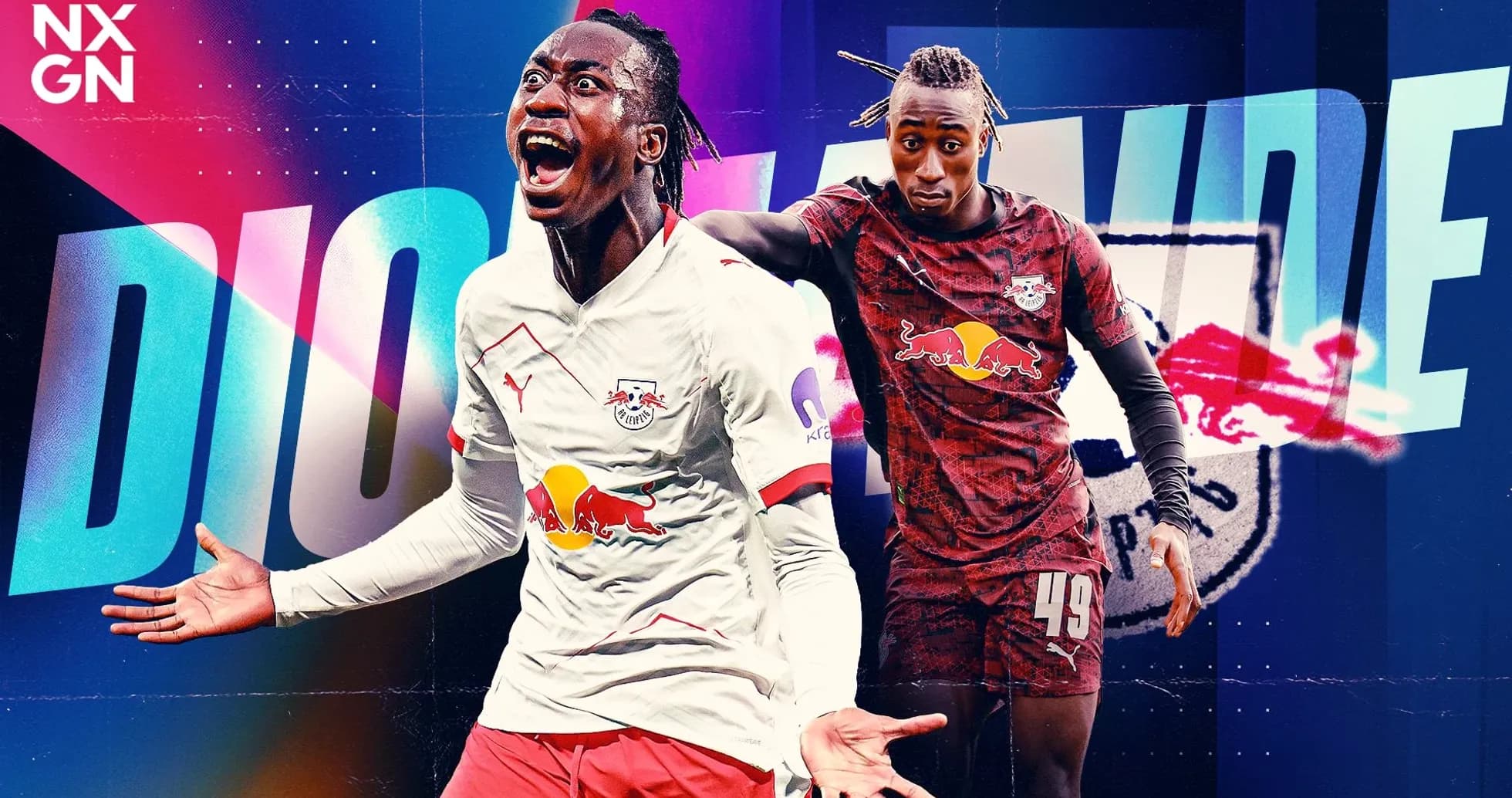
Diomande: The Winger Redefining Speed and Impact
Diomande, the Winger Built for the Breakneck Era
Real Madrid have chased wide men of every flavour in recent years: artists like Vinicius, finishers like Rodrygo, hybrids like Brahim. Diomande belongs to a different species altogether.
He is not the winger who slows the game down to knit passing triangles or lull a full-back to sleep. His game is vertical shock. Hit, run, repeat.
At the last World Cup, the Ivorian was clocked at 34.7 km/h. That still leaves him short of Kylian Mbappé’s blistering 37.6 km/h, but it places him firmly in the elite bracket of pure sprinters. You see it in every run: sharp changes of direction, sudden bursts, the sense that one misstep from a defender will be fatal.
And then there is the dribbling.
Across the Bundesliga last season, no one got near him. Diomande completed 118 successful dribbles from 213 attempts. Michael Olise, second on the list, finished with 65 from 149. The gap is not a detail; it’s a chasm. Defenders know what is coming. They just cannot live with it often enough.
Right or left? Two faces of the same threat
Marca’s analysis of his season with Leipzig drew a clear dividing line between the two wings. On paper he is a right-sided player, and the minutes confirm it: 1,591 on the right flank, just 478 on the left. Yet the numbers and the eye test tell a more nuanced story.
On the right, Diomande plays like a classic touchline winger. He receives the ball to feet, wide, almost on the chalk. He draws his marker, pauses, looks, resets if he does not like the picture. It is a more measured version of his game, but still loaded with menace.
Working on his natural side, he hunts for space down the outside, drives to the byline and then pulls the ball back. When he beats defenders, it is usually with raw power and a violent change of pace rather than intricate footwork. He can go from still to gone in a heartbeat.
Cutting inside from that flank is another matter. His diagonal movements towards the centre do not have the natural elegance of a left-footer like Olise, and it shows. His left foot is functional, a tool rather than a signature. It still produced several goals last season, often when he rolled the ball onto it at the last second on the edge of the box, but he prefers to use it during long, sweeping runs where the emphasis is on stride and speed, not finesse.
Yet that is where one of his most dangerous patterns emerges. When teams sit deep and seal off the outside lane, Diomande has built himself an escape hatch. He drags defenders across with him, then whips a cross into the front zone or the weak side. He bends a locked defence out of shape.
The data backs up the feeling. On the right wing he generates more of almost everything per 90 minutes: dribbles (4.41 vs 3.23), completed crosses (0.91 vs 0.67), passes into the box (2.21 vs 1.48), shot volume (1.7 vs 1.48) and expected goals (0.21 vs 0.16). The downside is obvious too: he loses the ball more often from that side (2.21 vs 1.48), a natural by-product of constant risk.
Shift him to the left, though, and the personality of his game changes.
He still starts wide, but not as frequently, and his touch map tilts towards the danger area. He records more touches inside the box from the left, 7.8 per 90 compared to 6.51 on the right. Out there, he is less interested in bulldozing his way down the flank. The right foot becomes the blade, cutting inside to shoot or cross, and his decision-making sharpens.
He looks bolder, more liberated. He goes at his man quicker. The dribbles are not just about beating a full-back; they are about detonating the entire defensive line.
Two numbers leap off the page. On the left, his expected goals jump to 1.17 from 0.84, and his expected assists rise to 0.43 from 0.21. Less volume than on the right, more damage. The right wing turns him into a relentless generator of situations. The left transforms him into a chaos agent who tilts matches.
Exploiting the blind side
One pattern keeps resurfacing despite the smaller sample of minutes on the left: his feel for empty space away from the ball.
Diomande has turned what could have been a limitation into an edge. When he receives with his back to goal in tight pockets, or when defenders try to crowd him out and trip him up, he often refuses the duel. Instead, he shifts the ball quickly into a teammate, triggers a one-two and explodes into the gap behind.
Once he is running and the space opens up, he is almost impossible to contain. His acceleration does the rest.
That same instinct carries over regardless of flank. His defensive work rate barely flickers whether he starts on the right or the left. He presses with real intent, not just for show, and he does it repeatedly. The numbers underline his relentlessness: he leads the Bundesliga for ball recoveries among forwards with at least 1,000 minutes played (148). He sits second for interceptions (16) and fourth for successful tackles (19).
This is not a winger who switches off when the ball is lost. He is often the first to react, the first to pounce.
At set pieces he tends to hold a more reactive role, staying in position rather than attacking the ball. The moment possession is regained, though, he springs to life. On the counter, he usually drifts into central areas, ready to receive or to sprint into the channel. With grass in front of him and defenders turning, his dribbling becomes lethal.
Built for Madrid’s favourite stage
For those who remember José Mourinho’s first spell at Real Madrid, the template is familiar. That team lived off counterattacks that tore through open fields, with Cristiano Ronaldo and Ángel Di María racing into the gaps left behind.
Diomande looks built for that landscape. The speed, the directness, the defensive bite, the ability to win the ball and then carry it 40 metres in seconds — all of it fits the Bernabéu’s taste for transition football when the game breaks open.
The only real question is positional, not conceptual.
Will he be the right-sided workhorse, grinding out chance after chance with repeated runs and crosses? Or will he be unleashed on the left, the side where his numbers scream influence and his movements invite chaos?
For Madrid, it is a luxury problem. For La Liga full-backs, it is a looming headache.
Related News
Ilia Topuria Accuses Justin Gaethje After UFC Defeat

Tyson Fury vs Anthony Joshua Fight Date and Venue Confirmed
Switzerland Calls Up In-Form Sion Striker Winsley Boteli for Nations League
Bournemouth Secures Historic 2-1 Win Over Real Sociedad in Spain
Portugal Announces Squad for 2026 UEFA Nations League; Cristiano Ronaldo Expected to Play
Raphinha Channels Ronaldo Nazario as Barcelona's Leading Striker After Position Change