
Declan Rice: England's Unmatched Midfield Anchor
Aaron Cresswell calls Declan Rice “a freak of nature”. It is not a throwaway line. It is the only way he can explain how England’s midfield anchor has kept going, week after week, year after year.
Since the start of the 2020‑21 season, Rice has played 360 matches. West Ham’s European runs, England’s tournament cycles, Arsenal’s tilt at the Premier League and Champions League. Every competition, every high‑stakes night, the same name on the teamsheet. The temptation, for club and country, has always been simple: pick him again.
On Wednesday in Yokohama, that old habit met its limit.
A rare off‑night for England’s constant
This was Rice’s 63rd game of the 2025‑26 campaign, England’s wild 4-2 win over Croatia in their World Cup opener, and for once he looked human. Heavy-legged. A half‑second late. The player who normally knits England together became the symbol of their disarray.
England’s midfield shape was wrong from the first whistle. Too much grass between Rice and Elliot Anderson. Too much room for Luka Modric to drag Rice into uncomfortable areas, forcing him to drop too deep and leaving England exposed in front of their back four. The vice‑captain, usually the side’s metronome and shield, found himself chasing shadows.
Thomas Tuchel chose his words carefully afterwards. “Declan had some unusual ball losses,” he said. Diplomatic, but telling. When Rice starts giving the ball away, you know the tank is close to empty.
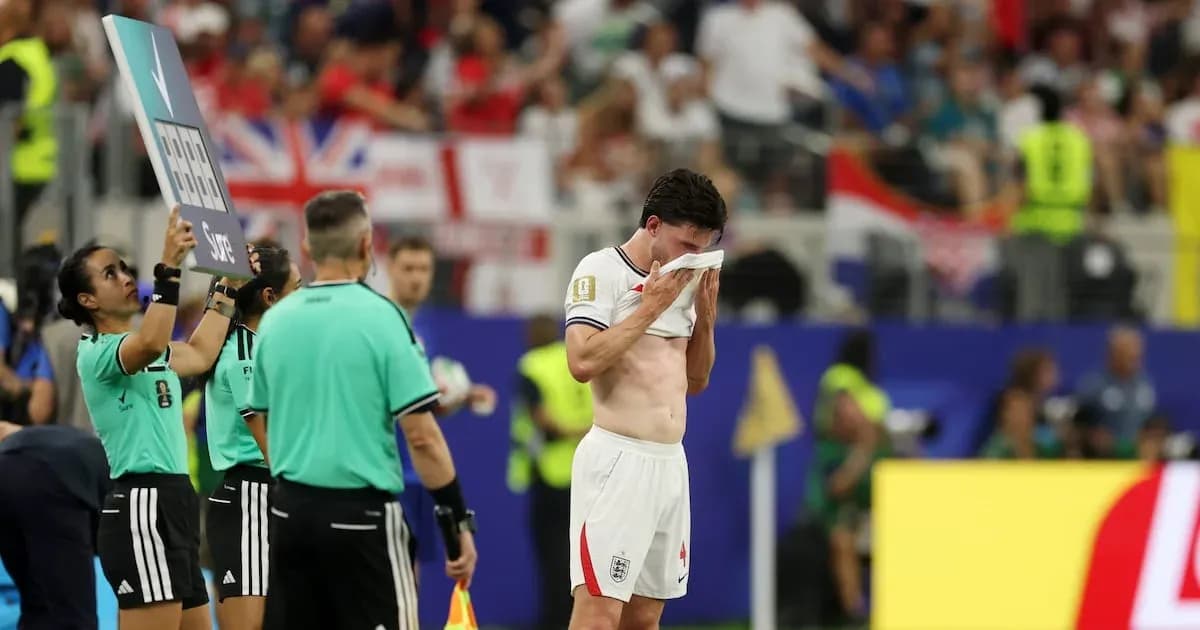
The concern deepened in the 72nd minute. England were clinging to a 3-2 lead when Rice signalled that he could not continue. Under normal circumstances, taking off your best ball-winner while defending a one-goal advantage in a World Cup game would border on reckless. With Rice, it is almost unthinkable. Yet off he went.
Tuchel later explained that Rice felt discomfort in his lower back and upper hamstring. The change, he stressed, was precautionary. Rice, predictably, wasted no time insisting he will be ready for Ghana on Tuesday.
England cannot simply take his word for it.
No like-for-like, no easy answers
The brutal truth for Tuchel is that England do not have another Declan Rice. They barely have a rough sketch.
Kobbie Mainoo is a joy on the ball, brave in tight spaces and blessed with a calm that belies his age. But he does not yet have Rice’s frame, his aerial dominance, his ability to bully set pieces at both ends. Jordan Henderson brings experience and leadership but, at 36, he was left on the bench as England chased tempo and intensity against Croatia. If Tuchel did not trust him then, how likely is he to build a World Cup midfield around him now?
The first solution Tuchel tried when Rice departed was Jude Bellingham. The plan was simple enough: pull Bellingham back, ask him to dictate from deep, preserve England’s attacking threat with fresh legs ahead of him. In reality, the move almost cost England their lead. Croatia surged into the gaps, Bellingham’s instincts dragged him forward, and England’s balance tilted dangerously.
The experiment lasted eight minutes.
Only when Djed Spence came on for Bellingham did something more coherent emerge. Reece James stepped out of right back and into midfield, sliding into a role he knows well from Chelsea. Suddenly, England had a different kind of anchor. Not Rice, but not a makeshift stopgap either.
It might be the most important eight-minute lesson of Tuchel’s tournament.
Reece James, the unexpected 6
James’s midfield credentials are not theoretical. They were forged in the Championship, during a loan at Wigan in 2018‑19, and sharpened at Chelsea under Enzo Maresca. While most of Europe still saw him as an elite right back or wing back, Maresca moved him inside and doubled down.
There were doubts at first, not least from Tuchel, who had coached James at Chelsea and insisted early in his England tenure that he saw him as a full back. Yet Maresca persisted. The payoff came on the biggest stage of all, when James patrolled midfield in the Club World Cup final and helped Chelsea beat Paris Saint‑Germain last year.
That performance was not an outlier. James dominated again when he partnered Moisés Caicedo in a 3-0 win over Barcelona last November, then outplayed Rice himself five days later as Chelsea dismantled Arsenal at Stamford Bridge. The evidence piled up. James could do the job.
Tuchel acknowledged as much when he named his World Cup squad and left Adam Wharton and Alex Scott at home. “Reece James can play in the 6 because he does on a high level for Chelsea,” he said then. It sounded like a theoretical justification for a tight squad. It now feels like a live tactical plan.
James offers a different profile to Rice. Less of a sweeping, end‑to‑end presence, more of a compact, muscular pivot. He reads danger, tackles hard, and has the passing range to switch play or slide balls through the lines. With him in midfield, England can morph again.
Tuchel has stocked his squad with versatility for precisely this reason. If James steps out of the back four, Spence, Ezri Konsa or Jarell Quansah can take over at right back. Konsa can even tuck in as a third centre half alongside John Stones and Marc Guéhi, allowing Nico O’Reilly to storm forward from left back. It is a structure that could protect James centrally while unleashing England’s full-backs.
On the tactics board, it makes sense. On the physio’s table, it is a risk.
A World Cup built on tired legs
James is not exactly an iron man. His history of hamstring problems is long and well documented, the latest layoff coming in March and costing him almost two months of the season. Chelsea have had to manage his minutes carefully. England must do the same.
They have already lost Tino Livramento to a calf injury, forcing Tuchel to call up Trevoh Chalobah as cover. It has been a draining year for so many in this squad. James may be first choice at right back, but he cannot start every game, let alone shoulder the extra physical and mental load of anchoring midfield if Rice is short of full fitness.
All of this hovered in Tuchel’s mind as the World Cup loomed. His decision to take England to Florida early for a sun‑drenched conditioning camp was not a whim; it was an attempt to harden bodies for what he knew was coming. Even so, Rice arrived late, having driven Arsenal all the way to the Champions League final.
He never stops. He never asks to. That is part of what makes him so valuable – and so vulnerable.
If England go all the way in this tournament and Rice is not given a proper rest, his tally for club and country this season will hit 70 matches. Seventy. For a midfielder who covers more ground than almost anyone else on the pitch, who tackles, presses, sprints, and then does it all again three days later.
At some point, even a “freak of nature” pays a price.
Tuchel has built his England around Rice’s reliability, his presence, his sheer volume of work. Now, with the World Cup barely under way and their vice‑captain already feeling the strain, he may be forced to discover what this team looks like without him – and whether England can really chase a trophy on legs that have already carried so much.
Related News

Raphinha’s Hat-Trick Powers Barcelona to 7-2 Victory Over Racing Santander

Carabao Cup Fourth Round Draw: Liverpool Set to Clash with Chelsea, Arsenal to Face Fleetwood Town
Key Football Matches to Watch in Azerbaijan This Autumn
Raphinha's Hat-Trick Drives Barcelona to 7-2 Triumph Over Racing Santander

Hansi Flick Leads Barcelona to Record-Breaking Seven Wins in a Row

Gavi Reflects on Injury Return as Barcelona Dominate Racing Santander 7-2