
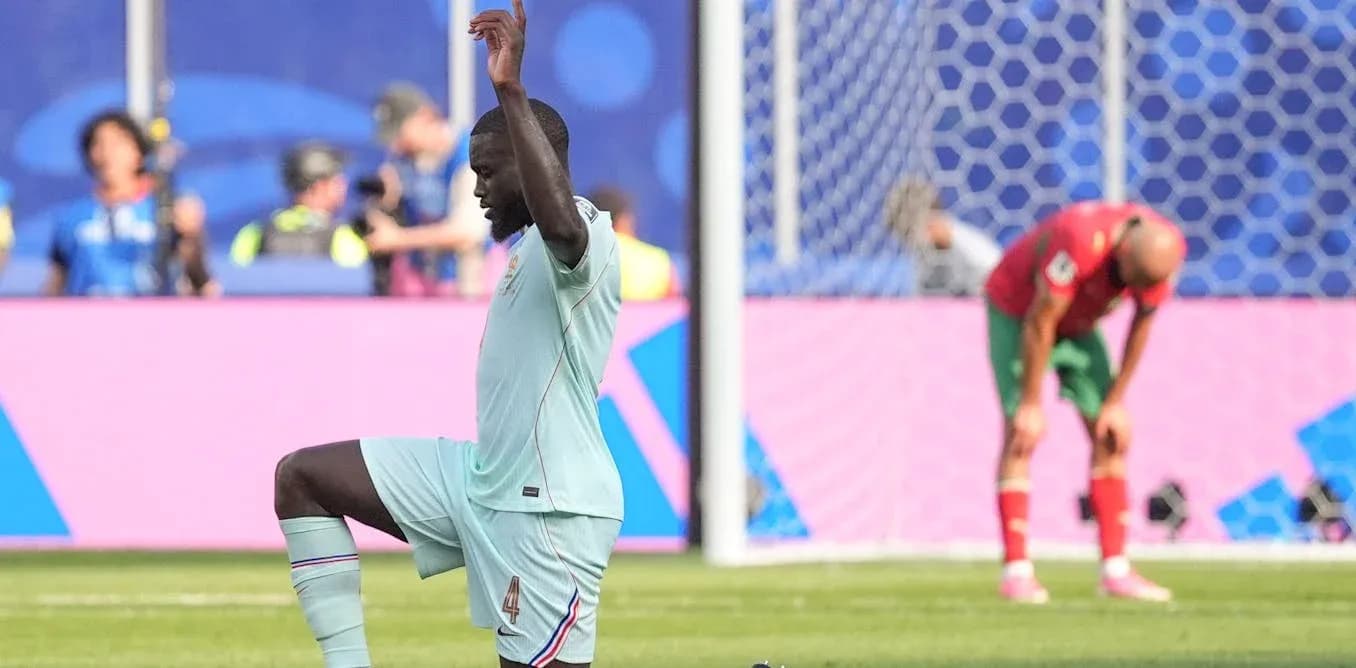
Dayot Upamecano's Mastery of Interceptions
Dayot Upamecano sees the danger before most people in the stadium have even finished inhaling.
A shoulder opens, a passer glances up, weight shifts through the standing leg – and the France defender is already on the move. The interception itself lasts less than a second. The calculation behind it is anything but brief.
In that heartbeat, the brain weighs speed, distance, angle. The body accelerates, twists, holds balance. One wrong step and he is stranded, his back line exposed. One right step and the attack dies at his feet.
At the start of the 2026 World Cup semi-final week, Upamecano sat top of the tournament charts with 12 interceptions. It is a number that does not shout as loudly as goals or assists, yet it tells a story of relentless, split‑second judgement. At this level, an elite defender is not just blocking passes; he is running a constant mental simulation of what might happen next.
Cape Verde’s debut World Cup campaign offered another vivid example of how powerful that art can be.
Thrown into a group with Euro 2024 winners Spain, the outsiders had little choice but to live on their wits without the ball. They recorded 15 interceptions in that Group H opener alone, repeatedly stepping into Spanish passing lanes to drag the game away from the script. Spain had the possession, Cape Verde had the timing, and the match finished 0-0.
Across four games, the tournament newcomers averaged roughly 13 interceptions per match. It was not a defensive curiosity; it underpinned a run that took them out of the group and into the round of 32, where they finally fell 3-2 after extra time to defending champions Argentina.
Those numbers do not prove interceptions “caused” Cape Verde’s success. They also hint at long spells spent defending, chasing, reacting. But cutting out passes gave them something priceless against superior technicians: disruption. It broke the rhythm of teams who wanted the ball, and it opened windows to counterattack before those opponents could reset.
The brain behind the tackle
To understand why this matters – and why it frays as legs and minds tire – you have to break down what an interception really is.
First comes prediction. A defender reads where the ball is likely to travel and whether he can realistically get there first. Research on anticipation in sport shows that skilled players blend what they already know about a situation with what they see in front of them. The passer’s posture, the angle of approach, the shape of the hips, the position of supporting teammates – all of it feeds into the decision.
Then the ball is struck, and everything speeds up.
Now its pace becomes critical. In an experimental study with well‑trained amateur footballers, players backed away from interception attempts as passes grew faster. When they did commit, their success rate dropped. The ball simply travelled too quickly for their bodies to match the calculation in their heads.
Distance weighs heavily too. Work on senior male futsal players – operating in a smaller, sharper environment – found that the defender’s starting distance from the ball helped determine whether an interception was even on. Yet that did not mean a one‑off choice. Players kept tweaking their speed and line in relation to the ball’s path until the moment of contact or failure. An interception is not a button pressed; it is an unfolding process.
Experience sharpens that process. A football‑specific study comparing expert and less‑expert athletes showed that both groups initially overestimated how often they could complete an interception task. With practice, their estimates improved. They learned, in effect, what their bodies could and could not do and adjusted their internal calculations accordingly.
That calibration is fragile. Fatigue pushes against it.
When tired minds meet tired legs
Mental fatigue is the quieter enemy. It builds through prolonged concentration, the constant scanning and assessing that defines a defender’s work. In a study of 20 professional male footballers, a demanding 30‑minute mental task before a training game damaged their passing decisions. Another study on well‑trained male players found that mental fatigue slowed and blunted football‑specific decision‑making in general.
Those experiments did not isolate interceptions, but the overlap is obvious. To cut out a pass, a defender must select the right visual cues, judge speed and distance, predict the play and commit – all under time pressure. If the mind dulls, the whole chain suffers.
Physical fatigue adds a different problem. A ball that felt reachable in the 15th minute may be a step too far in the 85th. Research involving 24 trained male players showed that acute physical fatigue reduced how far and how intensely they moved. It even altered aspects of their positioning and team play.
A related study split players by the strength of their decision‑making skills. Under acute physical fatigue, the better decision‑makers held their positioning and effectiveness more consistently, in part by moving at a slightly slower pace. They chose their moments. Those with weaker decision‑making pushed to maintain their physical output but lost clarity in their positioning and defensive work.
The lesson is stark. The smartest defenders adjust their movement to match what their bodies can still deliver. A tired centre‑back cannot simply repeat his early‑match runs; he has to reassess what is possible while still seeing the pass early enough to act.
The game within the game
Of course, attackers are not passive targets in this duel. They work just as hard to cloud the picture.
Research on deception in competitive sport shows how athletes deliberately disguise their intentions. A midfielder may shape his body towards one teammate, eyes and hips aligned, before slipping the ball somewhere else entirely. The defender, reading that initial cue, shifts into the wrong lane. By the time the true pass reveals itself, his weight is already gone.
Wait, and you see more. You gather richer information about where the ball will really go. But you also give the ball more time to travel and the attacker more time to exploit the space. Go early, and you might win it cleanly – or you might be left lunging at air.
For coaches, these details carry clear implications.
Training that treats interceptions as static drills misses the point. Research on realistic practice design argues that sessions must preserve the key information and actions players face in competition. For defenders, that means interception work with moving opponents, varied pass speeds, realistic starting distances and genuine disguise. The brain needs to rehearse the chaos, not just the technique.
Workload management matters too. Staff can track how far players run and how often they sprint, but those figures do not capture whether a defender is still making sharp, rapid judgments. A player might hit his physical numbers and yet be half a beat late into every lane that once looked his.
Because the goal is not simply to rack up interceptions. It is to know which ones to go for, which to leave, and how to keep updating that choice as the ball travels and the body tires.
By the time Dayot Upamecano slides in front of a pass this week, all the work has already been done – in his preparation, in his experience, in that instant where brain and body agree on what is still possible. The crowd sees a block. The attacker sees a move cut short. The defender, if he has judged it right, barely breaks stride and looks for the next pass to steal.
Related News

Ilia Topuria Accuses Justin Gaethje After UFC Defeat

Tyson Fury vs Anthony Joshua Fight Date and Venue Confirmed

Switzerland Calls Up In-Form Sion Striker Winsley Boteli for Nations League

Bournemouth Secures Historic 2-1 Win Over Real Sociedad in Spain

Portugal Announces Squad for 2026 UEFA Nations League; Cristiano Ronaldo Expected to Play

Raphinha Channels Ronaldo Nazario as Barcelona's Leading Striker After Position Change