
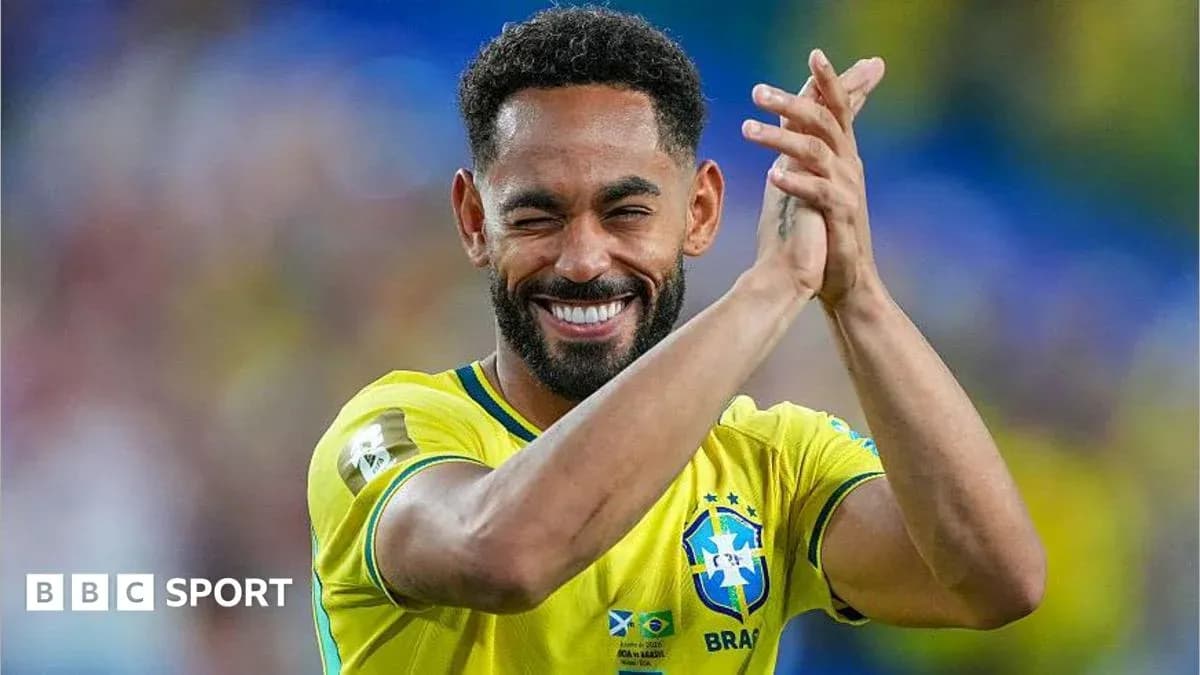
Cunha and Brazil's Evolving Attack Ahead of World Cup Knockouts
Brazil are beginning to look like Brazil again – and, crucially, so is their World Cup.
Carlo Ancelotti appears to have settled on his team, the pieces finally locking into place as the group stage unfolded. Each game has brought sharper combinations, cleaner pressing, more conviction. The timing could hardly be better. Japan await in the last 32, a slick, dangerous side who punish hesitation. Brazil are arriving with momentum rather than reputation alone.
Cunha, the nine-and-a-half changing Brazil’s attack
Matheus Cunha is not the classic Brazil No 9. He is not Ronaldo, not Adriano, not Romario. He does not plant himself between the posts and wait for service, nor does he drift around as a pure creator. He lives in the spaces between those roles.
Call him a nine-and-a-half. He can lead the line, but he also drops off like a No 10, stitching attacks together, creating angles, opening lanes for others. And he scores. Three goals already at this tournament say he is no false striker dressed up as a playmaker.
What he gives this Brazil side is something they have rarely had from a central forward: a constant tactical question for defenders. He steps away from the centre-backs, and suddenly they are unsure. Follow him, and Vinicius Jr and Rayan explode into the gaps. Hold the line, and Cunha receives between the lines, with time to turn, slide passes, or shoot.
There is a touch of Roberto Firmino in his movement, that perpetual teasing of the marker, the willingness to work without the ball, the intelligence to decide when to drop and when to pin. The resemblance is not in the statistics, but in the doubt he plants in defenders’ minds.
Crucially, Cunha embraces the ugly work. He initiates the press, sometimes operating almost like a No 6 in front of the midfield when Brazil step up. He chases, screens, angles opponents into traps. That defensive effort is part of why this attack suddenly looks balanced rather than improvised.
Ancelotti’s accident that wasn’t
For Brazil to reach a World Cup without a nailed-on No 9 felt almost surreal. The position has defined generations. Yet coming into the tournament, the shirt was still up for grabs.
Ancelotti experimented. Cunha, Igor Thiago, Endrick, Joao Pedro, Richarlison – all had their turn as the reference point. No one truly pulled away before the first ball was kicked. Even as late as the Scotland game, the identity of the starting centre-forward remained a live debate.
Then came the kind of twist managers never wish for but often end up using: injury.
Raphinha, an outstanding talent who loves to roam, began the tournament in a free role. Against Morocco he operated as a No 10 behind Thiago, but his versatility means he can pop up on either flank as well. His hamstring injury in that opening match changed everything.
On came Rayan, a more disciplined right-sided winger, someone who holds his width and stretches the pitch rather than wandering inside at every opportunity. Suddenly, with Vinicius Jr on the left and Rayan on the right, the central lane belonged to Cunha. Space opened exactly where he likes to operate. He often found himself alone, free to dictate the terms of his movement.
The dynamic clicked. Thiago still offers a more traditional option if Brazil need a physical presence to lock onto the centre-backs, particularly if they are chasing a game or facing a more robust defence. He can stay high, occupy both centre-halves and create chaos in the box. The difference now is that this is a choice, not a necessity.
Ancelotti has options. More importantly, he has a structure that suits his most in-form forward. Back home, the conversation is shifting. With every game, more Brazilians are starting to believe Cunha is not just a stopgap, but the solution.
Opponents will have studied him by now. They know he drops off, they know he links play. Yet reading Cunha is one thing; stopping him, with that intelligence and timing, is another matter entirely.
A Brazil comfortable without the ball
Strip away the romance and you find the core of this new Brazil: Ancelotti’s adaptability.
His reputation has long rested on man-management, on making big players feel important and understood. That side of him is real. But this Brazil is also a tactical project shaped by a coach who has seen almost every kind of football and won in almost every environment.
One of the most striking features of his side is their comfort in letting the opposition have the ball. This is not a team obsessed with 70% possession and sterile dominance. They are happy to concede territory and wait for the right moment.
Give the ball away, and the problem can become the opponent’s. Take up the right positions, press at the right instant, and you can flip the game in a heartbeat.
That pattern cut Scotland open. The first goal came from such a trap. The second, chalked off harshly, followed the same script. These were not isolated incidents or lucky breaks. Brazil scored similar goals in warm-up matches against Panama and Egypt, pressing on cues, not on emotion.
Against Scotland, they allowed the Scots to circulate the ball but subtly shepherded them into pre-planned zones. Brazil did not dominate possession, but they controlled the terms of engagement. Then, when the trigger came, they pounced. It was Ancelotti’s plan, not chaos, that set the trap.
This is why arguments about “identity” ring a little hollow around this Brazil. They are not wedded to one idea of themselves. They can attack with numbers when the game invites it, or sit in and spring forward when that makes more sense. With players who can adapt – technically and tactically – why would they lock themselves into a single script?
A different kind of Brazil
This is not the Brazil of flying full-backs and constant overlaps. It cannot be, and perhaps it should not be.
For the first time at a World Cup in modern memory, the full-backs are not the stars of the show. There is no Roberto Carlos tearing down the flank, no Cafu or Maicon surging past the winger, no Marcelo or Dani Alves constantly appearing in the final third.
With Douglas Santos and either Roger Ibanez or Danilo, the approach is more measured. They pick their moments to go. They hold their line more often than not. That restraint has a purpose: it allows Vinicius Jr to stay higher and conserve energy, ready to explode when Brazil win the ball instead of constantly tracking back to cover the space behind an adventurous full-back.
The back four looks stable, not spectacular, and that suits the balance of this side. The midfield has followed the same evolution.
In the opening game against Morocco, Casemiro stood alone in the middle, exposed and isolated. The criticism came quickly. Yet it missed the point. Even at his peak, Casemiro was never the player to cover the entire pitch on his own, flying into every duel and press. At 34, expecting him to do so is simply unrealistic.
The adjustment was swift and decisive. Brazil moved from a 4-2-3-1 to a 4-3-3. Now, when Bruno Guimaraes steps forward to join the attack as planned, Casemiro has Lucas Paqueta alongside him to share the workload. The distances shortened. The gaps shrank. The midfield stopped looking like a one-man fire brigade.
The difference has shown against Haiti and Scotland, and it will matter even more against Japan, a side whose movement and interchanging in attack far outstrips anything Brazil have seen so far in this tournament.
Belief, at last
The numbers tell a reassuring story: one goal conceded, seven scored. The performances tell an even stronger one: a team growing into itself.
In Brazil, the mood has flipped. Before the first game there was tension, a sense of unease about the unknowns – the No 9 question, the tactical identity, the age of key figures like Casemiro. After the opener, anxiety hardened into worry.
Three matches later, that has given way to excitement. The public are smiling again, not out of nostalgia, but because this team is winning in a way that feels sustainable.
The World Cup is tightening now. The margins shrink. The opponents grow sharper. Brazil arrive at the knockout stage with a coach who adapts, a forward line led by a nine-and-a-half who bends games to his rhythm, and a structure that finally looks like it belongs to this generation, not the last.
Japan will test that. The question is no longer whether Brazil have an identity, but whether this new one can carry them all the way.
Related News
Raphinha’s Hat-Trick Powers Barcelona to 7-2 Victory Over Racing Santander
Carabao Cup Fourth Round Draw: Liverpool Set to Clash with Chelsea, Arsenal to Face Fleetwood Town
Key Football Matches to Watch in Azerbaijan This Autumn
Raphinha's Hat-Trick Drives Barcelona to 7-2 Triumph Over Racing Santander
Hansi Flick Leads Barcelona to Record-Breaking Seven Wins in a Row
Gavi Reflects on Injury Return as Barcelona Dominate Racing Santander 7-2