
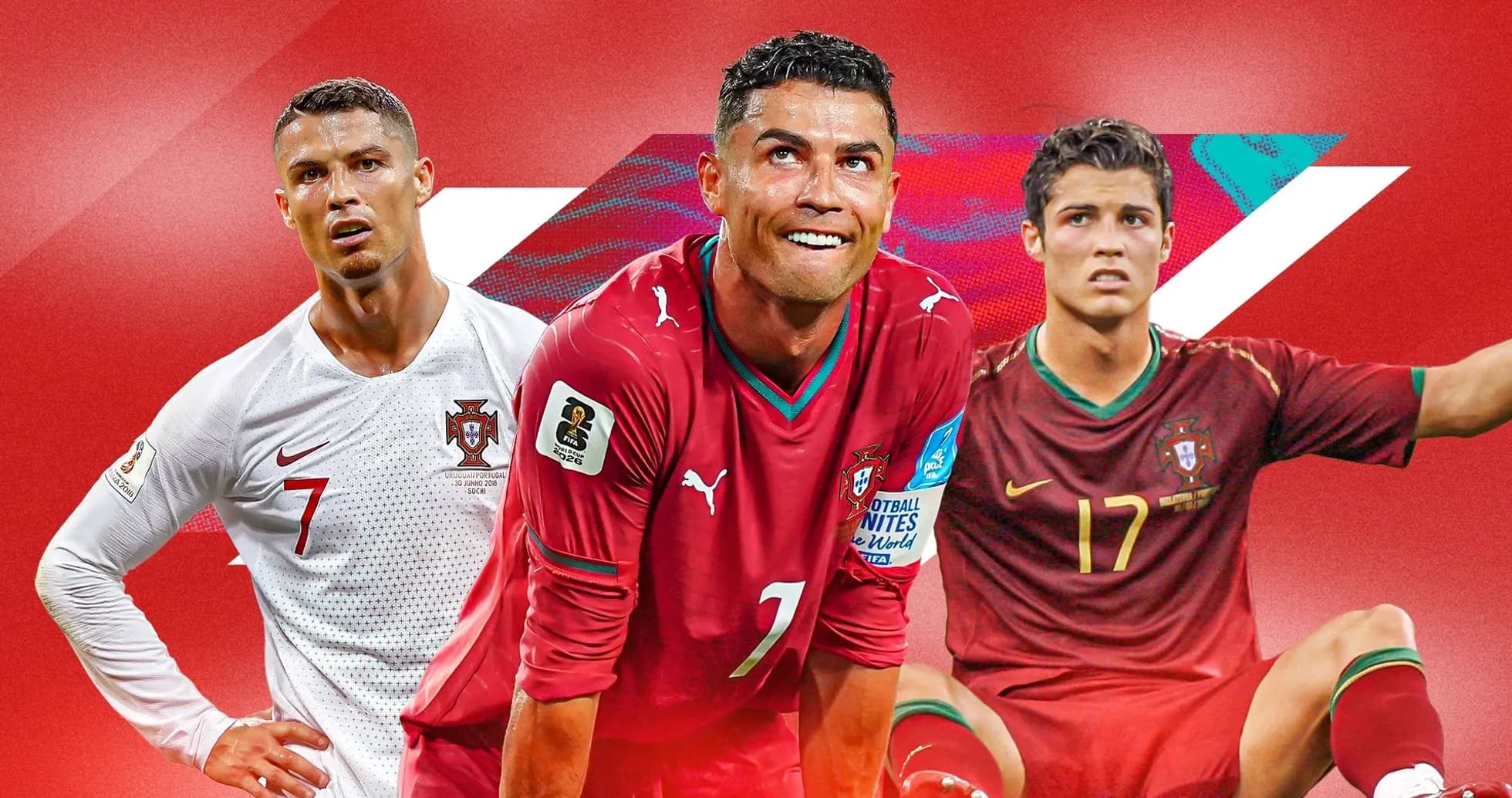
Cristiano Ronaldo's World Cup Journey: Chasing Knockout Glory
Cristiano Ronaldo’s World Cup story has never been a straight line. It has lurched from history-making highs to bruising controversy, from talismanic nights to the kind of scrutiny that only the game’s biggest personalities ever face. And still, at 41, he stands on the brink again, chasing the one thing that has always escaped him: a knockout-stage goal on football’s grandest stage.
The prodigy, the penalty and the wink
The journey began in 2006, when a 21-year-old winger with sharp feet and sharper cheekbones stepped into the World Cup spotlight. Ronaldo scored his first goal at the tournament from the penalty spot against Iran, becoming Portugal’s youngest-ever scorer at a World Cup. It finished 2-0, Group D rivals beaten, history already ticked off.
He did not score again in Germany. Back then he was a wide man, not yet the ruthless centre-forward who would terrorise defences for the next decade and a half, so the lack of goals in four knockout games as Portugal finished fourth barely registered.
His behaviour did.
In the quarter-final against England, Ronaldo’s involvement in Wayne Rooney’s red card lit a fuse that burned for the rest of the tournament. Rooney stamped on Ricardo Carvalho, the referee reached for red, and television cameras caught Ronaldo racing into the scene, then later winking towards the Portugal bench. From that moment, every touch was booed, every run jeered. The semi-final defeat to France played out to a soundtrack of hostility aimed squarely at the young Manchester United star.
England’s players queued up to condemn him. Steven Gerrard accused him of being “bang out of order” and said he would be “absolutely disgusted” if Ronaldo were his team-mate. Frank Lampard pointed to the supposed code that players should not try to get opponents booked or sent off and suggested Ronaldo had crossed a line, especially given his club connection with Rooney.
Ronaldo insisted he had done nothing wrong. FIFA’s technical study group did not see it that way. When it came to naming the young player of the tournament, they opted for Lukas Podolski, with group head Holger Osieck openly admitting that Ronaldo’s conduct had counted against him. “Players should be role models and fair play is a consideration,” Osieck said. Talent alone was not enough.
The first World Cup had delivered a goal, a semi-final and a global storm around his name. The world knew exactly who Cristiano Ronaldo was. It just could not agree on what to make of him.
The armband and the anger
Four years later in South Africa, Ronaldo arrived as captain and undisputed star of Portugal. The expectation was heavy, the reality sobering.
He scored only once, the sixth goal in a 7-0 demolition of North Korea. That strike ended a 16‑month drought for his country, but it did little to alter the shape of Portugal’s campaign. A goalless draw with Brazil set up a last-16 clash with eventual champions Spain, and a tight 1-0 defeat sent the Seleccao home.
This time, the focus fell on his words. “I feel completely disconsolate, frustrated and an unimaginable sadness,” he admitted after the loss, the captain cut open on camera. Yet another clip did the damage: asked to explain the defeat, he replied, “Ask that question of Carlos Queiroz.”
In Portugal, that landed badly. It sounded like the star distancing himself from the coach. Ronaldo later tried to clarify, saying he meant only that Queiroz was holding a press conference and was better placed to analyse the match. “I am a human being, and like any human being I suffer and I have the right to suffer alone,” he said. “I know that I am the captain, and I have always assumed and will assume my responsibilities.”
Queiroz pushed back. He spoke of never tolerating anyone putting himself above the national team, stressing that “Portugal needs Ronaldo, and Ronaldo needs the national side,” but warning that if the shirt unnerved some players, “they have no grounds to be there.”
The armband had not softened the glare. It had intensified it.
Brazil, the body and the burden
Ronaldo dragged Portugal to the 2014 World Cup almost single-handedly. Across two play-off games against Sweden, he scored all four of his team’s goals, outduelling Zlatan Ibrahimović in a private duel that felt like a heavyweight title fight.
By the time Brazil came around, his body was already sending out warning signals. Knee and thigh problems hung over his preparation, yet he insisted he was “100 percent fit.” The pitch told another story.
In a 4-0 hammering by Germany, Ronaldo was a bystander. Against the United States, he produced a trademark moment, whipping in a perfect cross for Silvestre Varela to snatch a last-gasp 2-2 draw. Against Ghana, he finally scored, an 80th-minute winner in a 2-1 victory. It was not enough. Portugal finished third in Group G and went out before the knockouts.
The criticism came quickly. He had missed chances he normally buried, looked short of his usual explosive power. Coach Paulo Bento refused to hang him out to dry. “I don’t think it’s fair to make things individual,” he said, taking responsibility for the campaign and stressing that “Cristiano is usually really effective, but suddenly he couldn’t do it. But I’m not going to deem one player responsible.”
For once, the numbers did not protect him. The bar he had set for himself was too high. Anything less than dominance felt like failure.
The hat-trick and the familiar ending
Russia 2018 began like a Ronaldo highlight reel. Against Spain in Sochi, he produced one of the great World Cup performances: a hat-trick in a wild 3-3 draw, capped by his first free-kick goal at a major international tournament. He had dragged Portugal to a point almost on his own.
He spoke afterwards about the team, not himself. He called it a “personal best” but quickly shifted attention to the collective effort against one of the favourites. Portugal, he said, would “do well for sure.”
They did not. Ronaldo scored again in the group stage, against Morocco, and led Portugal into the last 16. There, Uruguay shut him down. Portugal lost 2-1. Ronaldo neither scored nor assisted in the knockout round yet again.
At 33, questions surfaced about whether this was his World Cup farewell. He refused to be drawn. “I reckon it is not the right time to talk about it,” he told FIFA, instead talking up the “fantastic group” of players and their ambition. The hint was there: Portugal would go on, with or without him.
Qatar, the bench and the backlash
If Russia had ended with a quiet fade, Qatar began with noise. Ronaldo arrived with his Manchester United exit still crackling in the background, his relationship with the club having collapsed in a very public, very messy fashion. He came determined to silence critics and chase the one trophy missing from his collection.
He scored from the spot in the opening win over Ghana, becoming the first man to score at five World Cups. The landmark did not mask the problems. In the final group game against South Korea, he reacted furiously to being substituted. Coach Fernando Santos had seen enough.
For the last-16 tie against Switzerland, Ronaldo was dropped. In came Goncalo Ramos. Portugal won 6-1, Ramos hit a hat-trick, and the story of the night was the superstar on the bench.
Reports swirled that Ronaldo had threatened to leave the camp. He denied it. After the quarter-final defeat to Morocco, where he came on as a substitute and failed to change the game, he headed straight down the tunnel in tears.
The next day, he turned to social media. “My dedication to Portugal has never wavered for an instant,” he wrote, insisting he had never considered turning his back on his team-mates or country. He thanked Portugal and Qatar, then left a final line hanging in the air: “Now, we have to let time be a good adviser and allow everyone to draw their own conclusions.”
The consensus outside his camp was brutal. His only goal had been a penalty. His reaction to being benched had been petulant. At 37, many believed the World Cup chapter had closed. Even Ronaldo sounded like a man making peace with the end. “To win a World Cup for Portugal was the biggest and most ambitious dream of my career,” he wrote. “Unfortunately, that dream ended yesterday.”
“I’m back” – but how far?
And yet, he came again.
In the current campaign, just seconds after the final whistle in Portugal’s 5-0 win over Uzbekistan, Ronaldo turned to a nearby camera and shouted: “I’m back! I’m back!” It was classic Cristiano: defiant, theatrical, utterly convinced.
Not everyone bought it. He had struggled in the opening draw with DR Congo. Uzbekistan, ranked 60th in the world, were hardly elite opposition. Yes, he scored twice, but the temptation to declare a full-scale renaissance felt premature. That caution proved well-founded when he then laboured against Colombia. Roberto Martinez’s side were held to a 0-0 draw in Miami, a result that allowed Colombia to top Group K and left Portugal with a far tougher path.
Now comes Croatia. Luka Modric still pulls the strings, even if his supporting cast is not what it once was. The same description fits Ronaldo. At 41, he has already shown he can still score at this level, still bend a game to his will in flashes.
But the World Cup has kept one statistic out of his reach. Across five tournaments, in all the drama and all the noise, Cristiano Ronaldo has never scored in the knockout stage.
That is the gap in a career built on closing gaps. One more chance. One more night. Over to you, Cristiano.
Related News
Raphinha’s Hat-Trick Powers Barcelona to 7-2 Victory Over Racing Santander
Carabao Cup Fourth Round Draw: Liverpool Set to Clash with Chelsea, Arsenal to Face Fleetwood Town
Key Football Matches to Watch in Azerbaijan This Autumn
Raphinha's Hat-Trick Drives Barcelona to 7-2 Triumph Over Racing Santander
Hansi Flick Leads Barcelona to Record-Breaking Seven Wins in a Row
Gavi Reflects on Injury Return as Barcelona Dominate Racing Santander 7-2