
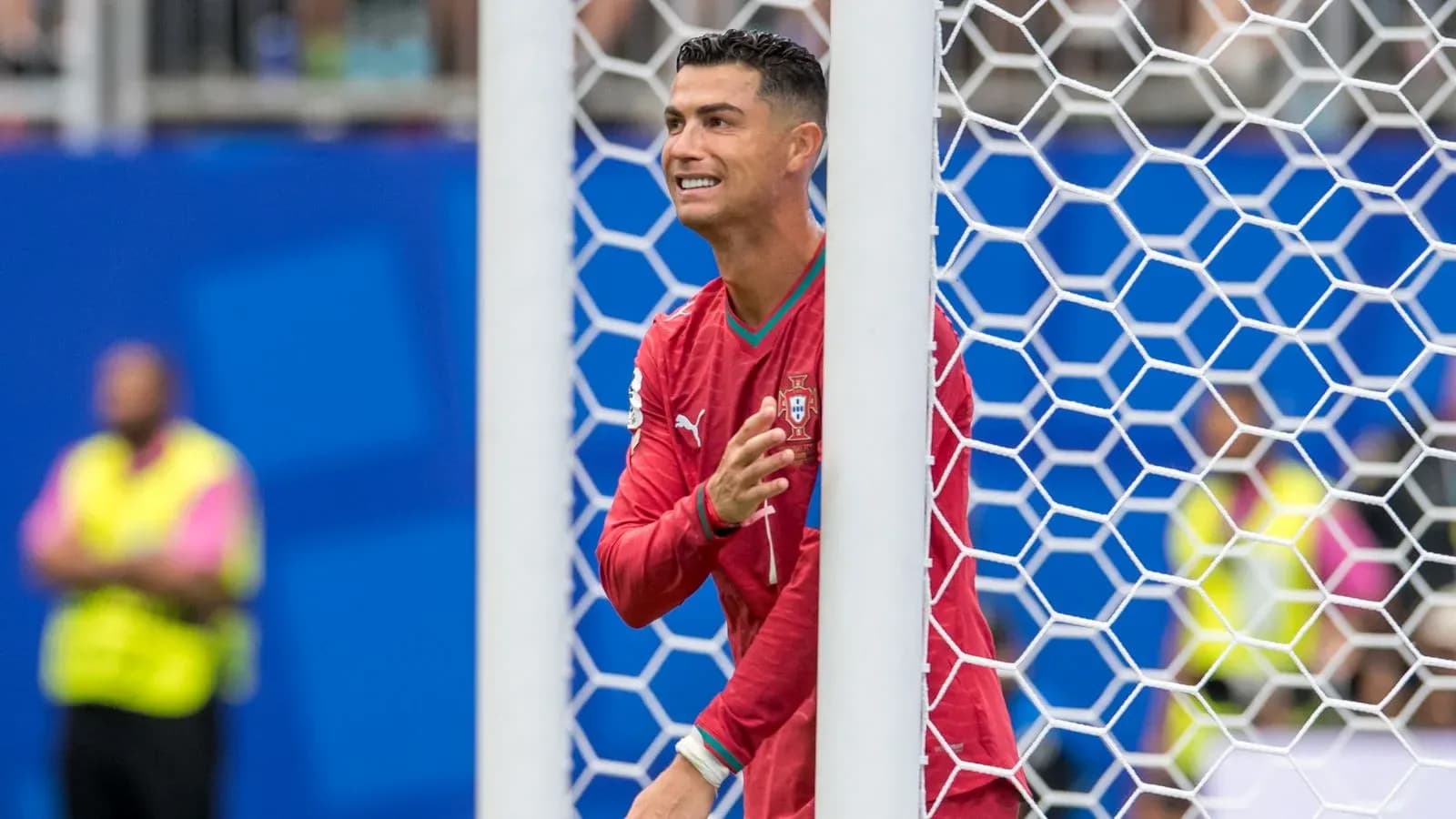
Cristiano Ronaldo's Struggles with Portugal: A Conversation to Address
Cristiano Ronaldo walked out in Houston chasing ghosts as much as goals. A record-extending sixth World Cup. The armband on his sleeve. The old, familiar spotlight fixed squarely on him.
The night before, Kylian Mbappe had scored twice. Erling Haaland had scored twice. Lionel Messi, the eternal measuring stick, had gone one better with a hat-trick.
Ronaldo’s answer? Twenty-nine touches. As many shots as Messi had goals. No goals of his own. A scowl. A flat 90 minutes as Portugal laboured to a draw against DR Congo.
At 41, he was still the story. Just not in the way he used to be.
The numbers that won’t go away
Ronaldo’s goalless streak in major international tournaments now stands at 10 games. Messi, over his last 10 in those same arenas, has nine goals.
The contrast is stark. So is the involvement.
Of Portugal’s starting XI in Houston, only Bernardo Silva had fewer touches than Ronaldo – and Silva came off at half-time. For a man still treated as the side’s attacking axis, Ronaldo simply wasn’t in the game.
Yet when the questions came, Roberto Martinez did what Portugal managers have done for nearly two decades: he protected his star.
“It makes no sense to get the best goalscorer in world football out in a game that you need goals,” Martinez insisted. He spoke of Ronaldo’s experience in the box, of how he drags defenders around, of the spaces that open for others. “When you look for goals, you need to have Cristiano.”
It was a firm defence. It was also a challenge to the rest of his squad.
Because behind Ronaldo, Martinez has Bernardo Silva, Bruno Fernandes, Pedro Neto, Vitinha, Joao Neves, Joao Cancelo, Nuno Mendes. A creative core that would walk into almost any national team on the planet.
So if the coach says Ronaldo is not the problem, the implication is clear: the others are.
Is the service really the issue?
Look at the data and Martinez’s argument gains a sliver of support, but only that.
Across their last 10 competitive internationals, Ronaldo has had fewer shots than Mbappe and Messi, and only slightly more than Harry Kane’s 30. His expected goals over that stretch sit at 5.36. Kane’s number is higher at 7.15. Mbappe’s is higher still at 8.76.
That gap points to something simple: Ronaldo hasn’t been getting chances of the same quality as his peers.
Zoom out to team level and the pattern holds. With Ronaldo on the pitch, Portugal have generated a combined xG of 12.76 in those 10 games. England, with Kane, have reached 16.39. France, with Mbappe, a hefty 21.99. On a per-90 basis, that’s 1.32 for Portugal, 1.34 for England, 1.72 for France.
Portugal, for all their talent, are not creating as much as the other heavyweights.
Look more closely at Ronaldo’s own chances and the picture sharpens. His xG from team-mate-assisted shots over this barren run is 2.55. Kane’s equivalent is 3.2. Mbappe’s is a remarkable 5.78.
All those playmakers, all that technical quality, and yet the man up front is feeding on less. The numbers suggest the supply line isn’t as rich as it should be.
But that’s only half the story.
The decline in the box
Because even with those caveats, Ronaldo has still had enough to change the narrative. A chance here, a header there, a volley on the stretch. The sort of half-openings he used to devour.
He isn’t devouring them now.
His post-shot xG – the measure of what happens after the ball leaves the boot or head – is damning. Kane and Mbappe both outperform their underlying chances, by 2.05 and 2.25 goals respectively. They are finishing above expectation, as elite forwards should.
Ronaldo is not. His post-shot xG differential stands at -2.8. That means he has scored nearly three goals fewer than the quality of his attempts suggests he should have.
For a player once defined by his ruthless precision, that is not a blip. It is a trend.
The sharpness has dulled. The split-second timing, the angles, the unerring contact – all slightly off. At this level, “slightly” is the difference between a match-winner and a talking point.
A passenger in the build-up
The other problem sits away from the penalty area.
Messi now drops into midfield to dictate games. Kane routinely drifts deep, knits play, sprays passes, drags defenders into places they don’t want to go. Mbappe roams across the front line, constantly involved, constantly dangerous.
Ronaldo doesn’t do that. He never really has, and at 41 he certainly won’t start now.
His touch map and heatmap against DR Congo underline how limited and isolated his involvement has become. The bulk of his actions came in narrow pockets on the left, areas where Neto and Mendes should have been combining and breaking lines. Instead, the captain often stood on their toes.
He isn’t dropping deep to link play. He isn’t drifting across the line to destabilise defences. He is occupying a fixed zone, waiting for the ball to arrive.
In his prime, that was enough. The ball would find him, and the net would ripple. Now, when he’s not finishing at an elite level and he’s not contributing to the build-up, the trade-off becomes harder to justify.
Martinez’s dilemma, Portugal’s risk
This is the crux of Martinez’s problem.
He cannot rip up his creative unit just to feed one man. Not when that unit includes some of the best technicians in Europe. Not when the data shows they are already underperforming as a collective.
Yet he also will not, or cannot, remove Ronaldo from the equation. He believes in the aura, the experience, the gravity Ronaldo still exerts on defenders. He believes that when the moment comes, the old instincts will return.
So Portugal exist in a kind of tactical limbo. A golden generation behind a legendary forward whose output no longer matches his name. A coach trying to balance sentiment, statistics and the sheer political weight of benching the country’s greatest footballer.
If Ronaldo buries one of those chances, this conversation quietens. If he strings together a run of goals, it disappears. But the numbers, the performances, the body language in Houston all point in another direction.
At some stage, Portugal will have to decide what they value more: the idea of Cristiano Ronaldo, or the reality of what he now is.
They can delay that decision. They can talk about service, about xG, about attraction of defenders. They just can’t avoid it forever.
Related News
Raphinha’s Hat-Trick Powers Barcelona to 7-2 Victory Over Racing Santander
Carabao Cup Fourth Round Draw: Liverpool Set to Clash with Chelsea, Arsenal to Face Fleetwood Town
Key Football Matches to Watch in Azerbaijan This Autumn
Raphinha's Hat-Trick Drives Barcelona to 7-2 Triumph Over Racing Santander
Hansi Flick Leads Barcelona to Record-Breaking Seven Wins in a Row
Gavi Reflects on Injury Return as Barcelona Dominate Racing Santander 7-2