
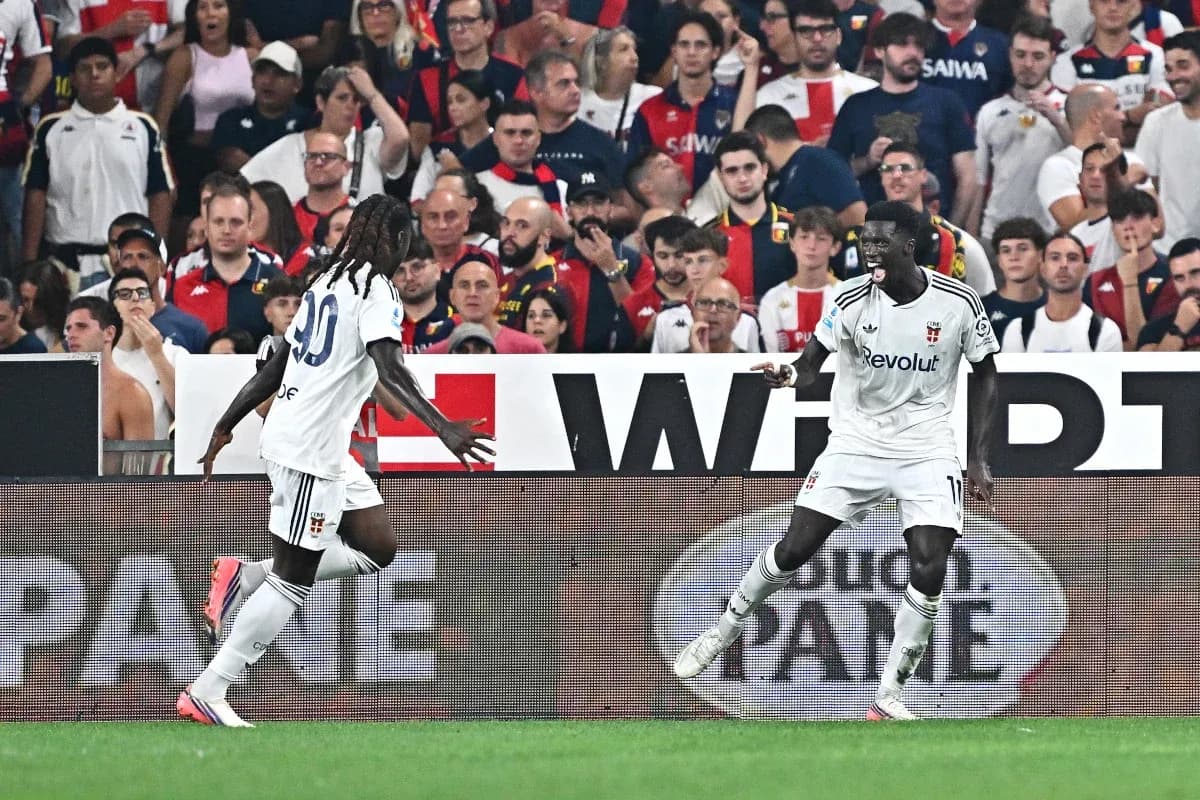
Como's Tactical Mastery Shines in 2-1 Victory Over Parma
Under the late afternoon light at Stadio Giuseppe Sinigaglia, Como’s 2–1 win over Parma felt less like an early-season skirmish and more like a statement of intent. Four rounds into the Serie A campaign, the table already tells a sharp story: Como sit 3rd with 10 points, unbeaten with three wins and one draw, and a goal difference of 5 (9 scored, 4 conceded). Parma, by contrast, are 17th with just 1 point, winless, and carrying a goal difference of -4 (2 scored, 6 conceded). This fixture crystallised those trajectories in 90 concentrated minutes.
Fabregas stayed loyal to the 4-2-3-1 that has underpinned Como’s start, and the shape looked almost etched onto the pitch. R. Sanchez anchored in goal behind a back four of Y. Couto, J. Ramon, M. O. Kempf and Kaiki. Ahead of them, the double pivot of M. Perrone and L. Da Cunha formed the hinge between control and incision, freeing a fluid band of three — A. Diao on the right, N. Paz centrally, M. Baturina from the left — to orbit around lone striker M. Kean.
It is a system already reflected in the season’s numbers. Overall this campaign, Como have scored 9 goals in 4 matches, with an overall average of 2.3 goals per game. At home, they had 2 goals in 1 match before this fixture, an average of 2.0. They had yet to fail to score anywhere, and had not lost home or away. The structure is clear: a team built to have the ball and to hurt opponents regularly.
Parma arrived in starkly different circumstances. Carlos Cuesta lined his side up in a 3-4-2-1, a shape that promises security but demands precision. E. Corvi started in goal behind a back three of Diego Carlos, M. Troilo and E. Delprato. The wing-backs S. Britschgi and E. Valeri flanked a central duo of V. Sierro and M. Keita, while E. B. Toure and S. Lontani supported central forward N. Elphege.
On paper, it was a compact block designed to absorb and counter. In practice, it reflected a side still searching for balance. Heading into this game, Parma had scored only 2 goals in total across 4 matches, with an overall average of 0.5 goals per game, and conceded 6, an overall average of 1.5. On their travels specifically, they had 1 goal in 2 away matches (0.5 per game) and had shipped 4 (2.0 per game). There were no clean sheets anywhere, and they had already failed to score in 2 of 4 outings.
The absences subtly shaped both squads. Como were without J. Addai due to an Achilles tendon injury, removing a potential option in wide or transitional roles from Fabregas’ bench. Parma missed H. Nicolussi Caviglia with a groin injury, a notable absence in the very zone where they most needed calm distribution and defensive reading.
In the “Hunter vs Shield” duel, Como’s attacking trident of Baturina, Diao and Kean stood opposite a Parma defence that had already looked porous away from home. Baturina, one of Serie A’s early leading lights, came into the round with 2 goals and 1 assist in 3 appearances, a rating of 7.17, and 90 completed passes at 87% accuracy. His role from the left half-space is not just to finish moves but to knit them together, as his 3 key passes and 5 fouls drawn underline.
On the opposite flank, Assane Diao brought a more vertical threat. Also on 2 goals and 1 assist before this match, with a 7.2 rating, 7 shots (3 on target), and 12 dribble attempts with 6 successful, he is the runner who stretches back lines and forces mismatches. Between them, they represent the sharp edge of a Como side that had yet to draw a blank in front of goal.
Parma’s “shield” was built around Diego Carlos and the rest of the back three, supported by Sierro and Keita in front. But the season’s pattern — no clean sheets, an away average of 2.0 goals conceded per game — suggested a line still learning each other’s movements. The back three can compress space centrally, but against a 4-2-3-1 with intelligent half-space occupiers, any hesitation in stepping out is punished.
In the “Engine Room” battle, M. Perrone and L. Da Cunha squared up to Sierro and Keita. Como’s double pivot is designed to give Fabregas control of tempo: one to recycle, one to break lines. Parma’s pair, by contrast, had to be both destroyers and first passers into transition. Without Nicolussi Caviglia, the onus on Sierro to provide progression from deep increased, leaving Keita to cover large defensive zones against Como’s rotating tens.
Discipline and game-state management also tilted the narrative. Como’s yellow cards this season had been split evenly between 46–60 minutes and 76–90 minutes, a late-game surge where 50.00% of their cautions arrived in each of those windows. It hints at a side that raises intensity — and risk — as matches stretch. Parma’s bookings were even more skewed towards the closing stages: 40.00% of their yellows had come between 76–90 minutes, with additional flashes between 46–60 and 61–75. Under pressure, this is a team that tends to become ragged late on.
Overlay that with Parma’s away defensive record and Como’s consistent scoring, and the tactical prognosis before a ball was kicked pointed towards the pattern we saw: Como asserting themselves, Parma resisting in phases but ultimately conceding twice. With both sides yet to take or miss a penalty this season, there was no safety net from the spot to distort the underlying dynamics.
Following this result, the numbers and the narrative align. Como’s 4-2-3-1, anchored by Sanchez and orchestrated by Perrone, Da Cunha, Baturina and Diao, looks like a coherent, repeatable blueprint for Champions League contention. Parma’s 3-4-2-1, meanwhile, remains an idea more than an identity: structurally sound in theory, but undermined by a blunt attack and an away defence that continues to leak at key moments.
At Sinigaglia, the table did not lie; it simply came to life in 90 minutes of football.
Related News
Fiorentina vs Napoli Prediction: Key Stats and Betting Tips
AS Roma vs Inter: Serie A Showdown on 19 September 2026
Inter’s Dominance in 5–3 Win Over Udinese
AS Roma vs Inter Prediction: Key Stats and Betting Tips
Lazio and AC Milan Battle to a 2–2 Draw: Early Serie A Insights
AC Milan vs Lecce Stats: Head-to-Head Record and Historical Context