
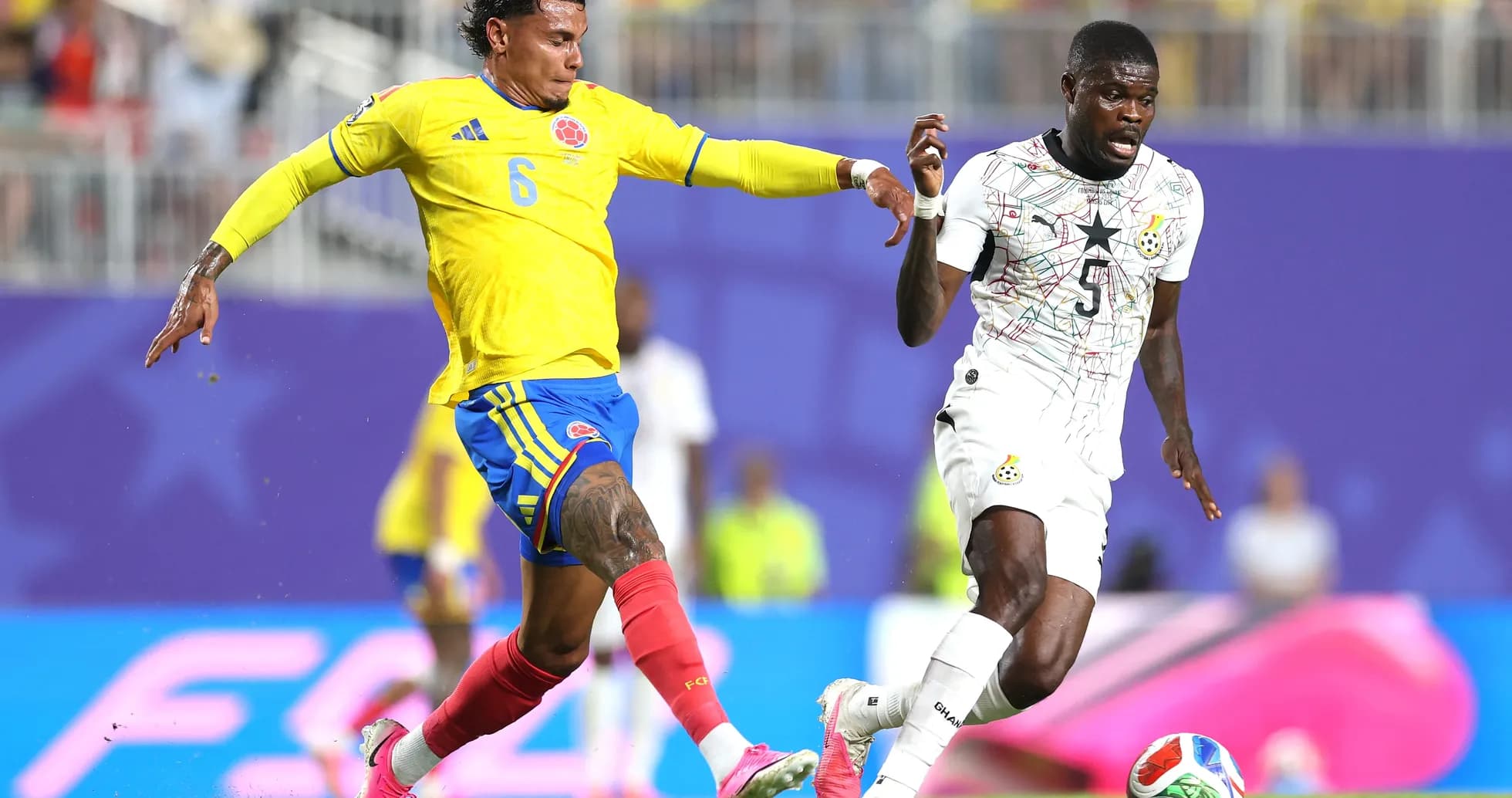
Colombia Triumphs Over Ghana in Round of 32 Clash
Arrowhead Stadium in Kansas City staged a Round of 32 tie that felt like a clash of identities as much as a knockout match: Colombia, top of Group K and riding an unbeaten wave, against a Ghana side that had edged through Group L with narrower margins and a more fragile goal balance. Following this 1–0 Colombian win in regular time, the narrative of the two campaigns tightened into focus: Colombia’s control and defensive discipline held, while Ghana’s sporadic threat again lacked a cutting edge.
Colombia arrived with the statistical profile of a side quietly built for tournament football. Heading into this game they had played 4 matches in total, winning 3 and drawing 1, with no defeats. At home they had played 3 times, winning 2 and drawing 1, and on their travels they had 1 away win from 1 away match. Overall they had scored 5 goals and conceded just 1 in total, an overall average of 1.3 goals scored and 0.3 conceded per match. At home their attack was more measured, with 2 goals at an average of 0.7, but they had not conceded a single home goal. Away, they were more expansive, scoring 3 at an away average of 3.0 and conceding 1 at an away average of 1.0. The goal difference across all venues stood at +4, built on a foundation of 3 clean sheets in total.
Ghana’s numbers told a different story. Across 4 matches in total they had 1 win, 1 draw and 2 defeats. At home they had played once, winning 1–0 and keeping a clean sheet, but on their travels they had played 3 times, failing to win and losing twice. In total they had scored 2 and conceded 3, an overall scoring average of 0.5 and an overall concession average of 0.8. At home they produced 1 goal at an average of 1.0 and conceded none; away they scored only 1 at an away average of 0.3 and let in 3 at an away average of 1.0. The overall goal difference was −1, and they had failed to score in 2 matches in total.
Those seasonal profiles were mirrored in the lineups. Nestor Lorenzo doubled down on Colombia’s 4‑3‑3, the formation they had already used in all 4 matches this campaign. C. Vargas anchored a back four of D. Munoz, D. Sanchez, J. Lucumi and J. Mojica, a unit that had already delivered those 3 clean sheets in total. Ahead of them, the midfield triangle of G. Puerta, J. Lerma and J. Arias was designed less for fireworks and more for control: secure first passes, counter‑pressing, and the sort of positional discipline that keeps a side’s overall concession average at 0.3.
The front three carried the creative burden. J. Rodriguez, notionally starting as a forward but functionally the free playmaker between the lines, linked with the direct running of L. Diaz and the penalty‑box presence of J. Cordoba. With Colombia’s biggest wins this campaign including a 1–0 at home and a 1–3 away victory, this trio embodied the duality of their attack: patient at home, ruthless when space appears.
Carlos Queiroz responded with a 4‑1‑4‑1 for Ghana, a shape that aimed to compress central zones and spring forward in transition. L. Ati Zigi sat behind a back four of M. Senaya, D. Luckassen, J. Opoku and G. Mensah, with T. Partey as the single pivot tasked with screening Colombia’s No. 10 space. Ahead of him, a line of four – I. Williams, C. Yirenkyi, K. Sibo and A. Semenyo – supported lone forward J. Ayew.
The selection of C. Yirenkyi was especially telling. Across the tournament he had become a disciplinary and intensity reference point for Ghana: 4 total appearances, 3 starts and 272 minutes, with 2 yellow cards but no reds. His numbers sketched the profile of a two‑way midfielder: 70 passes at 88% accuracy, 1 key pass, 2 tackles, 2 successful shot blocks and 3 interceptions. He had engaged in 32 duels and won 8 of them, dribbled 4 times with 3 successes, and drawn 3 fouls while committing 7. In other words, he was Ghana’s edge in the engine room, walking the tightrope between aggression and control.
Tactically, the “Hunter vs Shield” duel was Colombia’s front line against Ghana’s away defensive record. Ghana had kept 1 away clean sheet in total but had still conceded 3 goals on their travels, an away concession average of 1.0. Colombia, by contrast, were averaging 3.0 goals scored away, though here they were designated as the home side in Kansas City. The Colombian plan leaned on that attacking ceiling while trusting a defence that had yet to concede at home.
In midfield, the “Engine Room” confrontation centred on J. Lerma and G. Puerta against T. Partey and C. Yirenkyi. Colombia’s yellow‑card distribution hinted at a team comfortable managing tempo with controlled aggression: 2 yellows between 0–15 minutes (33.33% of their total yellows), 1 between 46–60 minutes (16.67%), 2 between 76–90 minutes (33.33%), and 1 in the 91–105 range (16.67%). That late‑game surge of 33.33% of their yellows in the final quarter of normal time suggested a side willing to foul to break rhythm when protecting a lead. Ghana’s own yellow‑card pattern was more dispersed, with 16.67% of their yellows between 16–30 minutes, 33.33% between 46–60, and a steady 16.67% in each of the 61–75, 76–90 and 91–105 ranges. It painted a picture of a team that often had to chase or react, picking up cautions as matches opened up.
Without penalty incidents to tilt the balance – both teams had taken 0 penalties in total this campaign, with 0 scored and 0 missed – the match hinged on open‑play structure and small margins. Colombia’s overall defensive record, with 3 clean sheets in total and only 1 goal conceded across 4 matches, proved decisive again. Ghana’s attack, limited to 2 total goals this tournament and an overall scoring average of 0.5, could not consistently unsettle a back line marshalled by D. Sanchez and J. Lucumi in front of the assured C. Vargas.
Following this result, Colombia’s campaign narrative hardens: a side whose 4‑3‑3 is now fully imprinted, whose defensive platform travels, and whose front three can win tight knockout games without needing to chase high‑scoring contests. For Ghana, the Round of 32 exit underlines both the promise and the limitations suggested by their numbers: organised in phases, combative through figures like C. Yirenkyi and T. Partey, but too blunt in the final third to overturn a team with Colombia’s defensive solidity. In a World Cup where xG and margins rule, this was a tie won by the side that best aligned its structure with its statistical identity.
Related News
Thomas Tuchel Reflects on England's 10-Man World Cup Triumph and a Surprising Regret
Robert Moreno Takes Over as Interim South Korea Coach After World Cup Setback

Jude Bellingham Returns to Form with Real Madrid After World Cup Success

Chloe Kelly, Beth Mead & 13 Lionesses Who Must Shine in the Upcoming WSL Season for England’s 2027 World Cup Bid
Barcelona Cancels World Cup Tribute Amid Political Tensions
Messi Breaks Record for Most Penalties Taken and Missed in FIFA World Cup History