
Celta Vigo vs Levante: Tactical Analysis of La Liga Defeat
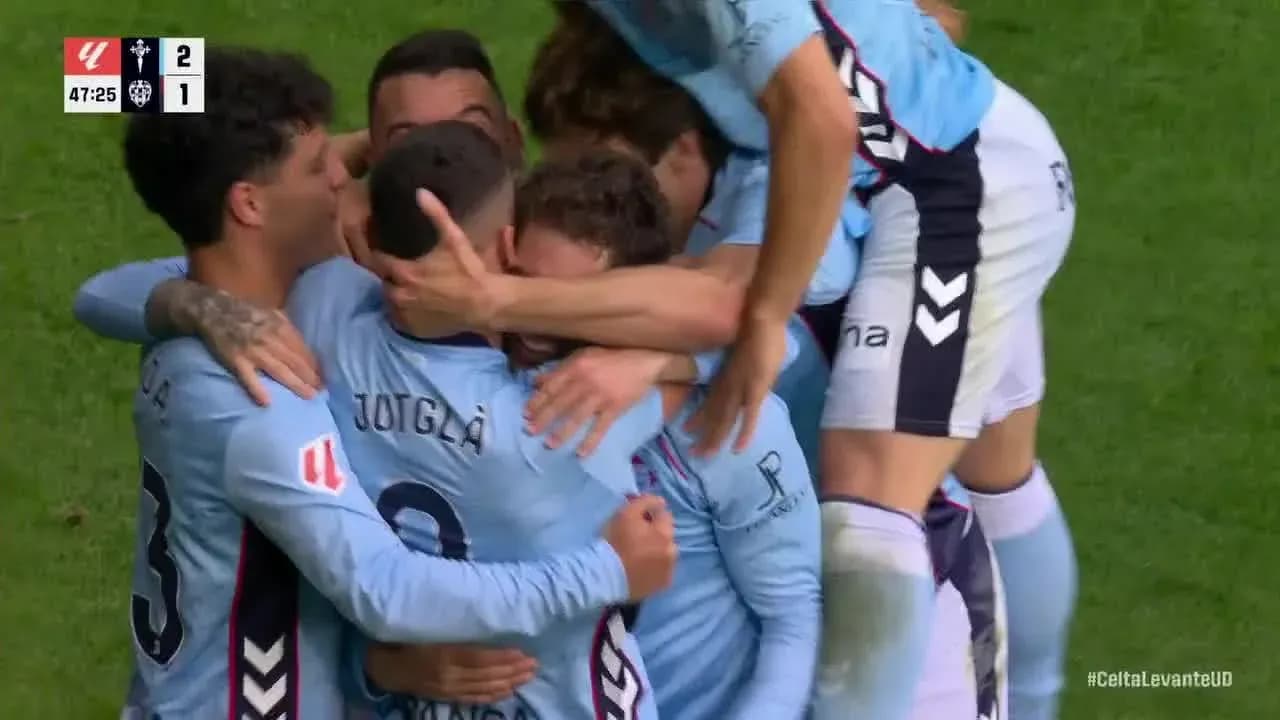
Celta Vigo’s 2-3 home defeat to Levante at Estadio Abanca-Balaídos unfolded as a study in contrasting structures and efficiency. Claudio Giraldez set Celta up in a 3-4-3 that dominated territory and possession (57%, 581 passes, 512 accurate, 88%), but Luis Castro’s 4-1-4-1 for Levante absorbed pressure and struck decisively in transition and set phases, turning 43% possession and 14 shots into three goals and a vital away win in this La Liga Regular Season - 36 fixture.
I. Executive Summary
Celta’s early and second-half surges, both finished by Ferran Jutgla, seemed to validate Giraldez’s aggressive back-three blueprint. Yet Levante repeatedly punished structural weaknesses around Celta’s wide center-backs and wing-backs. Koldo Arriaga’s late first-half equaliser, Dela’s second-half header, and Roger Brugue’s decisive strike flipped a match where xG slightly favored Celta (2.07 vs 1.46) but where Levante’s defensive organisation and clinical use of key moments outweighed volume of possession and shots.
II. Scoring Sequence & Disciplinary Log
Goal verification (5 goals, matching 2-3 full-time):
- 4' F. Jutgla (Celta Vigo) — assisted by H. Alvarez
- 43' K. Arriaga (Levante) — assisted by J. Toljan
- 48' F. Jutgla (Celta Vigo) — assisted by J. Rueda
- 57' Dela (Levante) — assisted by K. Arriaga
- 63' R. Brugue (Levante) — assisted by J. A. Olasagasti
Celta struck immediately: in the 4th minute, Ferran Jutgla attacked the right half-space, finishing from a cross or cutback by Hugo Alvarez. This play highlighted the 3-4-3’s intent: Alvarez high and wide, Jutgla and Iago Aspas occupying the inside channels to overload Levante’s full-backs.
Levante’s response in the first half came from their right flank. At 43', Koldo Arriaga arrived from his holding midfield base to finish a move created by right-back Jeremy Toljan. The pattern underlined Levante’s main offensive idea: Toljan overlapping beyond the midfield line, Arriaga timing his run into the edge-of-box pocket vacated behind Celta’s advanced wing-backs.
Half-time score: Celta Vigo 1-1 Levante.
Immediately after the interval, Celta reasserted control. On 48', Jutgla again finished clinically, this time from a delivery by Javi Rueda, who had stepped high from midfield. Celta’s wing-backs and wide midfielders pinned Levante deep, and Rueda’s positioning between Levante’s lines opened a channel for the second goal.
Levante’s equaliser at 57' came from a central defensive presence. Dela, stepping forward from the back line, converted after a ball from Arriaga, who this time acted as a creative pivot. The sequence exposed Celta’s vulnerability to late runs from deep when their three center-backs were occupied by the first line of attackers.
The decisive blow arrived at 63'. Fresh from the bench, Roger Brugue finished a move constructed by Jon Ander Olasagasti. Levante’s midfield line of four exploited the spaces either side of Celta’s single pivot in transition, with Olasagasti finding Brugue in a seam between center-back and wing-back.
Card verification (2 cards total, both Levante):
- 60' Diego Pampín (Levante) — Foul
- 90' Mathew Ryan (Levante) — Time wasting
Diego Pampín’s yellow at 60' for Foul reflected Levante’s need to disrupt Celta’s rhythm down the left. At 90', goalkeeper Mathew Ryan was booked for Time wasting, underlining Levante’s late-game game-management once they had secured the 3-2 lead.
III. Tactical Breakdown & Personnel
Celta’s 3-4-3
Giraldez’s 3-4-3 placed Ionut Radu behind a back three of J. Rodriguez, Y. Lago, and M. Alonso. The wing-back line of S. Carreira and J. Rueda, flanked by central midfielders F. Lopez and Hugo Sotelo, aimed to stretch Levante horizontally while maintaining a double pivot for circulation.
In possession, Celta’s structure was effective. They produced 12 total shots (11 inside the box, only 1 from range), with 6 on target, reflecting high-quality chance creation in central zones. The passing numbers — 581 passes, 512 accurate (88%) — show a side comfortable building from the back, using Radu and the back three to lure Levante’s first line before switching quickly to the wings.
However, the same structure created defensive fragility. With wing-backs high, Celta’s wide center-backs were repeatedly dragged into the channels by Levante’s wingers and overlapping full-backs. The equaliser by Arriaga and the later goals by Dela and Brugue all came from exploiting these half-space gaps or late arrivals from deep against a retreating line of three.
Radu’s contribution (3 saves, 1.12 goals prevented) suggests that, despite conceding three times, his shot-stopping actually limited further damage. The goals conceded were more about free headers and untracked runs than pure finishing quality; the goals prevented metric indicates Radu outperformed the xG of shots on target against him.
The second-half substitutions — W. Swedberg (IN) for Hugo Alvarez (OUT), Borja Iglesias (IN) for Javi Rueda (OUT), P. Duran (IN) for Iago Aspas (OUT) at 66', then J. El Abdellaoui (IN) for Jutgla (OUT) and O. Mingueza (IN) for Hugo Sotelo (OUT) at 76' — were clear attempts to inject fresh legs and more direct threat. But each change also eroded some of Celta’s earlier fluency between lines, especially after Jutgla, the most efficient finisher on the pitch, departed.
Levante’s 4-1-4-1
Luis Castro’s 4-1-4-1 was built on Mathew Ryan’s security in goal (4 saves, 1.12 goals prevented), a compact back four, and K. Arriaga as a single pivot shielding the defense. The midfield line of V. Garcia, P. Martinez, J. A. Olasagasti, and K. Tunde supported lone forward C. Espi.
Defensively, Levante accepted Celta’s possession, focusing on controlling the central lane. Arriaga’s screening limited Celta’s ability to play straight passes into Jutgla’s feet between the lines, forcing more circulation wide. Levante’s fouls count (10) and two yellow cards illustrate a willingness to break play and reset their block when Celta looked to accelerate.
In attack, Levante were direct but not simplistic. With 14 total shots (6 on target, 7 from outside the box), they mixed long-range efforts with well-timed entries into the area. The key was the vertical relationship between Arriaga and the advanced midfielders: Arriaga both scored and assisted, while Olasagasti’s assist for Brugue came from exploiting the space behind Celta’s midfield line.
The substitutions were decisive. At 46', I. Losada (IN) came on for K. Tunde (OUT), adding more vertical running from midfield. Later, R. Brugue (IN) for V. Garcia (OUT) at 61' and U. Raghouber (IN) for P. Martinez (OUT) at 62' freshened the wide areas and central creativity. Brugue’s goal at 63' was a direct payoff from this injection of energy and attacking intent. M. Sanchez (IN) for D. Varela Pampin (OUT) at 77' and I. Romero (IN) for C. Espi (OUT) at 86' were late-game adjustments to secure the flanks and add an outlet for counters.
IV. The Statistical Verdict
From a statistical perspective, Celta’s 2.07 xG against Levante’s 1.46 suggests the hosts generated the better aggregate chances. Their 6 shots on target from 12 attempts, with 11 inside the box, show that the attacking design worked in terms of access to high-value zones. However, defensive transition and set-piece or cross management undermined that advantage.
Levante’s 14 shots, split evenly between inside and outside the box, point to a more varied shot profile. The fact that they matched Celta’s 6 shots on target with fewer box entries underlines their efficiency. Ryan’s 4 saves and 1.12 goals prevented were crucial; he effectively neutralised a full expected goal’s worth of Celta opportunities.
Discipline tilted slightly against Levante (2 yellow cards, Celta 0), but those interventions — one for Foul, one for Time wasting — were part of a broader game-management plan once they led. Crucially, the defensive index suggested by their compactness and Ryan’s performance compensated for lower overall form in possession metrics.
In sum, Celta’s structural ambition and ball dominance were undone by poor control of key defensive zones and the timing of their substitutions, while Levante’s more conservative 4-1-4-1, combined with precise changes and a standout goalkeeping display, delivered a tactically coherent and statistically justified 3-2 away victory.
Related News

LaLiga 2026-27 Season Schedule Released: Kickoff on August 15, Clásico on October 25

Atletico Madrid vs Real Madrid: Head-to-head Stats and Past Meetings
Real Madrid Dominates Rayo Vallecano in La Liga Clash
Atletico Madrid Dominates Real Sociedad 3-0 at Reale Arena
Barcelona Dominates Levante in High-Scoring Clash

Sevilla vs Barcelona Stats: Head-to-Head Record and Past Meetings