
Canberra United Saved: New Owners Plan Permanent Home and Men’s Team
Canberra United has stared down oblivion before. This time, salvation walked through the gates at McKellar Park with a cheque book, a plan and a promise that women’s football in the capital will not just survive, but grow.
Australian Sports Group (ASG) has bought the club’s licence from Capital Football, ending two years of uncertainty and ushering in private ownership for the first time in United’s 18-year history. The deal is believed to be worth around $15 million across both women’s and future men’s operations, with an initial commitment to underwrite the A-League Women side to the tune of up to $3 million over multiple years.
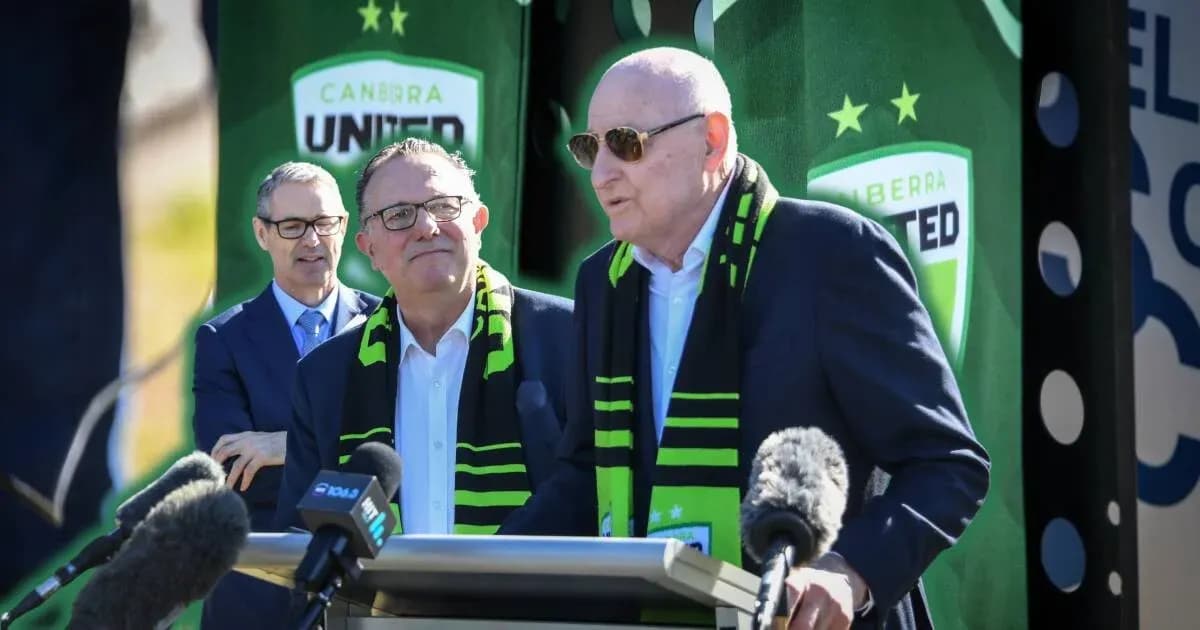
On Friday, ASG chief executive Theo Fotopoulos and chairman Morris McAlister stood on the McKellar Park turf and confirmed what Canberra has waited years to hear: United is safe for the 2026-27 A-League Women season — and an A-League Men team is locked in as the target for 2028-29.
McKellar at the heart of the rebuild
The message from Fotopoulos was blunt and reassuring. Canberra United is not going anywhere, and neither is its “spiritual home”.
McKellar Park will remain the club’s match-day base. ASG is already exploring how to turn it into something more substantial, with a dedicated training facility on the table and an office to be established next door at the Belconnen Soccer Club.
“It’ll come down to what we can get approved in terms of the facility here,” Fotopoulos told The Canberra Times, noting McKellar’s rare status as a private football ground in the ACT and its roughly six-hectare footprint. He has already spoken with key stakeholders and believes the prospects are “very positive”.
The ambition is clear: where Capital Football’s Throsby Home of Football project fell over under financial strain, ASG wants McKellar to become the beating heart of a fully professional club.
“Football needs a home,” Fotopoulos said. “It’d be great to be able to develop that here.”
If that happens, Canberra’s women’s side would train and play at the same venue, a luxury many A-League Women clubs still lack.
Coaching continuity and a race against the clock
With the season set to kick off on October 16 and pre-season just six weeks away, ASG has little time to waste. The first priority is the dugout.
The new owners have already held talks with coach Antoni Jagarinec, the local product who has guided United to the finals in each of the past two seasons. His record, Fotopoulos admitted, is hard to ignore.
“It’s never a no-brainer, but yeah, look, I think [Jagarinec’s] results speak for themselves,” Fotopoulos said. “We’re looking for continuity and consolidation. We’ll have those announcements out pretty soon.”
The same urgency applies to the playing group. The Professional Footballers Australia (PFA) is currently working with United’s squad, and ASG wants contracts sorted quickly.
“That is our priority to get that finalised,” Fotopoulos said. “We feel very confident with the reaction we’ve had so far from the players that that will happen in haste.”
The pressure is real. A new ownership group, a tight calendar, a league draw due next month and a fan base desperate for stability. The next few weeks will set the tone for the entire project.
A men’s team – finally?
The capital’s pursuit of an A-League Men licence has been a saga stretching nearly two decades. Promises, preferred bids, political support — and, until now, no team.
ASG does not yet hold a full men’s licence. What it has is an option: a pathway to enter an A-League Men side in the 2028-29 season. For a fan base burned by delays, three more seasons might feel like another deferral.
Fotopoulos, though, left little room for doubt about ASG’s intent.
“Well, we’re here today, so that’s your best guarantee,” he said. “That is part of our twin strategy. When we started speaking to the APL … that was part of our mix. We believe the strength comes from both.
“It would be almost discriminatory not to work with the men. It’s always been part of our plans.”
APL chair Steve Conroy backed the move, thanking the ACT government and Canberra’s football community and hailing ASG’s arrival as “an exciting next step for professional football in the ACT”.
The announcement also brings a sense of closure for long-time bid leader Michael Caggiano, who has spent eight years pushing Canberra’s case while watching Auckland, named alongside the capital as a preferred expansion location more than three years ago, join the competition and win a championship.
Canberra’s turn, finally, has a date attached.
United in name, open to a new identity
One thing won’t change: the badge.
“You’ve got 18 years of Canberra United. Why would you change it?” Fotopoulos said, confirming the club’s name will remain for both women and, eventually, men.
What might evolve is the identity wrapped around it. Fotopoulos wants the city to help create a nickname through a public campaign — potentially run via The Canberra Times — that can sit alongside the United brand.
The Cosmos. Arrows. Greens. Lakers. Green Machine. The options are already flying around. The point is to anchor the club even deeper in the community it represents.
“If the Canberra community want a nickname for their team … whatever they come up with, we’re happy to look at that,” Fotopoulos said.
It’s a small detail, but it speaks to the broader approach: a club that wants to be owned emotionally by the city, not just financially by ASG.
Who’s behind the rescue?
ASG is not a faceless investment fund parachuting into football for the first time.
Chairman Morris McAlister brings a commerce background and heads Petron Plus 7 Australia and New Zealand, a company dealing in engine and machine products such as lubricants and grease. He also serves as senior consultant at MEC Team Consultants, connecting Australian businesses with Chinese markets.
Fotopoulos is a marketing executive and chief executive of FOS Group Australia. Both men have deep roots in the game. They were involved with Sydney Cosmos, where Fotopoulos was chief executive, and with the Newcastle Breakers in the old National Soccer League. Fotopoulos also previously served as Sydney Olympic’s chief executive.
This is not their first attempt to build a football club. It may be their most ambitious.
Under the terms of their entry, Fotopoulos and McAlister have roughly two years to put the foundations of a men’s team in place before the 2028-29 launch. At the same time, they must stabilise and grow a women’s side that has long punched above its financial weight.
Pathways, infrastructure and a reset for the capital
Beyond the senior teams, ASG’s blueprint reaches into the grassroots.
Fotopoulos has committed to re-establishing Canberra’s academy pathways, three years after Capital Football controversially shut down United’s academy. The decision left a glaring hole in the development ladder for local boys and girls dreaming of professional football without leaving the territory.
“We’re excited to be part of growing the A-Leagues and building a strong club focused on community engagement, football excellence, commercial growth, new infrastructure and strengthening the football development pathways for boys and girls in the territory and the capital region,” Fotopoulos said.
That emphasis on infrastructure is not just talk. The failed Throsby Home of Football project still looms large over the ACT game, a reminder of how fragile big plans can be when the money runs out. ASG’s willingness to invest in bricks and mortar — starting with McKellar — is central to its pitch.
Capital Football, stretched by the rising cost of running a professional team, had reached the end of the road. Last season was its final one at the helm. Without a buyer, Canberra United’s place in the A-League Women would have been in genuine jeopardy.
Instead, one of the league’s best-supported clubs — a side built on a “huge participant and passionate supporter base”, as Fotopoulos put it — now has a private backer, a long-term roadmap and a clear link to the men’s competition.
The relief around McKellar Park on Friday was obvious. Players, coaches, officials and fans all knew what was at stake.
Canberra United has been saved. The real test starts now: can ASG turn a rescued licence into the integrated, ambitious club this football-mad city has been promised for nearly 20 years?
Related News
Ilia Topuria Accuses Justin Gaethje After UFC Defeat

Tyson Fury vs Anthony Joshua Fight Date and Venue Confirmed
Switzerland Calls Up In-Form Sion Striker Winsley Boteli for Nations League
Bournemouth Secures Historic 2-1 Win Over Real Sociedad in Spain
Portugal Announces Squad for 2026 UEFA Nations League; Cristiano Ronaldo Expected to Play

Raphinha Channels Ronaldo Nazario as Barcelona's Leading Striker After Position Change