
Canada Secures Historic 6-0 Victory Against Qatar in World Cup
Canada came for a statement. It left with a landmark.
What began as quiet hope for a routine win over Qatar in Vancouver on Thursday erupted into a 6-0 demolition, Canada’s first-ever men’s World Cup victory and a night already being spoken about as a hinge point in the country’s sporting story.
It felt less like a group-stage opener and more like a declaration: this is a soccer nation now, too.
A city painted red
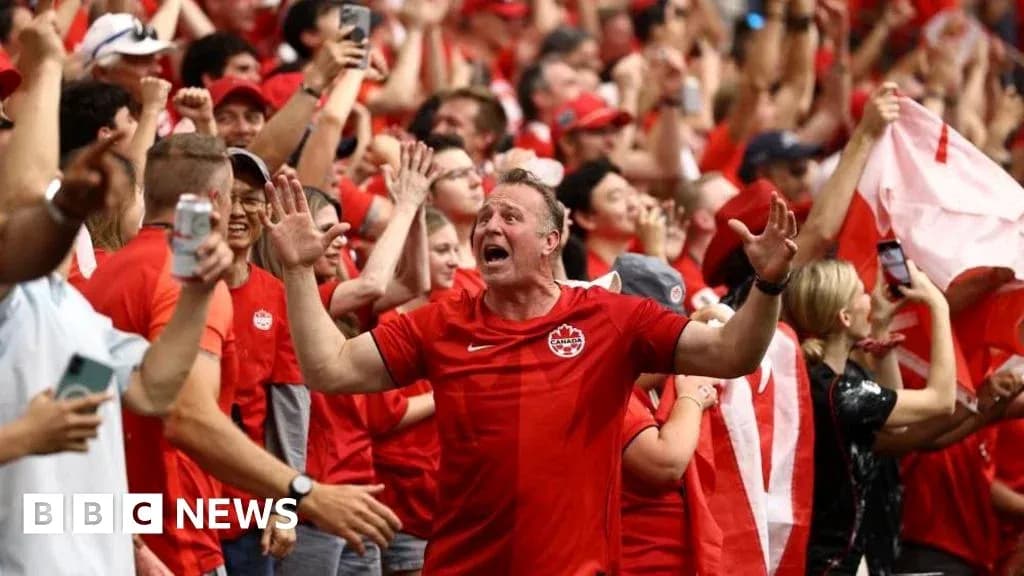
By mid-afternoon, Vancouver was already humming. Thousands of fans streamed along the “last mile” to the stadium, wrapped in scarves and flags, swallowed by clouds of red smoke. Inside, 52,000 people packed the stands, a sold-out sea of red and white that looked more like a hockey playoff night than a football group game.
Across the country, the same picture in miniature. Granville Street watch parties. Small neighbourhood bars in Toronto filling early. Generations of fans who had grown up with Canada as a football punchline suddenly leaning forward, expectant.
Dave Di Cola was one of them, a longtime believer in a team that rarely rewarded that faith. He walked into his Toronto bar with what he called “reserved optimism”. Anything can happen in football, and for Canada, it usually did in the worst possible way.
Not this time.
Goals, red cards and a rout
The tension barely had time to settle. Canada flew out, aggressive and front-footed, and the match tilted almost immediately in their favour. Three goals before half-time turned the night from hopeful to surreal, the noise in the stadium swelling with every finish.
By the time the final whistle blew, the scoreboard read 6-0. Qatar, reduced to nine men after two red cards, were overwhelmed. The numerical advantage helped, but the tone had been set long before the dismissals. Canada did not just win; it dominated, imposed itself, and refused to ease off.
Jonathan David led the charge with a ruthless hat-trick, the clinical edge that Canadian sides of the past so often lacked. His name rang around the stadium and, soon after, across social media.
One image captured the shift better than any statistic: a fan in a Connor McDavid ice hockey jersey, the “Mc” taped over and replaced with a hand-drawn “J” in honour of David. A hockey nation, repurposing its most sacred garment to celebrate a football striker. Symbolism rarely comes that neatly packaged.
Joy cut with heartbreak
Yet the night that announced Canada to the world also delivered a gut punch.
Midfielder Ismaël Koné, one of the heartbeat players of Jesse Marsch’s side, left the pitch with a serious leg injury that has ended his tournament. The mood inside the stadium flipped in an instant. Teammates rushed to surround him as medics treated him, a protective ring forming around a player who had grown into a central pillar of this team.
Marsch has described Koné as “a big part of the heart of our team.” On Thursday, that heart took a heavy blow.
Nathan Saliba, sent on in Koné’s place, responded in the only way footballers know. He scored Canada’s fourth goal and then lifted Koné’s jersey aloft in tribute, a raw, simple gesture that cut through the celebrations.
Koné underwent surgery and, on Friday morning, sent his own message back to the group. “What you guys did yesterday will stay with me forever,” he wrote on Instagram. The win will be replayed for years; for him, it will be watched from the sidelines.
For fans like Di Cola, the injury left a mark. The joy of six goals, the scale of the win, all of it tempered. “If that didn’t happen, I would have been running up and down the avenue yesterday,” he admitted.
A country watching
In the dressing room after the game, the magnitude of the moment drew an unlikely voice into the post-match chorus. Prime Minister Mark Carney addressed the squad, not to talk tactics or politics, but character.
He praised the players for the way they had responded to Koné’s injury, calling it “a level of character that some people never achieve.” It was not about the margin of victory; it was about how the team held together when the night threatened to sour.
“You showed it when the entire country and a good part of the world is watching,” Carney told them. “And if they didn’t watch they would have watched the highlights tomorrow.”
Canada’s sporting scrapbook is already crowded: Sidney Crosby’s golden goal in Vancouver in 2010, the Toronto Raptors toppling the Golden State Warriors in 2019, the women’s football team standing atop the podium in Tokyo in 2020. Those moments live in freeze-frame, instantly recognisable, forever replayed.
Thursday in Vancouver does not sit on that shelf yet. Di Cola is the first to say it. This was not a final, not a medal game, not a championship-clincher. “A long way to go,” he insists, and he is right. One emphatic group win does not make a dynasty.
What it does, though, is change the conversation.
For decades, “Canada soccer” was a punchline, something to be tolerated between hockey seasons. “It’s always secondary,” Di Cola said. On Thursday, watching the crowds, the noise, the outpouring of pride from coast to coast, he admitted it “nearly brought a tear” to his eye.
A nation that once shrugged at its men’s team is now marching in its colours, rewriting jerseys, packing stadiums. The players have given the country a night it will not forget. The country, in turn, has given them something just as valuable: belief.
Next comes Switzerland. A stronger test, a different challenge, the kind of opponent that measures whether this was a one-off explosion or the start of something more enduring.
Canada has its first World Cup win. The question now is how far this new “soccer nation” can push the story.
Related News

Raphinha’s Hat-Trick Powers Barcelona to 7-2 Victory Over Racing Santander
Carabao Cup Fourth Round Draw: Liverpool Set to Clash with Chelsea, Arsenal to Face Fleetwood Town
Key Football Matches to Watch in Azerbaijan This Autumn
Raphinha's Hat-Trick Drives Barcelona to 7-2 Triumph Over Racing Santander
Hansi Flick Leads Barcelona to Record-Breaking Seven Wins in a Row
Gavi Reflects on Injury Return as Barcelona Dominate Racing Santander 7-2