
Brazil's World Cup Collapse: The Impact of Experience and Loyalty
Brazil’s World Cup collapse did not come out of nowhere. It was built, brick by brick, in the team sheets.
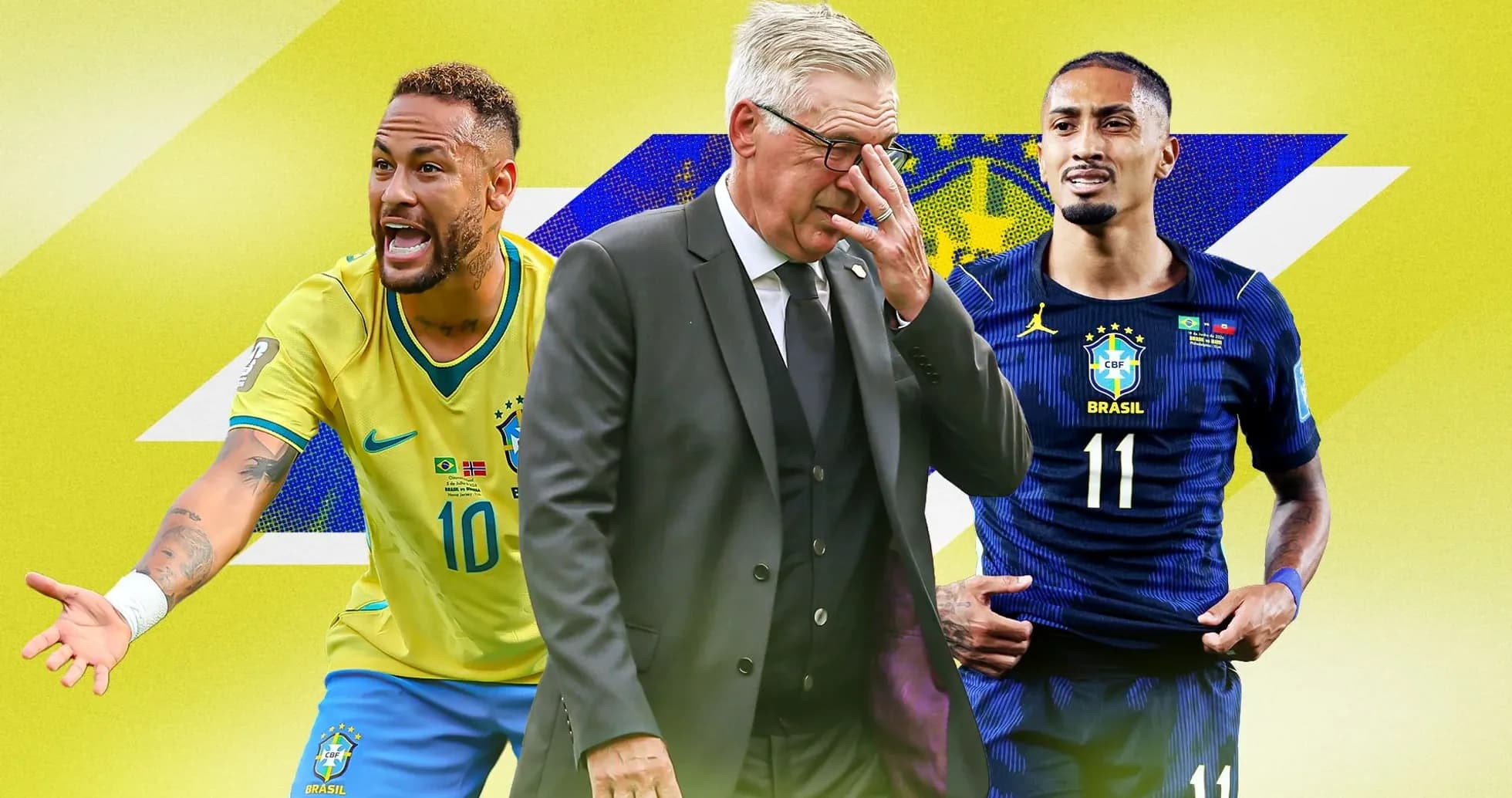
Carlo Ancelotti backed experience. He backed loyalty. In the end, he backed a group that no longer had the legs to carry a nation’s weight.
An old team in a young tournament
The numbers told their own story before a ball was kicked. Brazil arrived with three goalkeepers aged 33, 32 and 38. The defenders called up averaged 31, with Danilo and Alex Sandro – once elite full-backs at Juventus – now looking more like echoes of a different era than the rampaging forces they used to be.
In midfield, the pattern hardened. Casemiro, 34, was again asked to anchor the side, to be the reference point in and out of possession. Fabinho, 32, was given significant minutes as well. Both are warriors, serial winners, but the modern international game is ruthless to those a step off the pace.
There were glimmers of tomorrow. Bournemouth’s 19-year-old Rayan, and Danilo of Botafogo at 25, offered flashes of energy and possibility. But that was all they were: flickers. The core remained firmly in the hands of the old guard.
Ancelotti did not hide from the issue when the campaign imploded.
“We need some young talent, we need some high-level players coming into Brazilian football,” he said. “This national team has a very solid group, great players that continue and some new players that can come in.”
The problem in this tournament was obvious: the “new players that can come in” were mostly watching from home.
The Neymar gamble that never made sense
One veteran overshadowed all others. Neymar’s recall dominated the build-up, the debate, the expectation.
Ancelotti bowed to the pressure – from media, from fans, from the mythology that still surrounds the Santos idol – and named the 34-year-old despite his last cap coming in October 2023 and a string of fitness problems since. It was a romantic decision in a competition that rarely rewards romance.
Predictably, the body broke before the dream did. On the eve of the World Cup, Neymar suffered a calf injury, ruled out for “two to three weeks”. He missed the first two group games, only reappearing for 14 subdued minutes against Scotland in Miami. Those minutes felt more like a testimonial cameo than the triumphant return of a national hero.
In the last-32 win over Japan, Ancelotti didn’t turn to him at all. Chasing the game against Norway in the round of 16, he finally sent Neymar on for a longer spell. It changed little. The forward won and converted a late penalty, a consolation goal in what is almost certainly his final act in a Brazil shirt.
The bigger issue lay in what Neymar’s inclusion cost.
The Joao Pedro omission that won’t go away
As Neymar limped through the tournament, the decision to leave Joao Pedro at home grew more and more inexplicable.
The Chelsea striker, 24, had delivered 29 combined goals and assists in his debut season at Stamford Bridge. He offered mobility, versatility, and form – the three qualities Brazil’s attack ended up crying out for.
By the time the squad announcement rolled around, it was almost taken for granted that Pedro would be on the plane, perhaps even wearing the No.9. Ancelotti himself admitted the forward “probably deserved to be on this list”. That made the snub feel even more brutal.
The inquest has already begun, and it will not be kind.
“I have to be honest, I think this elimination begins with the decisions from the bench,” Ronaldo Nazario said afterwards. “I still don’t understand why Joao Pedro was not part of this squad. He has had an exceptional season, he is in form, and Brazil needed a striker who could offer something different.”
Instead, Brazil carried an injured legend and left a fit, in-form centre-forward at home. When Neymar broke down, the logic of that choice completely collapsed.
Midfield left exposed
Selection issues did not end in attack. Midfield, the engine room of any serious World Cup contender, was left worryingly thin.
Ancelotti initially named just five central midfielders, one of them Lucas Paqueta, who is more of a No.10 than a true central operator. Manchester United-bound Ederson was only drafted in late to replace injured right-back Wesley, a reshuffle that underlined how unbalanced the squad had been from the start.
That left Bruno Guimaraes carrying a ridiculous load. The Newcastle captain was asked to create, to press, to dictate tempo, to cover ground others could no longer reach. He responded with four assists and an enormous work rate, but he could not do it alone.
The coach’s trust in alternatives was minimal. Ederson and Danilo saw only scraps of minutes, a clear signal that Ancelotti did not truly believe in his depth options in the middle of the pitch.
After the defeat to Norway, he pointed straight at that area.
“We have to think about the future, but it is very evident that in the midfield, I think that we have to move some players,” he said. The admission came too late to save this campaign.
The penalty that defined a tournament
One moment will linger: the first-half penalty against Norway.
At 0-0, with Brazil needing control and calm, Bruno Guimaraes stepped up. His effort was saved. Norway grew. Brazil wobbled. They never fully recovered.
Given his form and his status as the team’s leading scorer at the tournament, many expected Vinicius Junior to take responsibility. Instead, to widespread surprise, he watched as Guimaraes placed the ball on the spot.
Ancelotti later explained that the call was driven by data.
“We did statistics for the players and according to that, Raphinha was the best option,” he said. “The best person would be Raphinha and then Neymar [who weren’t on the pitch], and after that, Bruno Guimaraes. After Bruno, it would be Martinelli, so we chose Bruno Guimaraes as we felt he would be the best.”
The science was clear. The football, less so. In a World Cup, where emotion, rhythm and personality collide with numbers, that kind of cold calculation can look brutally exposed when it goes wrong. This time, it did.
Injuries and the thinness of the squad
Ancelotti will argue, with some justification, that the deck was stacked against him long before that missed penalty.
Key players fell away even before the squad list was finalised. Eder Militao, Rodrygo and Estevao Willian were all ruled out early, depriving Brazil of their starting right-back and two wide players capable of changing games on their own.
Once the tournament began, the injury list kept growing. Neymar’s issues were predictable; the timing was still cruel. Raphinha pulled up with a hamstring problem in the first half against Haiti and never played again. Paqueta, already carrying a huge creative burden, was forced off at half-time in the knockout tie with Japan.
By the time Norway arrived, Brazil were patched together, short on invention and short on trust in the bench. The lack of depth, especially in midfield and attack, was laid bare.
Ancelotti’s next cycle
For Ancelotti, this World Cup will sit as a scar on an otherwise glittering career. He called it “the beginning of a new adventure” and insisted the defeat marks the start of a new cycle, not the end of anything.
“We have to keep improving, to find new ideas. It is not an end, it is the start of a new cycle,” he said. “We will manage this defeat by bringing a fresh impetus to our work and the assessment of the players. We will try to improve and look for new ideas. The same as we did this year.
“I think the work we’ve done has been good. Football is like this; sometimes you have to manage the sadness of a defeat. I am used to this.”
The question is whether Brazil are willing to endure another cycle built around the same old names and the same cautious instincts. The calls for youth, for Joao Pedro and his generation, for a midfield that can run as well as remember, will only grow louder.
Brazil have their new adventure. The real test is whether they are brave enough to pick the right travellers.
Related News
Ilia Topuria Accuses Justin Gaethje After UFC Defeat
Tyson Fury vs Anthony Joshua Fight Date and Venue Confirmed
Switzerland Calls Up In-Form Sion Striker Winsley Boteli for Nations League
Bournemouth Secures Historic 2-1 Win Over Real Sociedad in Spain
Portugal Announces Squad for 2026 UEFA Nations League; Cristiano Ronaldo Expected to Play
Raphinha Channels Ronaldo Nazario as Barcelona's Leading Striker After Position Change