
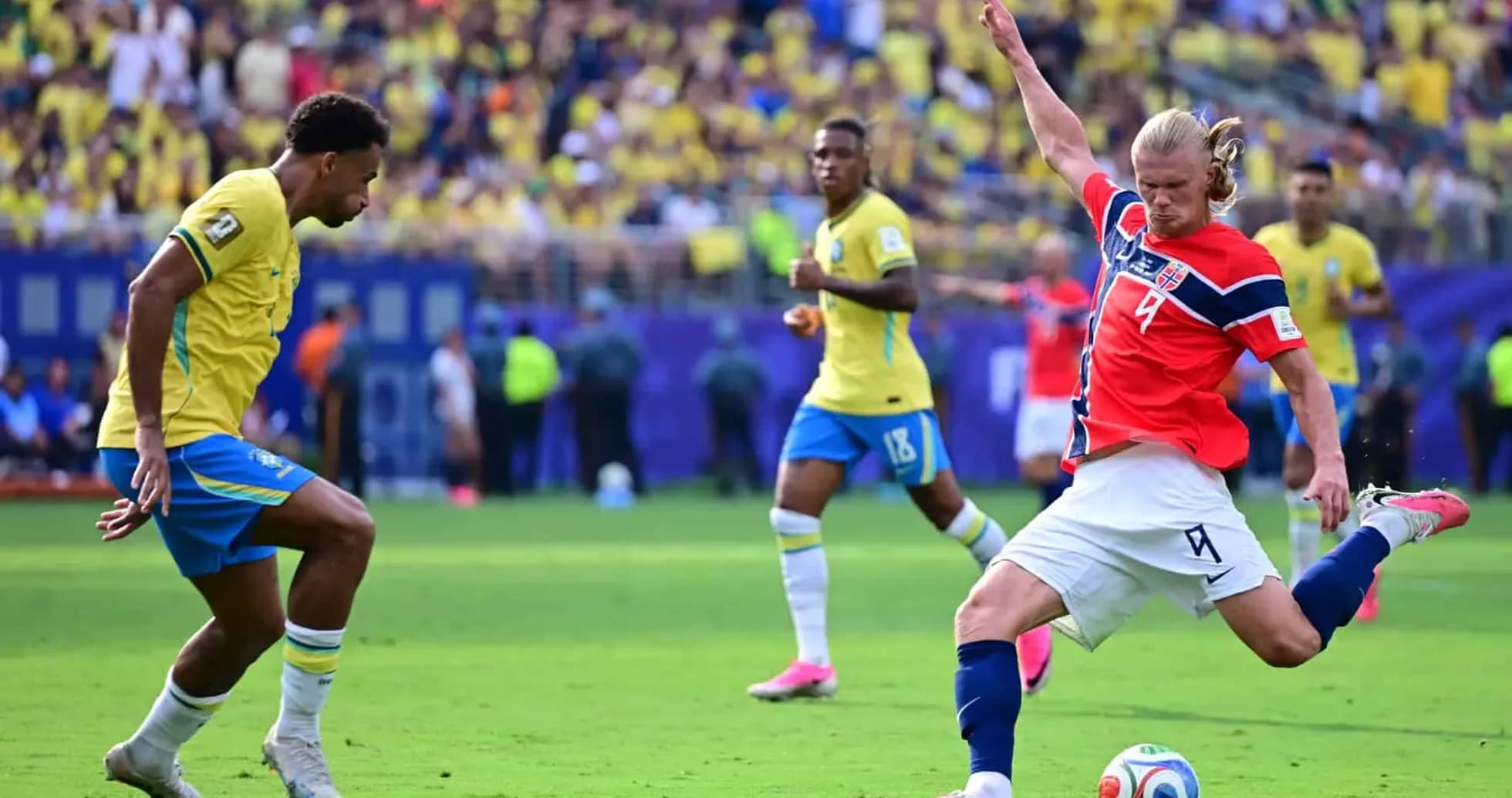
Brazil vs Norway: Tactical Analysis of a World Cup Knockout Match
Under the New Jersey lights of MetLife Stadium, a classic heavyweight met a rising force. Brazil, group winners from Group C with 7 points and a commanding overall goal difference of 6 (7 scored and 1 conceded in the group), arrived in the Round of 16 as a tournament metronome: controlled, largely secure, and with attacking depth spread across the front line. Norway, second in Group I with 6 points and an overall goal difference of 1 (8 scored, 7 conceded), came in as the disruptor, powered by the most devastating individual weapon of this World Cup: Erling Haaland.
Heading into this game, Brazil’s tournament profile was that of a balanced contender. Across the campaign they had played 5 fixtures in total, winning 3, drawing 1 and losing 1. At home venues they had played 4 times, with 2 wins, 1 draw and 1 loss; on their travels they had 1 win from 1. Their attack was steady rather than wild: in total this campaign they had scored 10 goals, with 7 at home and 3 away. That translated to an average of 2.0 goals per game overall, with 1.8 at home and 3.0 on their travels. Defensively, they had conceded just 4 in total – 4 at home, 0 away – an average of 0.8 overall, 1.0 at home and 0.0 away. The numbers painted a side that usually controlled games and rarely collapsed.
Norway’s data sketched a very different, more volatile story. Across 5 fixtures in total, they had 4 wins and 1 defeat, with 2 games at home (1 win, 1 loss) and 3 on their travels (3 wins, no draws, no defeats). Their attack was prolific: 12 goals in total, 4 at home and 8 away, an overall average of 2.4 per game, with 2.0 at home and 2.7 on their travels. But the defensive trade‑off was obvious: 9 goals conceded in total – 6 at home, 3 away – an overall average of 1.8, with 3.0 at home and 1.0 away. Norway were built to outscore you, not to suffocate you.
Tactical Voids and Selection Choices
Carlo Ancelotti’s lineup choice signalled a deliberate shift. Having used 4‑3‑3 most frequently in this World Cup (3 times), with a single outing in 4‑2‑3‑1, he turned to 4‑4‑2 for only the second time in the tournament. Alisson anchored the side behind a back four of Danilo, Marquinhos, Gabriel and Douglas Santos. Across midfield, Rayan, Bruno Guimarães, Casemiro and G. Martinelli formed a flat but flexible band, with M. Cunha partnering Vinicius Junior up front.
The absences told their own tactical story. Brazil were officially without Raphinha and Lucas Paquetá, both ruled out with hamstring injuries. Raphinha’s omission removed a natural wide right outlet who could stretch and threaten in behind. Paquetá’s absence stripped away a creative, press‑resistant interior who normally knits midfield and attack. In response, Ancelotti pushed G. Martinelli into the wide line and trusted Bruno Guimarães as the chief organiser between lines.
On the bench, Brazil still had game‑changing artillery: Neymar, Endrick, Luiz Henrique and I. Thiago offered different flavours of final‑third threat, while Fabinho and Danilo Santos gave options to adjust the midfield’s defensive or box‑to‑box balance. At the back, Leo Pereira, Ibanez, Bremer and Alex Sandro provided cover and the possibility of flipping to a back three if required.
Ståle Solbakken kept Norway close to their tournament identity. They had lined up in 4‑3‑3 four times already, and did so again here. O. Nyland started in goal, behind a back line of J. Ryerson, K. Ajer, T. Heggem and D. Wolfe. The midfield triangle of M. Ødegaard, S. Berge and P. Berg was built for control and vertical service, while the front three of A. Sorloth, Haaland and A. Nusa offered a blend of aerial presence, penalty‑box brutality and dribbling from the left.
Norway’s bench underlined their flexibility. A. Schjelderup – already with 3 assists this tournament – waited as a high‑impact attacking substitute, while F. Aursnes, M. Thorsby, J. Hauge, O. Bobb and T. Aasgaard could all re‑shape the midfield and wide zones. J. Larsen added another central forward option, and L. Ostigard, F. Bjorkan, H. Falchener and S. Langas gave depth across the back line.
Disciplinary profiles coloured the risk map. Brazil’s season card distribution showed yellow cards spread across the match, with a notable late‑game surge: 25.00% of their yellows arriving between 31‑45 minutes, another 25.00% between 61‑75, and 12.50% in each of 0‑15, 46‑60, 76‑90 and 91‑105. Casemiro and Danilo embodied that edge: both had collected 2 yellows in this World Cup, with Casemiro also blocking 4 shots and making 6 interceptions. Norway’s yellows were more concentrated early and just after the break, with 50.00% in the opening 15 minutes and 50.00% between 46‑60, hinting at an aggressive start to each half.
Key Matchups – Hunter vs Shield, Engine Room
The headline duel was unavoidable: Erling Haaland versus Brazil’s defensive structure. Haaland entered this knockout clash with 7 goals in 4 appearances, from 15 shots and 12 on target, plus a striking 8.3 average rating. He had won 18 of 37 duels and drawn 3 fouls, a centre‑forward who doesn’t just finish moves but batters defensive lines.
Brazil’s answer was collective rather than individual. Marquinhos and Gabriel formed the central shield, with Casemiro screening in front. Casemiro’s World Cup so far had included 14 tackles, 4 blocked shots and 6 interceptions, alongside 227 passes at 88% accuracy. His job was as much about preventing Ødegaard and S. Berge from playing into Haaland’s feet as it was about direct duels with the striker.
On the other side, Vinicius Junior and M. Cunha formed Brazil’s “hunter” pairing. Vinicius had 4 goals and 1 assist from 5 starts, with 14 shots (11 on target) and a relentless 36 dribble attempts, 16 of them successful. M. Cunha added 3 goals, 10 shots and 6 tackles, a forward who initiates the press as well as finishing moves. Against a Norway defence that had conceded 9 goals in total – 3 on their travels – and averaged 1.8 goals against per game overall, the Brazilian front two were primed to exploit any looseness in Ajer’s and Heggem’s positioning.
The engine‑room duel pitted Bruno Guimarães against M. Ødegaard. Bruno arrived as one of the World Cup’s premier playmakers: 4 assists, 191 passes at 86% accuracy, 10 key passes, and 11 tackles. Ødegaard answered with 3 assists of his own, 263 passes at a stunning 90% accuracy, 4 key passes and 6 tackles. Where Bruno’s role blended ball‑winning and vertical progression, Ødegaard’s was about tempo and unlocking Haaland’s runs. The side that gave their conductor more stable platforms and second balls was always likely to control the game’s rhythm.
Statistical Prognosis and Tactical Trajectory
Heading into this game, the numbers pointed towards a high‑wire contest rather than a cagey chess match. Brazil’s overall average of 2.0 goals for and 0.8 against suggested they were used to winning by margins, not grinding out 0‑0s. Norway’s overall profile – 2.4 goals scored and 1.8 conceded per game – screamed chaos: they had not kept a single clean sheet in 5 fixtures in total, and had failed to score in none of them.
Penalty data added a layer of jeopardy. Brazil had earned 2 penalties in total this campaign, scoring 1 and missing 1, a 50.00% conversion rate that underlined that their spot‑kicks were no sure thing. Norway had been even more fragile from the spot: 1 penalty in total, missed, for a 0% success rate and 100.00% missed. In a knockout tie where fine margins decide everything, neither side could rely on penalties as a guaranteed edge.
Tactically, the crucial intersection lay between Brazil’s late‑game discipline and Norway’s attacking persistence. Brazil’s yellow‑card spikes around 31‑45 and 61‑75 minutes hinted at phases where their aggression could open doors for Ødegaard’s set‑piece delivery or Haaland’s penalty‑box movement. At the same time, Norway’s tendency to concede – 9 goals in 5 games – against a Brazil side that had failed to score in none of their fixtures in total suggested that Vinicius and Cunha would eventually find space, especially on transitions when Norway’s full‑backs pushed on.
The final scoreline – Brazil 1, Norway 2 – confirmed that the game bent towards Norway’s volatility rather than Brazil’s control. Following this result, the statistical logic holds: a Norwegian side that lives on the edge, led by a prolific Haaland and orchestrated by Ødegaard, managed to drag a defensively solid Brazil into the kind of open, high‑risk exchanges they usually avoid. Brazil’s structure, even with Casemiro’s bite and Bruno Guimarães’ craft, could not fully cage the tournament’s most ruthless hunter.
Related News
Thomas Tuchel Reflects on England's 10-Man World Cup Triumph and a Surprising Regret
Robert Moreno Takes Over as Interim South Korea Coach After World Cup Setback

Jude Bellingham Returns to Form with Real Madrid After World Cup Success

Chloe Kelly, Beth Mead & 13 Lionesses Who Must Shine in the Upcoming WSL Season for England’s 2027 World Cup Bid
Barcelona Cancels World Cup Tribute Amid Political Tensions
Messi Breaks Record for Most Penalties Taken and Missed in FIFA World Cup History