
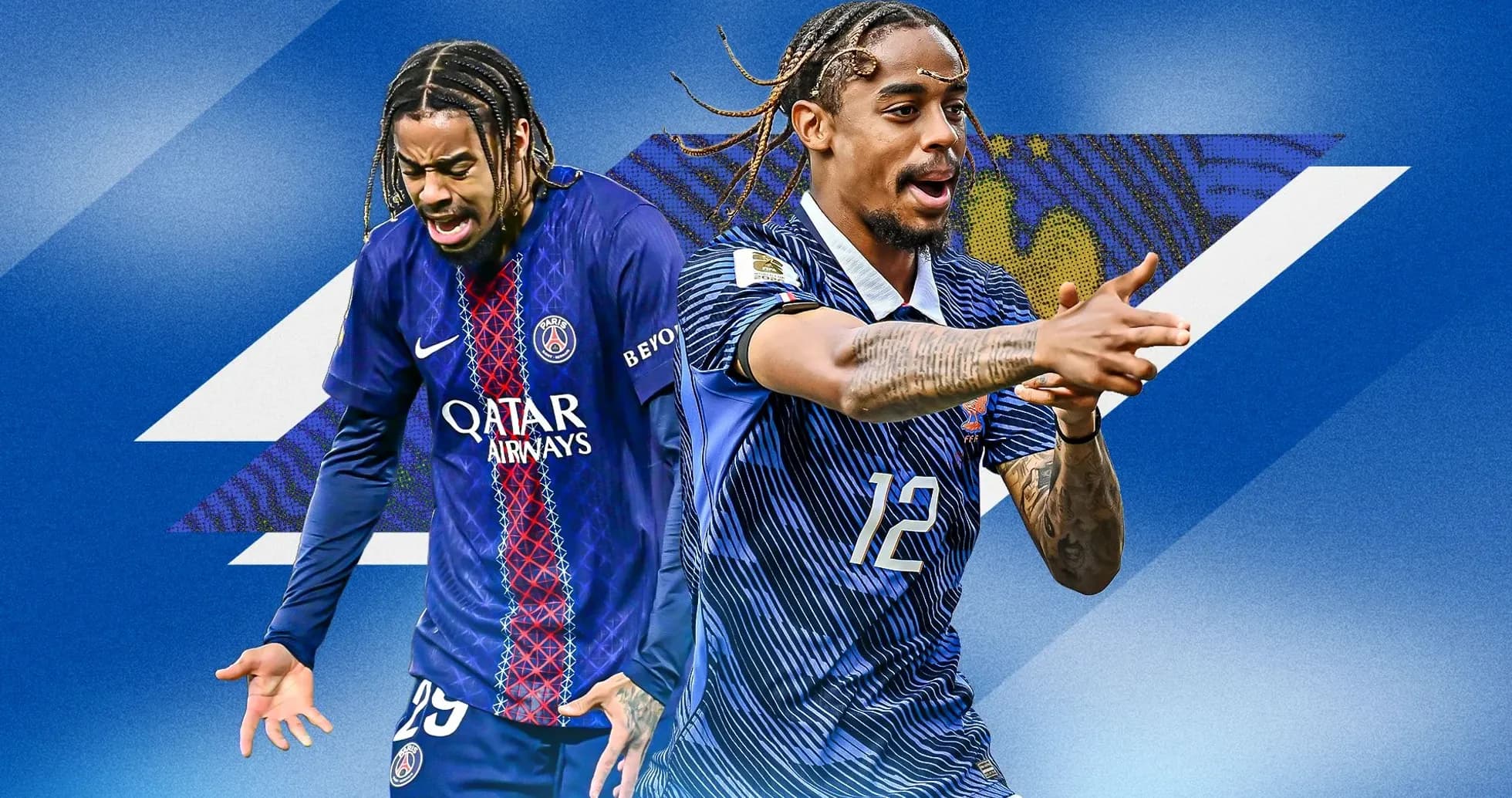
Bradley Barcola's PSG Journey: From Rising Star to Uncertain Future
Three years on from swapping Lyon for Paris, this was not the script Bradley Barcola had in mind.
By 23, he expected to own the left flank at the Parc des Princes, not hover on the margins of the biggest nights, not live in that awkward space between “important squad player” and undisputed starter. Yet that is exactly where one of France’s most gifted wide forwards finds himself — at club level and, increasingly, with his country.
From rising star to rotation piece
Barcola’s first season in Paris was respectable. Fourteen goal contributions, flashes of electricity, the sense of a player growing into a superclub. Then Kylian Mbappé walked out, and the left wing looked like his to inherit.
PSG thought differently.
Desire Doue arrived in the summer of 2024, another precocious left-sided talent. Six months later came the real earthquake: Khvicha Kvaratskhelia, a blockbuster January 2025 signing who instantly recalibrated the attacking hierarchy.
Barcola responded on the pitch. His 2024-25 numbers were outrageous: 21 goals and 21 assists. On paper, that’s the profile of a player you build around. In reality, Luis Enrique often turned elsewhere when it mattered most. Barcola started some big games but rarely finished them, and he watched the Champions League final against Inter slip by without being a central figure.
The pattern hardened last season. His output collapsed to 13 goals and seven assists in 2025-26, and his status followed. Luis Enrique routinely protected his stars for Europe by rotating in Ligue 1. The damning detail? Barcola didn’t start in the Champions League quarter-finals, semi-finals or final of another triumphant campaign, and he was an unused substitute for marquee league fixtures against Lyon and Monaco in the first half of the season.
For a player of his ambition, that stings more than any dip in numbers.
A World Cup in miniature
International football has offered no great escape.
Barcola might reasonably have targeted France’s left wing as his stage, a place to become Les Bleus’ next big thing. Instead, his national-team career has mirrored his club existence: promising, productive, but never fully trusted.
At this World Cup, he began on the bench against a powerful Senegal side. When he did get on, he changed the game, scoring the decisive goal just two minutes after his introduction. It felt like a statement cameo, the kind that forces a manager’s hand.
Didier Deschamps rewarded him with a start against Iraq on matchday two. Barcola couldn’t grab the game in the same way and promptly returned to the bench for the final group match against Norway. Again he responded as a substitute, this time with a beautifully measured cross for Doue’s late header to add shine to the scoreline.
Deschamps went back to him from the start in the last-32 tie with Sweden. Barcola finally produced the kind of ruthless moment that can define a tournament run, lashing home a fine second-half finish while Michael Olise ran the show around him.
He kept his place for the ill-tempered round-of-16 win over Paraguay, but his performance faded into the background. Anonymous, in a game begging for someone to grab it. Now, with Morocco looming in the quarter-finals, his starting spot is under threat again.
His World Cup is playing out like his PSG career: decisive in flashes, decisive from the bench, yet never quite secure.
Contract tension and a shifting stance in Paris
All of this unfolds against a tense backdrop in Paris. Barcola’s contract runs until 2028, but talks over a new deal have stalled. The issue is not money; it’s status. He wants clarity on his place in the pecking order, and PSG cannot offer the assurances he craves.
Earlier in the summer, the club’s position sounded uncompromising. He was “not for sale,” and internally they rated him at a “much higher price” than the £116 million Manchester City paid Nottingham Forest for Elliot Anderson, according to The Athletic. That valuation underlined how highly the European champions still regard his talent, even if they don’t always show it in their team sheets.
Then the mood music changed.
Transfer specialist Fabrizio Romano summed it up bluntly on his YouTube channel: until last week, Barcola was “untouchable.” Now, he said, “Barcola is not untouchable. Barcola has serious possibilities to leave Paris in the summer transfer window.”
Something has clearly shifted. The reason sits in Leipzig.
Diomande, the market shock and PSG’s calculation
RB Leipzig’s Diomande has been one of the breakout stars of 2025-26, a 19-year-old Ivory Coast sensation who has lit up the Bundesliga and Europe. Liverpool were widely reported to be leading the race for his signature, with a deal around €100m being discussed.
Then came the twist: Diomande prefers Paris.
He sees PSG, under Luis Enrique, as the fastest route to trophies and, potentially, the Ballon d’Or. Leipzig, aware of the demand, are said to want around €130m. Even for PSG, that figure bites. Goncalo Ramos has already gone to AC Milan, Lee Kang-in is heading to Atletico Madrid, and the French champions still need to keep their books in order.
Suddenly, a player who was “not for sale” begins to look like a solution.
If Diomande walks through the door, Barcola’s minutes threaten to shrink further. From his perspective, that’s intolerable. From PSG’s perspective, this is a rare chance to cash in on a valuable asset while upgrading to a younger, even more hyped attacking talent.
The equation is brutal but simple: to bring in Diomande, someone significant has to go. Barcola’s name now sits near the top of that list.
Liverpool’s opening
Ironically, Liverpool may end up profiting from losing Diomande.
With Mohamed Salah gone, Anfield needs a new attacking star, someone with pedigree at the highest level and the charisma to carry a forward line in transition. Victor Munoz has already arrived, Rio Ngumoha is a phenomenon in the making, but the teenager does not turn 18 until late August. New manager Andoni Iraola must protect him, not overload him.
Barcola fits the gap almost perfectly.
He is 23, already steeped in Champions League football, used to the pressure of competing for titles and coping with the scrutiny that comes with PSG. At Liverpool, he would not be a rotation piece; he would be a pillar. A guaranteed starter on the left, asked to attack full-backs relentlessly in Iraola’s aggressive, vertical system.
For the club, he offers something Diomande cannot yet guarantee: immediate impact at the very top level. For the player, Merseyside represents exactly what Paris no longer can – a clear runway, a central role, a chance to define a project rather than orbit around one.
It is the sort of transfer that feels clean for all parties. PSG get funds and room for Diomande. Liverpool land a ready-made star. Barcola gets his stage.
“Honestly, I don’t know”
If there was any lingering doubt over how open he is to a move, Barcola removed it with a few candid words at the World Cup.
“Right now, I’m really focused on the World Cup,” he said in a France press conference before facing Paraguay. “But regarding what happens afterward, honestly, I don’t know at the moment.”
No declarations of loyalty. No insistence that he will stay and fight for his place. Just uncertainty, laid bare.
As Diomande edges closer to Paris and the shadows lengthen on Barcola’s role at the Parc des Princes, the choice in front of him sharpens. Remain a luxury option in a team that keeps winning without fully needing him, or walk away in search of a club prepared to build around his talent.
For a player entering his prime, it no longer looks like a tactical dilemma. It looks like a career-defining decision.
Related News
Ilia Topuria Accuses Justin Gaethje After UFC Defeat
Tyson Fury vs Anthony Joshua Fight Date and Venue Confirmed
Switzerland Calls Up In-Form Sion Striker Winsley Boteli for Nations League
Bournemouth Secures Historic 2-1 Win Over Real Sociedad in Spain
Portugal Announces Squad for 2026 UEFA Nations League; Cristiano Ronaldo Expected to Play
Raphinha Channels Ronaldo Nazario as Barcelona's Leading Striker After Position Change