
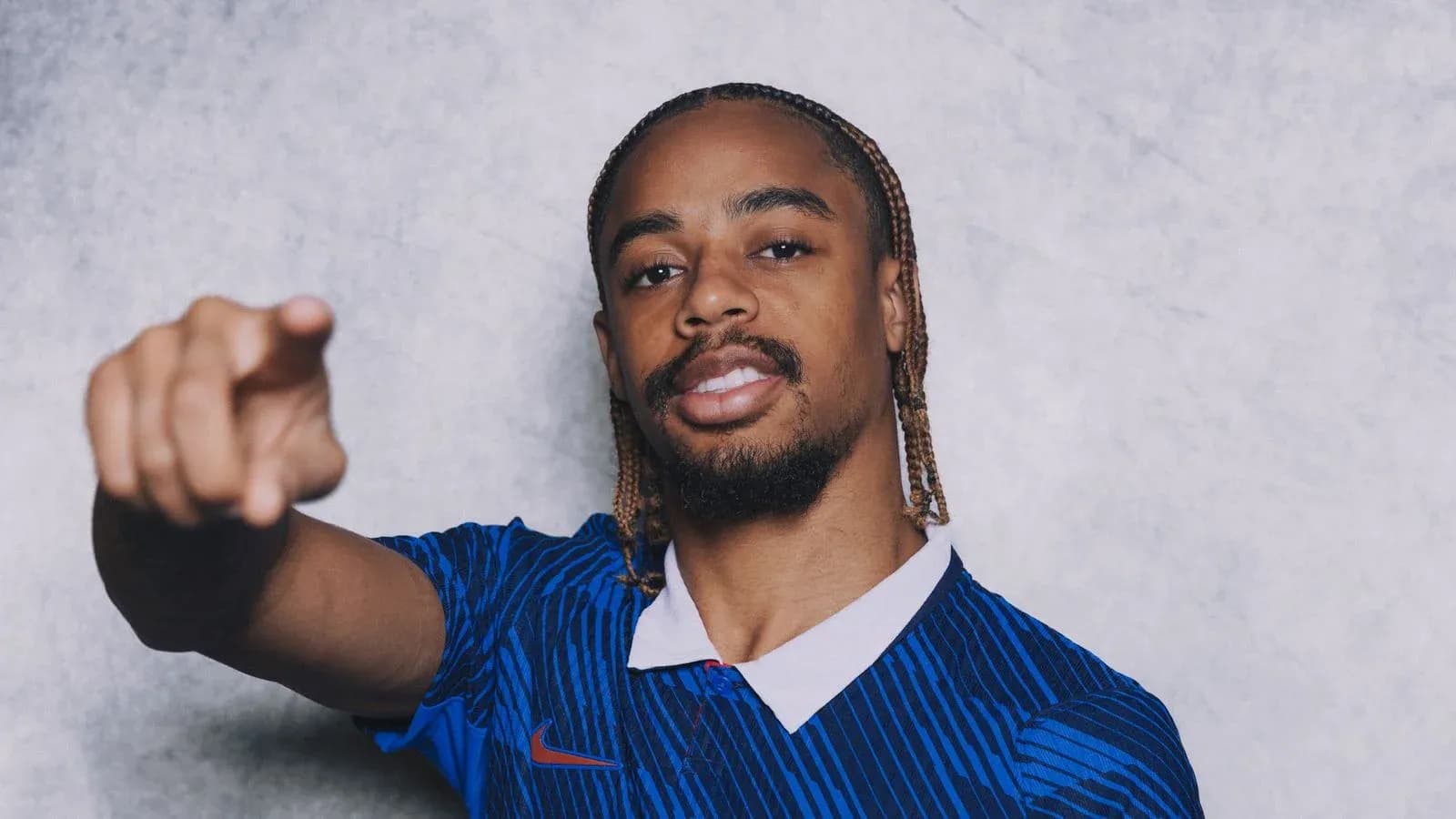
Bradley Barcola: The Rising Star of Champions League Football
Bradley Barcola is about to discover what a Champions League medal really costs.
Liverpool want him. Arsenal want him. Paris Saint-Germain, who have just won Europe’s biggest prize in consecutive seasons, know exactly what they have. The fee being whispered around the market reflects it: if someone pries him from Paris this summer, he could become the most expensive signing of the window.
And yet, he is not even a guaranteed starter for his club.
A Champions League winner in the shadows
Barcola is 23, a France international, and already a back-to-back Champions League winner with PSG. Both finals told a similar story: Barcola on the bench, waiting, then unleashed late on. The decisive role on the left belonged to Khvicha Kvaratskhelia, whose arrival from Napoli in January 2025 shifted the hierarchy in Luis Enrique’s attack.
Being second choice to Kvaratskhelia in a treble-chasing PSG side, though, is not the same as being a squad player elsewhere. Inside the club, they see a forward with pace, power and a sharp football brain, a player Luis Enrique has been steadily refining. Outside, the biggest clubs in England see the same thing – and are ready to pay for the years still to come, not just the trophies already won.
With Barcola, the feeling is simple: the potential is as vast as the price.
The turning point in Lyon
His rise did not follow the usual script for a €100m-level forward. No age-group stardom with France. No stories of him playing three years above his category. At Lyon, he was a good academy prospect, nothing more, progressing step by step.
Jean-François Vulliez, who worked with him at Lyon’s academy and now at PSG as a development coach, remembers how close it came to drifting away. Barcola was on the fringes of Laurent Blanc’s first team, a name on the squad list rather than in the starting XI, when a transfer decision elsewhere changed everything.
Karl Toko Ekambi wanted out. A club in Switzerland had shown interest in Barcola because he was not playing for the first team. Then Lyon pulled the plug on that loan.
Toko Ekambi left. Barcola stayed. One game later, an injury opened a gap. Blanc needed someone. Barcola stepped through.
That was the hinge moment. From there, his season caught fire: five goals in nine games in early 2023, a burst of form that suddenly made sense of all those quiet academy years. After impressing at the European Under-21 Championship that summer, his move to PSG dragged on, but in Vulliez’s words, by then “his body was in Lyon but his head was in Paris.”
A late developer who learned to think first
The player PSG signed was not a finished product, but he was something more interesting: a late developer who had learned to solve problems without leaning on physical dominance.
As a teenager, Barcola was not the powerful runner he is now. He did not bully defenders. He could not. That limitation forced him into a different path. He had to read the game, scan the pitch, understand space. Vulliez talks about him as a player who always took good information, who saw the gaps before others did, who already had the speed but needed time for the rest of his body to catch up.
Lyon gave him that time. They waited for the psychological and physical maturation to arrive, trusting that once it did, his progress would accelerate. It did.
At PSG, under Luis Enrique, the transformation has continued. Across three seasons he has collected 13 trophies and scored 39 goals in over 150 appearances. The raw wide forward who liked to run at defenders has become far more selective. He knows when to dribble, when to combine, when to recycle the ball and wait for a better moment. The chaos has been trimmed; the threat has not.
A winger with a striker’s instincts
On the teamsheet, Barcola is usually a left-sided forward. On the pitch, he often moves like a No 9.
He grew up as a striker at Lyon, playing through the middle until the age of 17, and those habits remain. From the left, he loves to cut inside and whip shots towards the far corner with his stronger foot. The numbers back up the eye test: his shot volume at PSG last season ranked among the top 10 in Ligue 1 per 90 minutes, an unusually high output for a wide player.
Top clubs crave that profile. It is not enough anymore to have wingers who dribble, who look good on the ball but do not decide games. They want wide forwards who live in the box, who attack the back post, who arrive on the blindside of defenders. Barcola brings goals and creativity in roughly equal measure, a balance that drives his value up.
His movement is the key. Because of his time as a striker, he knows when to come inside, when to drift between the lines, when to spin in behind. Coaches can design patterns around that. Give him a full-back overlapping, a midfielder who can find those diagonal passes, and he will repeatedly hit the spaces that hurt.
Intelligence you cannot teach
Vulliez is blunt on one point: the intelligence Barcola shows now is not something you can manufacture late.
He believes that if a player does not show that level of game understanding by 17, it is unlikely to appear later. With Barcola, the intelligence was always there. It just needed the physical side to catch up. That is why he has proved so adaptable. At Lyon’s academy, they never had problems with him tactically. He listened, understood, adjusted.
That trait has followed him to PSG. Luis Enrique has used him primarily on the left, but he has also appeared on the right, stretching defences with pure pace, going to the byline when required, or simply knocking the ball past his man and trusting his legs. He ranked among the top 10 fastest players in the Champions League last season. For defenders, there is no safe option: stand off and he runs at you; get tight and he spins away.
It is the blend that seduces recruiters – tactical awareness, technical quality, physical explosiveness.
The next step: from promise to ruthlessness
For all the excitement, there is still work to do. His finishing can be loose. The chances he creates for himself do not always end with the net bulging. Inside PSG, Luis Enrique has pushed him to become more clinical, to turn volume into efficiency.
History is full of forwards who sharpened their finishing as they matured, and Barcola has time on his side. Vulliez is convinced he has the mentality to make that leap. The question is not whether he improves, but how far that improvement goes.
Right now, the left wing looks like his most natural home. Yet those who know him best are intrigued by the possibility of him eventually becoming a true No 9, a central forward who can link play, spin in behind and finish moves. His flexibility only increases his appeal: he can flip flanks, he can attack through the middle, he can adapt to different systems and different leagues.
How much better can he get?
Strip it back, and you have a player who was once a “normal kid” in Lyon’s academy, never fast-tracked, never hyped, who now stands at the centre of a transfer tug of war between European giants. A player who has already lifted the Champions League twice, yet still fights for his place every week.
He is better than the teenager Lyon nurtured. Better than the exciting prospect PSG signed. Better than the version who first pulled on the France shirt.
As Liverpool, Arsenal and others weigh up whether to go all in, one question keeps surfacing around Bradley Barcola: if this is where he is now, at 23, how much more is still to come?
Related News
Ilia Topuria Accuses Justin Gaethje After UFC Defeat

Tyson Fury vs Anthony Joshua Fight Date and Venue Confirmed
Switzerland Calls Up In-Form Sion Striker Winsley Boteli for Nations League
Bournemouth Secures Historic 2-1 Win Over Real Sociedad in Spain
Portugal Announces Squad for 2026 UEFA Nations League; Cristiano Ronaldo Expected to Play
Raphinha Channels Ronaldo Nazario as Barcelona's Leading Striker After Position Change