
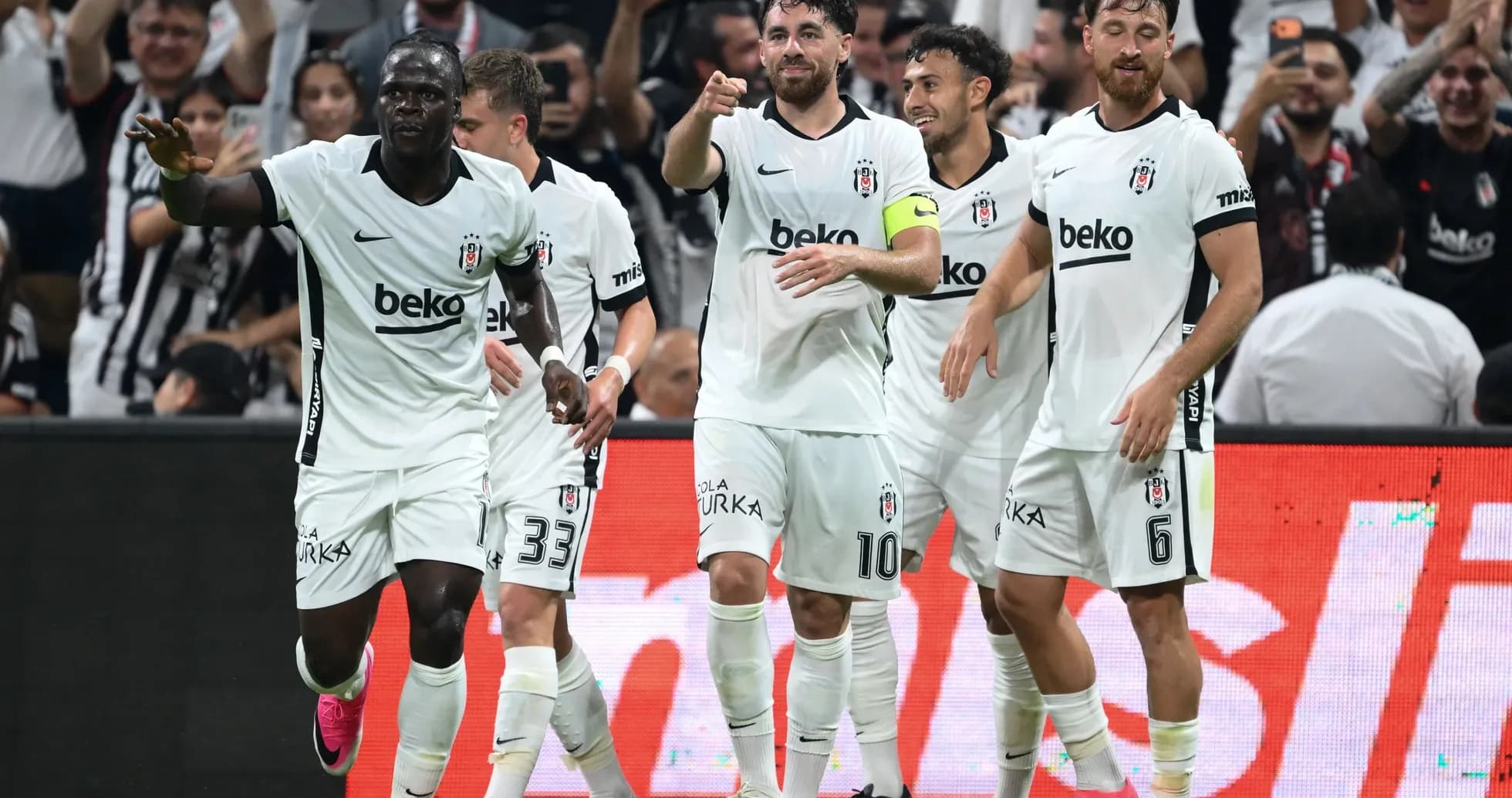
Beşiktaş Dominates FC Midtjylland in Tactical Display
Beşiktaş’s 1-0 win over FC Midtjylland at Tüpraş Stadyumu was a tactical strangling disguised as a narrow scoreline. In this UEFA Europa League 2nd Qualifying Round tie, Vincenzo Italiano’s 4-1-4-1 delivered overwhelming territorial control and chance volume, while Mike Tullberg’s 4-3-3 was forced into survival mode after an early red card. The numbers are stark: 75% possession, 28 total shots and 685 passes for Beşiktaş versus just 5 shots and 237 passes for FC Midtjylland. Yet with only a single goal to show, the story is as much about Midtjylland’s emergency defensive block and goalkeeping resilience as it is about Beşiktaş’s structured dominance.
The game’s tactical hinge arrived on 15 minutes, when Friday Etim’s red card shattered Midtjylland’s initial 4-3-3 plan. Reduced to ten men, Tullberg’s side abandoned any meaningful pressing and collapsed into a deep, narrow block in front of E. Olafsson (FC Midtjylland). The front line ceased to be a pressing unit and became the first line of a low block, with wide forwards tracking back to almost full-back depth. From that moment, the match turned into a half-pitch exercise: Beşiktaş circulating, probing and overloading; Midtjylland compressing space, delaying and clearing.
Beşiktaş’s 4-1-4-1 was built to exploit that scenario. S. Ozcan sat as the single pivot, screening transitions but, crucially, acting as the distributor that allowed the hosts to keep 75% of the ball. Ahead of him, the four-man line of V. Cerny, J. Olaitan, O. Kokcu and I. Fakili operated between Midtjylland’s midfield and defence, constantly rotating positions to unbalance the block. With 606 accurate passes from 685 total, Beşiktaş not only dominated possession but did so with precision, circulating quickly enough to shift the defensive structure and open interior lanes.
The breakthrough on 26 minutes was the logical product of this positional play. O. Kokcu scored the only goal, assisted by V. Cerny, a pattern that underlined Italiano’s intent: wingers and advanced midfielders occupying half-spaces and combining centrally rather than relying solely on crosses. Beşiktaş’s shot profile supports this: 15 shots inside the box and 13 from outside, with 7 on goal and 5 blocked. The volume and variety of attempts indicate a side that could reach the final third at will and then experiment with different finishing angles.
Out of possession, Beşiktaş’s control was equally clear. With the ball almost permanently in Midtjylland’s half, A. Nubel (Beşiktaş) was largely a spectator, called upon for just 1 save. The defensive line of M. Murillo, T. Djalo, E. Topcu and R. Yilmaz held an aggressive starting position near halfway, compressing the pitch and ensuring that any clearance became an immediate second ball for Beşiktaş’s midfield to reclaim. The foul count – 12 for Beşiktaş to 9 for Midtjylland – reflects a home side willing to counter-press and stop the rare transition at source rather than retreat.
For Midtjylland, the tactical story after the red card was pure damage limitation. Their 25% possession and 237 passes (146 accurate) show how little time they spent constructing play. With only 5 total shots – 3 inside the box, 2 outside, and just 1 on goal – they were almost never able to turn their sporadic counters into sustained pressure. When they did escape, it was usually via direct passes into the channels for the lone forward, but with Beşiktaş’s rest defence well-structured around Ozcan and the centre-backs, those moves rarely progressed beyond the first or second action.
Substitutions from Tullberg reinforced the defensive focus rather than altering the basic shape. The introduction of D. Castillo, M. Erlic and Cho Gue-Sung via substitutions reshaped roles but did not change the strategic reality: a compact, low 4-4-1/4-5-0 hybrid, lines close together, minimal risk in possession. The red card, combined with Beşiktaş’s passing rhythm, simply removed the possibility of a proactive press.
Italiano’s changes, by contrast, were about maintaining tempo and energy in the zones that mattered. The rotations involving I. Fakili, Oh Hyeon-Gyu, S. Ozcan, R. Yilmaz and T. Djalo allowed Beşiktaş to keep their intensity in the final third and at the back, ensuring that the hosts’ structure did not sag as fatigue set in. Despite the dominance, however, the finishing efficiency lagged behind the approach play, as reflected in the 16 shots off target and 5 blocked. The lack of cards for Beşiktaş also underlines how controlled their aggression was; they managed 12 fouls without disciplinary punishment.
The statistical verdict is unambiguous about the game’s pattern. Beşiktaş out-shot FC Midtjylland 28–5, with a 7–1 advantage in shots on goal and a 5–3 edge in blocked efforts. They generated 5 corners to Midtjylland’s 2, another marker of territorial control. The passing gap – 685 total passes for Beşiktaş versus 237 for Midtjylland, with 606 and 146 accurate respectively – illustrates not just possession, but a sustained ability to progress and recycle the ball under little pressure.
Defensively, Midtjylland’s resistance hinged on E. Olafsson (FC Midtjylland), who made 6 saves. That figure, against 7 shots on goal, shows how close Beşiktaş came to turning dominance into a multi-goal victory. The red card count – 1 for FC Midtjylland, none for Beşiktaş – was decisive in shaping the tactical landscape, effectively locking the visitors into a reactive posture for 75 minutes. Fouls were relatively balanced (12–9), but the numerical inferiority and lack of yellow cards suggest Midtjylland tried to defend more by position than by persistent breaking up of play.
In summary, this was a textbook example of a possession-heavy 4-1-4-1 exploiting a numerical advantage to suffocate an opponent, yet without the clinical edge to translate statistical superiority into a bigger margin. Beşiktaş leave with a deserved 1-0 win and a strong tactical platform; FC Midtjylland leave knowing that one early dismissal dictated an entire night of containment.
Related News

Celje vs Red Bull Salzburg Predicted Lineups and Team News

Anderlecht vs Red Bull Salzburg Predicted Lineups and Team News
NEC Nijmegen vs Benfica Predicted Lineups: Team News for UEFA Europa League
Plzen vs Benfica Predicted Lineups: Team News Ahead of UEFA Europa League

Benfica vs Lech Poznan Predicted Lineups and Team News

Benfica vs OFI: Predicted Lineups and Team News for UEFA Europa League