
Bellingham's Incident After England's World Cup Loss
The final whistle had barely finished echoing around Mercedes-Benz Stadium when the simmering tension finally snapped.
Jude Bellingham, already seething after England’s 2-1 World Cup semi-final defeat to Argentina, found himself at the centre of an ugly flashpoint that now threatens to follow him into the final days of the tournament.
A handshake, a comment, a slap
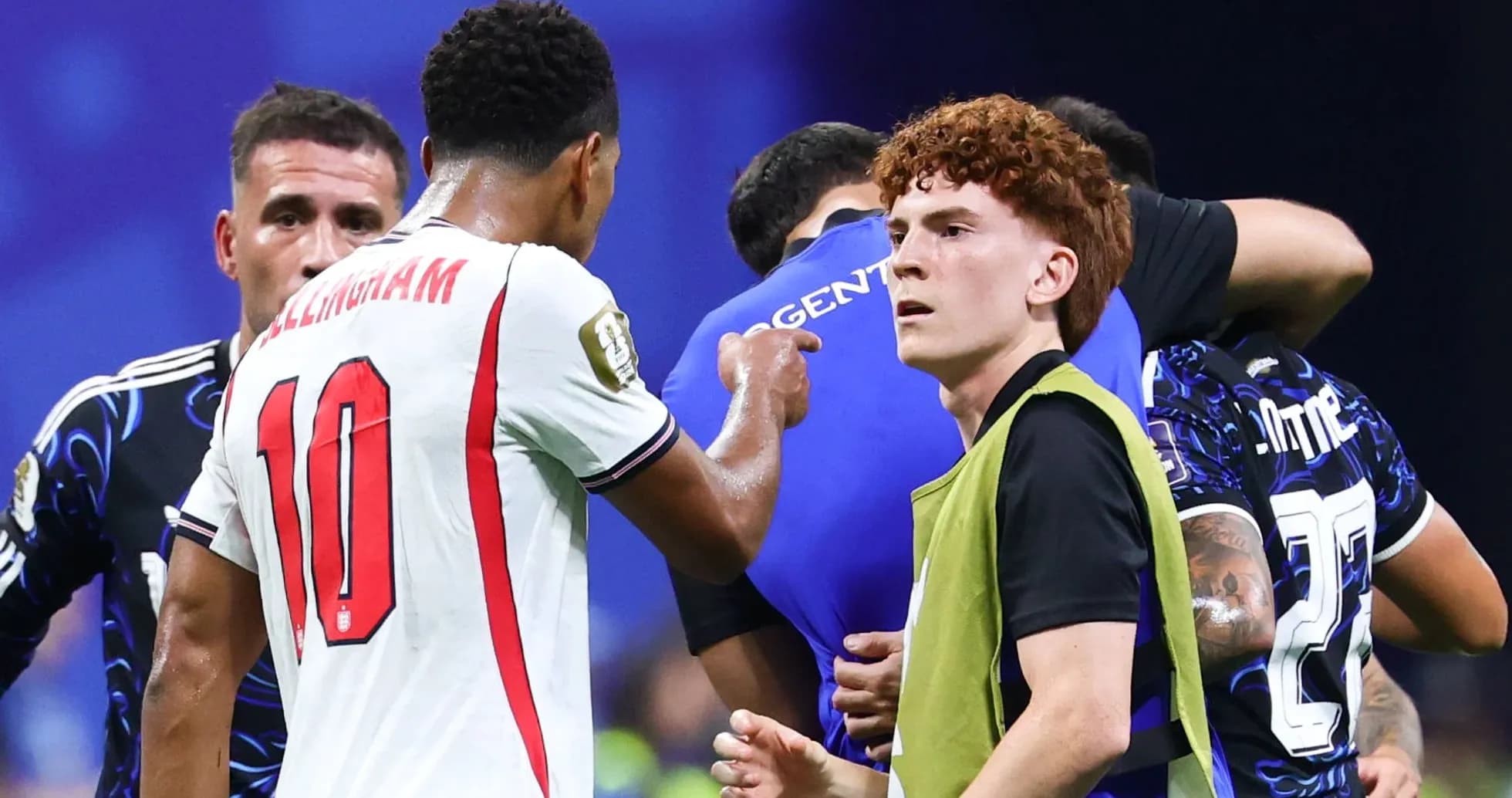
Fresh footage from the stands has shed light on the incident that saw Bellingham slap Valentin Barco on the back of the head in the post-match chaos.
The Real Madrid midfielder was making his way through the traditional handshake line, stopping to greet an Argentina reserve goalkeeper, when Barco stepped in and appeared to say something within earshot. Bellingham, fluent in Spanish after his time in La Liga, reacted instantly. No hesitation. He turned and struck the former Brighton man on the back of the head.
Barco shoved him back. Tempers spiked. Nicolas Otamendi, never one to stand far from a confrontation, charged into the scene. England goalkeepers James Trafford and Dean Henderson moved quickly to separate the players, while Ollie Watkins dragged a furious Bellingham away before things spiralled further.
It was a brief incident, but it captured the mood of an England camp that had watched their World Cup dream ripped away in stoppage time.
Barco the irritant, even from the bench
Barco never kicked a ball in the semi-final. He didn’t need to.
The Strasbourg full-back, expected to join Chelsea this summer, operated as Argentina’s chief irritant from the touchline and beyond. Video from the stands showed him sprinting onto the pitch after Enzo Fernandez’s equaliser, celebrating directly in the faces of the England players. No disguise, no attempt to rein it in. Pure provocation.
By then, the emotional temperature was already soaring. Bellingham had been a magnet for Argentina’s aggression all night. Leandro Paredes escaped a booking for a heavy challenge on the 23-year-old. Cristian Romero, true to type, celebrated a clearance almost on top of Bellingham, roaring in his direction as if it were a goal.
Those small moments stack up. The shove, the glare, the late tackle. When Lautaro Martinez’s stoppage-time header confirmed England’s elimination, the pressure finally burst.
Tactical gamble that backfired
Beneath the flashpoints and fury lay a more familiar English story: a lead squandered, a game plan that unravelled.
Anthony Gordon had put England ahead, a breakthrough that seemed to tilt the night in their favour. At that point, they were front-footed, confident, dictating the rhythm. Then came the turning point on the touchline.
Thomas Tuchel, sensing the magnitude of the occasion, chose to protect the advantage. He shifted to a defensive back five, an attempt to close the game down and see it out. Instead, the decision dragged England backwards.
The world champions smelled hesitation. Argentina pushed higher, squeezed the midfield, and began to own the ball. England’s attacking threat thinned out. They stopped pressing with conviction and started defending space, not moments.
Tuchel did not hide from it afterwards, accepting full responsibility and admitting the change made his team “passive” at the exact moment they felt they had everything to lose. Argentina needed no second invitation. Fernandez levelled. Martinez delivered the dagger in stoppage time.
Bellingham’s anguish and a possible ban
In the middle of it all stood Bellingham, the face of this England side and its emotional barometer.
He fronted up after the game, speaking directly to the travelling support who had come in hope of seeing history made, 60 years on from 1966. He talked about experience, about lessons, but the overriding note was raw regret.
He admitted how “gutting” it felt to be repeating the same consoling lines England fans have heard for generations, instead of celebrating the moment they had all craved. He wanted to be part of the squad that finally “got it over the line”. Instead, he was left explaining another near-miss.
Now, even the consolation prize is under threat.
The clash with Barco went unnoticed by the match officials, but the clarity of the video footage changes the picture. FIFA can intervene retrospectively, and Bellingham could face a fine or a suspension. If the governing body decides to act, England’s talisman may be ruled out of Saturday’s third-place play-off against France in Miami.
For a side already nursing bruised pride and heavy legs, losing their standout performer of the tournament would be a brutal late twist.
A World Cup run at risk of being overshadowed
Across the past month, Bellingham has been one of the World Cup’s defining figures, driving England through games with authority and maturity beyond his years. His performances have underpinned their best run since 2018 and put them within touching distance of a first final since 1966.
Now, that body of work is at risk of being overshadowed by a few seconds of red mist.
England must pick themselves up quickly. A bronze medal match may never match the allure of a final, but a podium finish would still mark their best World Cup placing since lifting the trophy 60 years ago. It would also offer a measure of closure to a group that believed it was capable of more.
Argentina, meanwhile, march on to MetLife Stadium for a heavyweight final against Spain, fuelled by the same edge and streetwise aggression that boiled over in front of the England players.
For Bellingham and England, the question is stark: does this World Cup end with a statement of resilience in Miami, or with their leader watching from the stands, left to replay one impulsive moment in his mind?
Related News
Ilia Topuria Accuses Justin Gaethje After UFC Defeat

Tyson Fury vs Anthony Joshua Fight Date and Venue Confirmed
Switzerland Calls Up In-Form Sion Striker Winsley Boteli for Nations League
Bournemouth Secures Historic 2-1 Win Over Real Sociedad in Spain
Portugal Announces Squad for 2026 UEFA Nations League; Cristiano Ronaldo Expected to Play
Raphinha Channels Ronaldo Nazario as Barcelona's Leading Striker After Position Change