
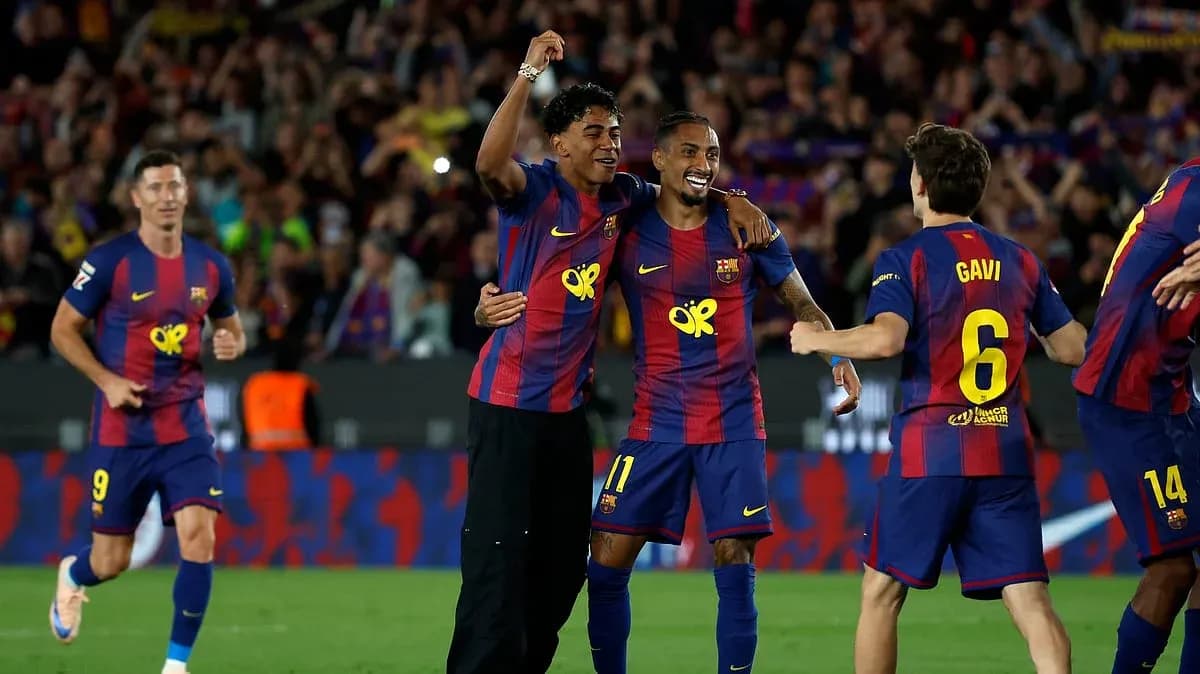
Barcelona vs Real Madrid: Tactical Breakdown of the 2-0 Clash
Camp Nou under the lights, La Liga’s title race framed by the old rivalry, and a 2–0 scoreline that felt as definitive as it looked. Following this result, Barcelona’s season-long dominance at home met Real Madrid’s resilience on their travels – and the league table simply reflected what unfolded on the pitch: first against second, 91 points against 77, and a gulf in cohesion that mattered more than any single moment.
I. The Big Picture – Two 4-2-3-1s, one superior machine
Both coaches mirrored each other on the board with a 4-2-3-1, but the systems carried very different identities.
Hansi Flick doubled down on Barcelona’s season-long blueprint. Heading into this game, Barcelona had played 35 league matches, winning 30 overall and astonishingly taking all 18 at home. At Camp Nou they were averaging 3.0 goals for and only 0.5 against, a home goal difference of +45 built on relentless attacking and controlled risk. That DNA was visible from the first whistle: J. Garcia as a calm distributor in goal, a back four of J. Cancelo, P. Cubarsi, E. Garcia and G. Martin pushing high, with Gavi and Pedri forming a double pivot that was more about circulation and counter-press than sitting deep.
Ahead of them, the three of M. Rashford, Dani Olmo and Fermín played narrow and fluid behind Ferran Torres. It was less a rigid 4-2-3-1 and more a rotating box of creators, with Rashford and Olmo constantly swapping half-spaces and Fermín timing his underlapping runs to disturb Real Madrid’s centre-backs.
Alvaro Arbeloa’s Real Madrid also lined up 4-2-3-1, but theirs was a compromise shaped by absences. T. Courtois anchored a back four of T. Alexander-Arnold, R. Asencio, A. Rudiger and F. Garcia. In front, E. Camavinga and A. Tchouameni formed a muscular double pivot, with B. Diaz and Vinicius Junior flanking J. Bellingham behind G. Garcia.
Heading into this game, Real Madrid’s season profile on their travels was strong but not overwhelming: 10 away wins, 4 draws and 4 defeats, with 1.7 away goals for and 1.1 against. In total this campaign, their goal difference of +37 (70 scored, 33 conceded) spoke of balance, but not the kind of crushing superiority Barcelona had shown at home. At Camp Nou, that difference in ceiling became stark.
II. Tactical Voids – The weight of absences and discipline
Both sides were missing structural pieces, but the nature of those absences shaped the narrative.
For Barcelona, A. Christensen and Lamine Yamal were ruled out, Christensen with a knee injury and Yamal with a thigh problem. Christensen’s absence removed a calm, experienced presence from the back line, forcing Flick to lean fully into youth with P. Cubarsi and E. Garcia. Yamal’s absence was more tactical: Barcelona lost their most explosive 1v1 winger and league-leading creative force (16 goals and 11 assists in total this campaign), which might have tempted a more conservative plan. Instead, Flick re-routed the creativity through the middle – Pedri and Dani Olmo became the primary zone 14 architects, while Rashford attacked space rather than hugging the touchline.
Real Madrid’s voids were brutal in volume and profile. D. Carvajal (toe injury), Eder Militao, A. Guler, K. Mbappe, F. Mendy, Rodrygo and F. Valverde all missed out, along with D. Ceballos by coach’s decision. That stripped Arbeloa of his first-choice right-back, two elite ball-carrying forwards, a high-volume creator, and Valverde’s all-action engine. It forced Alexander-Arnold to balance attacking instincts with emergency defending, while B. Bellingham had to carry too much of the creative and emotional load.
Disciplinary patterns added another layer. Heading into this game, Barcelona’s yellow-card curve peaked between 46–60 minutes at 27.59% and again late at 76–90 minutes with 20.69%, a sign of an aggressive pressing side that risks fouls as fatigue and game state intensify. Real Madrid’s yellows were more evenly spread, with 22.06% between 61–75 and 17.65% in both the 46–60 and 76–90 ranges, hinting at a team that often ends up firefighting in the second half. At Camp Nou, that translated into Madrid chasing shadows, then contact, as Barcelona controlled rhythm and territory.
III. Key Matchups – Hunter vs Shield, Engine Room vs Enforcer
The headline duel was always going to be Ferran Torres against Real Madrid’s defensive structure. In total this campaign, Barcelona had scored 91 league goals, with Ferran contributing 16. He is not a pure penalty-box poacher; he thrives on timing, arriving into spaces created by others. Against a back line missing Militao and Mendy, with A. Rudiger forced to cover wide spaces and R. Asencio stepping into a major role, Ferran’s movement between the lines was a constant problem. Real Madrid’s overall defensive record of 33 goals conceded in total this campaign was solid, but without their full complement of defenders, the shield was thinner than the numbers suggested.
Behind Ferran, the true “hunter” in creative terms was Pedri. With 8 assists in total this campaign, a 91% pass accuracy and 59 key passes, he orchestrated Barcelona’s tempo. His duel with A. Tchouameni and E. Camavinga defined the midfield battle. Tchouameni’s job was to step out and disrupt; Camavinga’s to shuttle and cover. But with Dani Olmo and Fermín also operating between lines, Madrid’s double pivot was constantly overloaded. The “engine room” became a Blaugrana workshop, with Gavi and Pedri dictating where the game was played.
On the flanks, M. Rashford against T. Alexander-Arnold was a study in risk and reward. Rashford, with 8 goals and 7 assists in total this campaign, attacked the space behind Alexander-Arnold whenever Madrid’s right-back advanced. Each Madrid foray forward opened a channel for Barcelona’s transition, forcing A. Rudiger into repeated lateral sprints and leaving G. Garcia often isolated up front, cut off from clean service.
Vinicius Junior, with 15 goals and 5 assists in total this campaign, was Madrid’s primary outlet. But without Mbappe or Rodrygo to share defensive attention, Barcelona could tilt their block towards him. J. Cancelo and G. Martin narrowed the corridors, while Gavi and Fermín collapsed onto his first touch. The Brazilian still carried threat, but the support structure around him was thinner than usual.
IV. Statistical Prognosis – Why 2–0 felt inevitable
Strip away the emotion and the numbers point in one direction. Heading into this game, Barcelona’s overall goal difference of +60 (91 scored, 31 conceded) and flawless 18-win home record built an aura of inevitability. They averaged 2.6 goals in total this campaign and conceded only 0.9, while keeping 15 clean sheets overall. Real Madrid’s profile – 2.0 goals for and 0.9 against in total this campaign, with 12 clean sheets – was that of a high-level contender, but not an unstoppable force.
Even without explicit xG figures, the structural indicators are clear. Barcelona’s volume of goals, variety of scorers (Ferran, R. Lewandowski, Raphinha, Rashford, Fermín, Yamal when fit) and penalty perfection – 7 scored from 7 in total this campaign, with no misses – point to a side that consistently manufactures high-quality chances. Real Madrid’s attack, while spearheaded by elite talents like Vinicius and the absent Mbappe, was heavily compromised by injuries in this fixture.
Following this result, the 2–0 at Camp Nou felt less like an upset and more like the logical outcome of two trajectories. Barcelona’s 4-2-3-1, honed across 25 league matches in that shape, functioned as a synchronized press-and-play machine. Real Madrid’s 4-2-3-1, used only 9 times in total this campaign, looked more like an adaptation born of necessity.
In a season where details define margins, Barcelona’s structural continuity, home invincibility and depth of creative options made them overwhelming favourites. The scoreboard simply confirmed the story the numbers had been telling all along.
Related News

LaLiga 2026-27 Season Schedule Released: Kickoff on August 15, Clásico on October 25
Atletico Madrid vs Real Madrid: Head-to-head Stats and Past Meetings
Real Madrid Dominates Rayo Vallecano in La Liga Clash
Atletico Madrid Dominates Real Sociedad 3-0 at Reale Arena
Barcelona Dominates Levante in High-Scoring Clash

Sevilla vs Barcelona Stats: Head-to-Head Record and Past Meetings