
Barcelona Dismantles Racing Santander 7-2 in La Liga Clash
Under the lights of Camp Nou, this Regular Season - 6 clash in La Liga felt less like a contest and more like a statement. Barcelona, already top of the table, dismantled Racing Santander 7-2, a scoreline that perfectly mirrors the broader trajectories of both squads this season.
Heading into this game, Barcelona sat 1st with 18 points from 6 matches, a perfect record built on 28 goals scored and just 6 conceded overall. That is a staggering overall goal difference of +22, and it is no statistical mirage: they have averaged 4.7 goals per match both at home and on their travels, while allowing just 1.3 at home and 0.7 away. Racing arrived in Barcelona as a far more fragile proposition: 10th in the table with 7 points from 6 matches, 11 goals scored and 16 conceded overall for a goal difference of -5. At home they have been competitive, but away they had lost all 3 matches, scoring 4 and conceding 11. Camp Nou was always likely to be unforgiving.
I. The Big Picture – Structures and Seasonal DNA
Hansi Flick stayed loyal to Barcelona’s new-age identity with a 4-3-3 that is as aggressive as the numbers suggest. J. Garcia anchored the side in goal, protected by a back four of J. Cancelo, G. Martin, A. Christensen and E. Garcia. In front of them, a midfield trio of Rodri, Pedri and Dani Olmo offered a rare blend of control, incision and vertical running. Up front, the front three of Lamine Yamal, Raphinha and K. Adeyemi looked like a pure chaos machine on paper – and played like one on the pitch.
On the opposite bench, Jose Lopez chose a 4-1-3-2 for Racing Santander, a bolder set-up than their usual 4-2-3-1. J. Agirrezabala started in goal, with a back line of A. Martin, F. Gonzalez, Pedro Felipe and Manu Hernando. M. Prati sat deepest, trying to screen a line of three in midfield – I. Sainz-Maza, M. Gueye and S. Canales – behind the strike pair A. Villalibre and J. Arana.
The problem for Racing was structural as much as individual. They walked into the stadium with an away defensive record of 3.7 goals conceded per match and no clean sheets anywhere this season. Barcelona, by contrast, had failed to score in none of their league outings and had already recorded 3 clean sheets overall. The 7-2 scoreline was less an anomaly than an acceleration of existing trends.
II. Tactical Voids – Absences and Discipline
Both managers had to navigate notable absences. Barcelona were without R. Bardghji and F. de Jong, both sidelined by knee injuries. De Jong’s absence, in particular, removed a natural press-resistant pivot, placing even more responsibility on Rodri to dictate tempo and cover transitions.
For Racing, the gaps were even more destabilising. André Almeida was suspended due to a red card, while S. Eriksson and another A. Martin (a different profile from the starting full-back A. Martin) were ruled out with shoulder and knee injuries respectively. Losing Almeida’s defensive presence in midfield, especially against a side that thrives between the lines, forced Lopez into a more makeshift balance with M. Prati as the lone shield.
Discipline has been a quiet subplot of both seasons. Barcelona’s yellow cards this campaign have clustered heavily between 46-60 minutes, with 62.50% of their bookings coming in that window – a sign of an aggressive reset after half-time. Racing, by contrast, spread their cautions more evenly, but their single red card this season has arrived late, between 76-90 minutes. That late-game volatility framed a narrative where Racing not only tire defensively but also lose control just as opponents ramp up pressure.
III. Key Matchups – Hunter vs Shield, Engine Room Battles
The headline act was always going to be the duel between Barcelona’s devastating right side and Racing’s left defensive channel.
Raphinha, the league’s top scorer heading into this match with 9 goals and 3 assists, came in as a complete wide forward: 17 shots, 13 on target, 14 key passes and 84% passing accuracy overall. Alongside him, Lamine Yamal had 7 goals and 2 assists, with 44 attempted dribbles and 22 key passes, functioning as both winger and playmaker. Together, they are less a flank and more a storm front.
Up against them, Racing’s defensive record away from home – 11 goals conceded in 3 matches – always looked brittle. The 4-1-3-2 shape left M. Prati isolated as the single pivot, often dragged sideways by Barcelona’s rotations. With Rodri and Pedri stepping into half-spaces and Cancelo underlapping, Racing’s back four were repeatedly forced into emergency defending, often without the time to set their line.
In the engine room, Rodri and Dani Olmo quietly dictated the script. Olmo arrived with 3 assists from just 245 minutes, completing 94% of his passes and creating 11 key passes overall. His ability to receive between lines and immediately connect with Lamine Yamal or Adeyemi turned Racing’s midfield into a corridor rather than a barrier.
For Racing, S. Canales tried to be the creative counterweight, but the lack of compactness behind him meant that his forays left even more space for Barcelona’s counters. Up front, the most dangerous profile in the Racing squad this season has actually been on the bench: M. Zabiri, with 6 goals, 3 yellow cards and a reputation for direct, physical attacking. His presence among the substitutes underlined the tactical gamble: Racing tried to start with structure and hold Zabiri as a chaos option, but the game was already running away from them by the time his profile might have mattered.
IV. Statistical Prognosis – What the Numbers Foretold
Barcelona’s overall attacking output – 4.7 goals per match, with their biggest home win already a 7-2 scoreline – made a multi-goal victory the most likely outcome even before kick-off. Their penalty record this season, 5 awarded with 4 scored and 1 missed, shows they are not flawless from the spot, but they simply create so many high-quality chances that the occasional miss barely dents their expected scoring curve.
Racing’s numbers painted the opposite picture. An overall average of 1.8 goals scored per match is respectable, but the 2.7 conceded on average, and specifically 3.7 conceded away, suggested that any open game at Camp Nou would tilt heavily towards the hosts. Their penalty record – 2 taken, 1 scored and 1 missed – mirrors a broader inconsistency in execution in big moments.
In the end, the 7-2 result felt like the statistical script playing out in fast-forward. Barcelona’s front three overwhelmed Racing’s fragile away structure, the midfield control of Rodri, Pedri and Olmo smothered any hope of sustained counters, and the absence of Almeida’s defensive bite in the visitors’ midfield left J. Agirrezabala exposed.
Following this result, Barcelona’s aura at the top of La Liga is not just about points and goal difference; it is about a squad whose individual metrics – from Raphinha’s ruthless finishing to Lamine Yamal’s creative volume – align almost perfectly with a collective system designed to overwhelm. Racing Santander, meanwhile, leave Camp Nou with their away frailties brutally underlined, and with a clear tactical mandate: tighten the midfield shield, or continue to suffer whenever they step onto the road.
Related News

Barcelona Dismantles Racing Santander 7-2 in La Liga Clash

Atletico Madrid's Dominance Shines in 4-0 Victory Over Osasuna
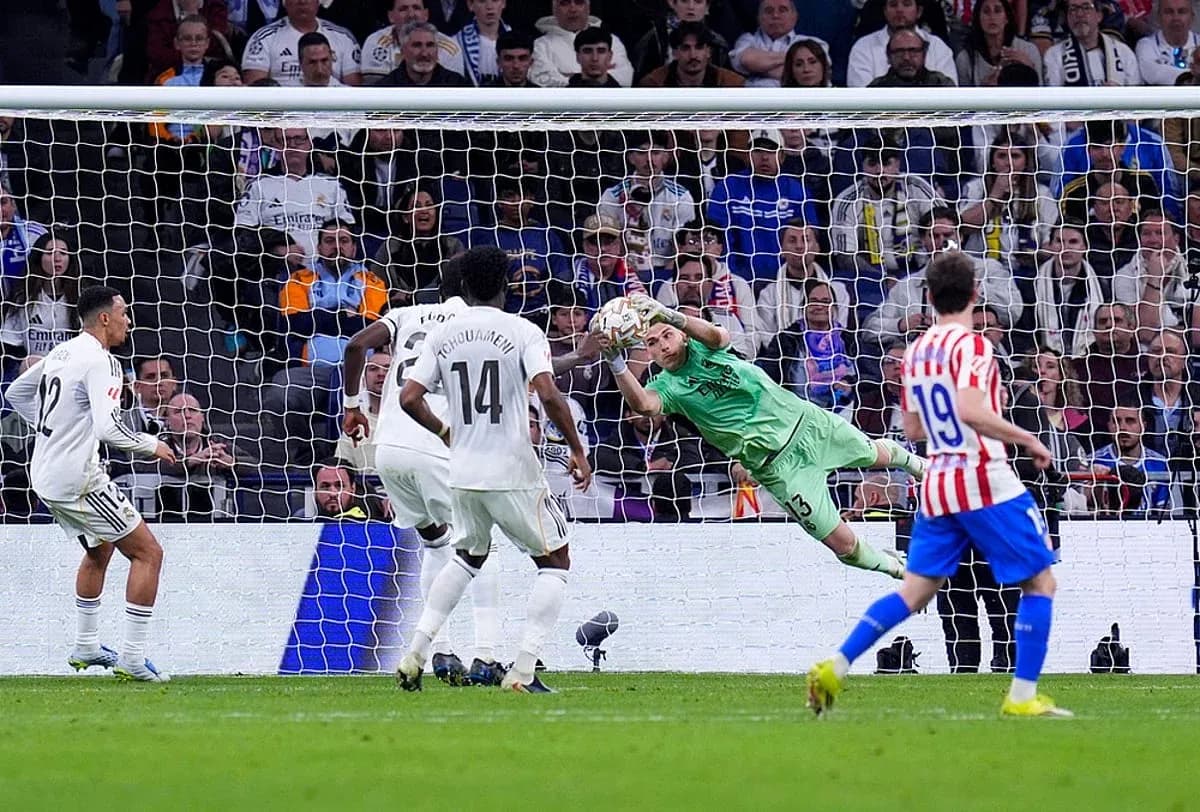
Atletico Madrid vs Real Madrid Predicted Lineups: Team News for La Liga Derby

Sevilla vs Barcelona Predicted Lineups: Team News for La Liga Clash

Atletico Madrid vs Real Madrid: La Liga Derby Preview

Sevilla vs Barcelona: La Liga Showdown on September 19, 2026