
Atletico Madrid Triumphs Over Real Madrid in Tactical Derby
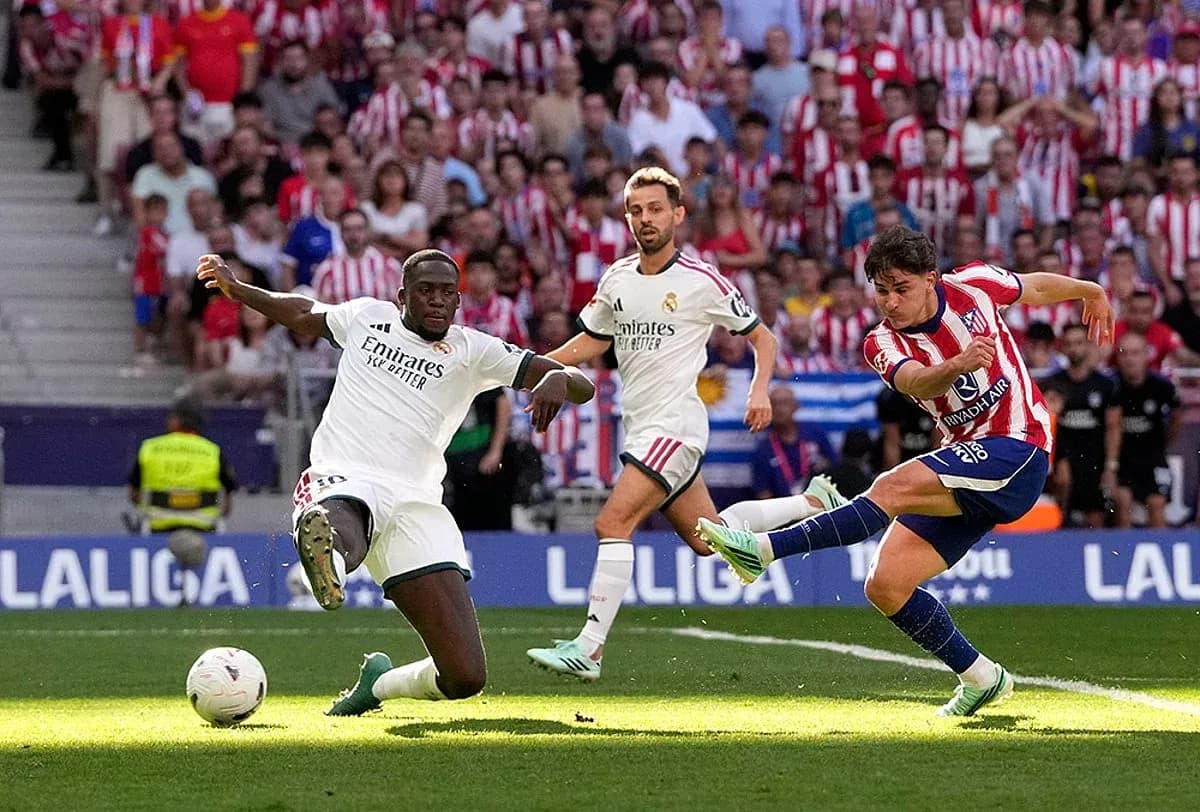
Under the Riyadh Air Metropolitano lights, this derby was less a spectacle of chaos and more a masterclass in control. Atletico Madrid’s 2–1 win over Real Madrid did not just tilt the city’s balance; it confirmed a clear tactical identity and exposed fissures in José Mourinho’s evolving side.
I. The Big Picture – Two contenders, two different truths
Heading into this game, Atletico sat 2nd in La Liga with 16 points from 7 matches. Their overall goal difference was 9, built from 16 goals scored and 7 conceded. At home they had been imposing: 4 matches, 3 wins, 1 draw, 10 goals for and only 3 against, averaging 2.5 goals scored and 0.8 conceded at the Metropolitano.
Real Madrid arrived 4th with 15 points from 7 matches, their overall goal difference slightly better at 10 (18 scored, 8 conceded). At the Bernabéu they had been devastating – 12 goals in 3 home games, an average of 4.0 – but on their travels the picture was more fragile: 4 away matches, 2 wins and 2 defeats, 6 goals scored and 6 conceded, an away average of 1.5 goals for and 1.5 against.
This derby, then, was the collision of Atletico’s home certainty with Real’s split personality: irresistible at home, vulnerable away.
Diego Simeone leaned into his roots with a 4-4-2, but the names told a story of evolution. Jan Oblak behind a back four of Marc Pubill, C. Romero, Dávid Hancko and Álex Grimaldo; a midfield of G. Simeone, Marcos Llorente, J. Cardoso and Álex Baena; and a mobile front pair of Lee Kang-In and Jonathan David. It was classic Simeone structure, modernised with technical full-backs and playmaking between the lines.
Mourinho’s Real Madrid stayed faithful to a 4-2-3-1 that has been a constant this season. Thibaut Courtois in goal; a back four of Denzel Dumfries, Ibrahima Konaté, Dean Huijsen and Marc Cucurella; a double pivot of Fede Valverde and Aurélien Tchouaméni; and an attacking band of Arda Güler, Jude Bellingham and Vinícius Júnior behind Kylian Mbappé.
II. Tactical Voids – Who was missing, and what that changed
Both coaches had to navigate significant absences.
Atletico were without P. Barrios and A. Sorloth, both out with muscle injuries. Barrios’ absence removed a natural connector in midfield, forcing Simeone to trust Cardoso as the metronome and lean more heavily on Llorente’s two-way running. Sorloth’s injury meant there was no classic reference No. 9, pushing Simeone towards a more fluid, pressing-oriented front with Lee and David.
Real Madrid’s absences were more structural. Eder Militao (hamstring injury) and Ferland Mendy (hip injury) stripped Mourinho of his most aggressive centre-back and his natural left-back. Huijsen stepped in alongside Konaté, while Cucurella provided width and ball progression but less pure defensive dominance than Mendy. Rodrygo’s knee injury removed a vertical runner from the right, compelling Mourinho to field Güler as a more creative, ball-to-feet option.
Disciplinary trends framed the risk profiles. Atletico, across the season, had shown a tendency to pick up yellow cards early and around the break, with 30.77% of their yellows coming between 31–45 minutes and 23.08% between 46–60. They also carried the memory of a late red – 100.00% of their red cards arriving between 76–90 minutes – a reminder of how emotional their finishes can become.
Real’s card map was more stretched but just as telling. They had a red card in the 46–60 minute window and yellow spikes between 46–60 and 61–75 minutes (25.00% in each range). In a derby where tempo often surges after the interval, that pattern hinted at a second-half storm.
III. Key Matchups – Hunter vs Shield, Engine Room vs Enforcer
The headline duel was obvious: Kylian Mbappé versus Atletico’s defensive shield.
Mbappé came into the fixture as one of the league’s most lethal forwards: 7 goals and 2 assists in 7 appearances, with 32 shots and 22 on target. He had already won and lost battles inside the box, scoring 1 penalty but also missing 1 – a 50.00% conversion from the spot that underlined both his threat and his fallibility.
Against him, Simeone’s armour was layered. Romero and Hancko formed the central wall, supported by Oblak’s positional mastery. On the flanks, Pubill and Grimaldo had to walk a tightrope: step high to pin Vinícius and Güler, yet never leave Mbappé lanes to attack the channels. The choice of a compact 4-4-2, rather than a back three, spoke of Simeone’s faith in his centre-backs to duel Mbappé with cover from Cardoso and the wide midfielders.
If Mbappé was the hunter, Jude Bellingham was the conductor. With 3 goals, 2 assists, 17 key passes and 90% pass accuracy, Bellingham arrived as Real’s true engine. His duel with J. Cardoso and Llorente in the central corridor defined the rhythm. Cardoso’s role was to screen and delay; Llorente’s to break from deep and turn Bellingham whenever Atletico recovered.
On the other side, Atletico’s creative axis ran through Álex Baena and G. Simeone. Baena, with 4 goals and 1 assist, and 14 key passes, drifted in from the left, looking to overload Cucurella and pull Konaté out of the line. G. Simeone, with 2 goals and 2 assists and 71 duels contested, was the embodiment of his surname: relentless in pressing, snapping at Tchouaméni and Valverde, and turning midfield turnovers into quick strikes.
Jonathan David added a ruthless edge: 3 goals and 1 assist in only 160 minutes, with 10 shots and 6 on target. His movement between Konaté and Huijsen stretched Real’s improvised pairing, especially with Huijsen already carrying a disciplinary shadow from his red card earlier in the season.
IV. Statistical Prognosis – Why this derby tilted red and white
The season’s numbers pointed towards a knife-edge game, but one that subtly favoured Atletico at home. Atletico’s overall scoring average of 2.3 goals per match, combined with only 1.0 conceded, contrasted with Real’s more open profile of 2.6 scored and 1.1 conceded. Crucially, on their travels Real were conceding 1.5 goals per away game, while Atletico at home were scoring 2.5.
Defensively, Atletico’s structure had produced 3 clean sheets overall, compared to Real’s single clean sheet across the campaign. Real’s penalty record – 2 taken, 1 scored and 1 missed, a 50.00% success rate – hinted at small margins going against them in high-pressure moments.
Layer on top the disciplinary tendencies – Real’s vulnerability to cards in the second half and Atletico’s emotional late-game edge – and the script of a tight, combative derby, decided in moments of control and concentration, becomes clear.
The 2–1 scoreline at the Metropolitano was not an upset; it was the logical intersection of Atletico’s home solidity, Simeone’s compact 4-4-2 with modern attacking profiles, and a Real Madrid side still searching for balance away from home, even with the brilliance of Mbappé, Bellingham and Vinícius Júnior. In a city split in two, the numbers and the narrative both leaned, for now, towards red and white.
Related News

Barcelona Overcomes Sevilla in La Liga Showdown
Atletico Madrid Triumphs Over Real Madrid in Tactical Derby
La Liga Refereeing Body Admits Mistake in Atletico Madrid vs Real Madrid Derby Over Lee Kang-in's Challenge
Elche vs Real Madrid: A Clash of Imbalances
Barcelona Dismantles Racing Santander 7-2 in La Liga Clash
Atletico Madrid's Dominance Shines in 4-0 Victory Over Osasuna