
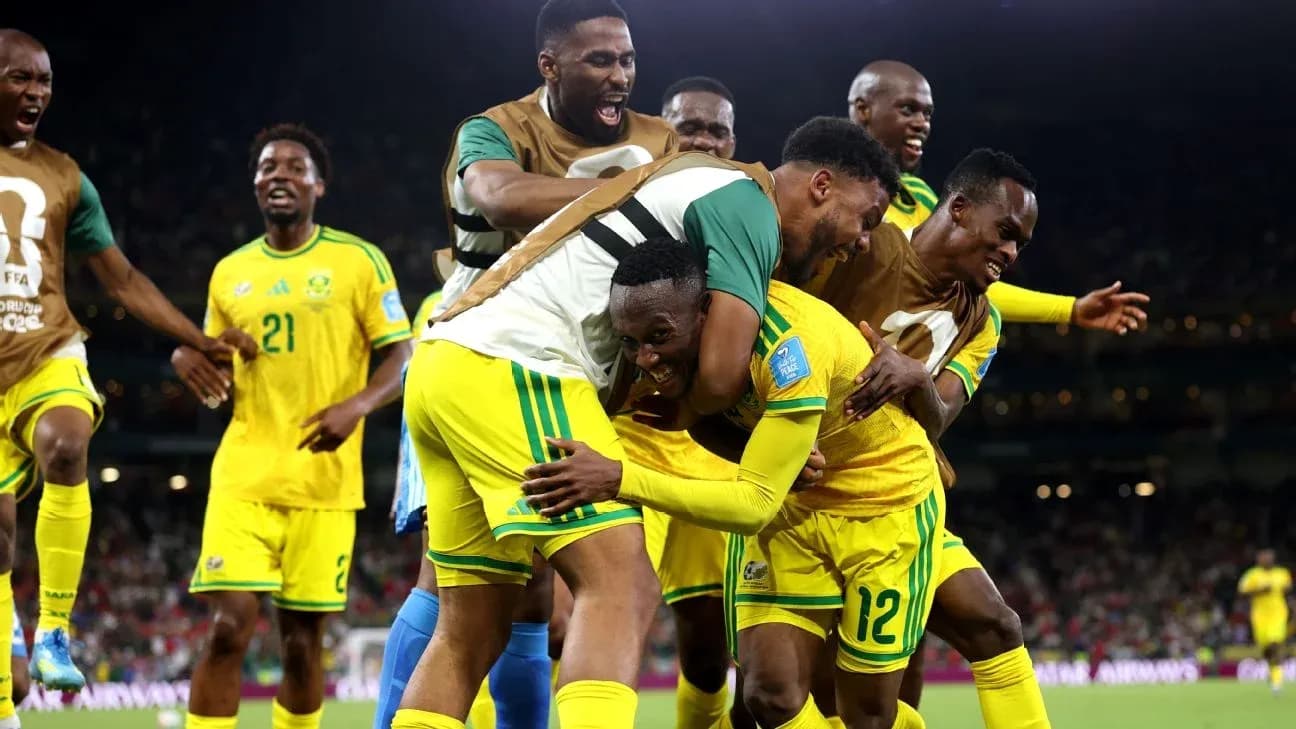
Bafana Bafana and Canada Aim for World Cup History in Los Angeles
Bafana Bafana and Canada step into the unknown on Sunday in Los Angeles, two nations with long World Cup memories but no knockout pedigree, finally breaking through the glass ceiling together.
For both, this is history.
South Africa’s previous trips to the tournament – 1998, 2002, 2010 – all ended at the group stage. Canada’s did too, in 1986 and 2022. Generations have come and gone without a single knockout whistle. Now, in Inglewood, they share a stage neither has reached before.
South Africa’s slow burn to liftoff
It almost didn’t happen for Bafana.
They opened with a 2-0 defeat to co-hosts Mexico, a flat, familiar start that felt painfully in tune with their World Cup past. Then came Czechia. South Africa trailed again, the campaign seemingly slipping into that same old pattern of plucky exits and regret.
Tension built. The clock bled away.
In the 83rd minute, Teboho Mokoena dragged them back, his equaliser jolting life into a team that had looked resigned to another early flight home. That goal changed more than the result; it shifted belief.
The real statement followed.
Against South Korea, a side many expected to move through with ease, Thapelo Maseko struck in the 63rd minute. One clean finish, one 1-0 win, and suddenly South Africa were not a subplot but a story. Second place in Group A secured, a knockout ticket punched, and a sense that something long dormant in South African football might finally be stirring.
Mokoena missed that South Korea game through suspension after back-to-back yellows in the first two matches. He returns now, a midfield anchor and metronome restored just when the stakes rise.
Hugo Broos will, however, still be without Themba Zwane. The appeal against the extension of the attacker’s suspension from one game to three, after his red card against Mexico, failed. It’s a major creative loss, but the cast around him has started to grow.
Relebohile Mofokeng, in particular, has stepped into the spotlight. In that win over South Korea, he led the match in key passes with four, according to FlashScore, threading play between lines and giving Bafana a cutting edge they’ve often lacked on this stage.
Behind him, the likely shape is clear: Ronwen Williams in goal; a back four of Aubrey Modiba, Mbekezeli Mbokazi, Ime Okon and Khuliso Mudau; Sphephelo Sithole and Mokoena shielding and building from midfield; Oswin Appollis and Maseko flanking Mofokeng; Evidence Makgopa leading the line.
It’s a side with balance, bite and, for once, momentum.
Canada chase a deeper run at home
On the other side, Canada arrive with their own sense of unfinished business.
They started Group B with a 1-1 draw against Bosnia & Herzegovina, a solid but unspectacular opening. Then they exploded. A 6-0 demolition of Qatar announced Jesse Marsch’s team as something more than just enthusiastic co-hosts. It was ruthless, confident, and loud.
The noise dipped with a 2-1 defeat to Switzerland in their final group match, but the damage had already been done in their favour: second place secured, knockout football achieved for the first time.
This is not just any tournament for Canada. They are co-hosting alongside Mexico and the USA, and the pressure to deliver at home is real. This match is a chance not just to make history, but to deepen it – to turn a landmark into a run.
They have done it so far without their biggest name.
Alphonso Davies, the Bayern Munich star and face of Canadian football, has yet to play at this tournament as he recovers from a hamstring injury. His absence would cripple many sides. Canada have simply adjusted and pushed on.
They have had to absorb more than just one missing talisman. Ismaël Koné, the Sassuolo midfielder, suffered a broken leg against Qatar and is out for the rest of the tournament. Other niggles have tested Marsch’s depth and resolve.
Still, the expected XI remains strong: Maxime Crepeau in goal; Richie Laryea, Derek Cornelius, Luc de Fougerolles and Alistair Johnston across the back; Ali Ahmed, Mathieu Choiniere, Nathan Saliba and Tajon Buchanan stretching and snapping in midfield; Tani Oluwaseyi partnering Jonathan David up front.
It is a team built to run, to press, to ask constant questions.
A rare meeting, a new stage
These two nations hardly know each other on the pitch.
Their only previous meeting came in Durban in 2007, a friendly that ended 2-0 to South Africa, with Teko Modise scoring both goals. That result belongs to another era, another generation. Sunday is something else entirely.
Kickoff is set for 12 p.m. local time in Los Angeles (9 p.m. CAT, 8 p.m. BST, 7 p.m. GMT) at Los Angeles Stadium in Inglewood, under the watch of Portuguese referee João Pinheiro. He brings Champions League experience and a reputation sharpened by criticism from his handling of Bayern Munich’s semi-final against Paris Saint-Germain. The spotlight on him will be fierce.
In South Africa, fans can follow the drama on SuperSport’s DSTV channels 201, 202 and 235, with SABC offering free-to-air coverage and SportyTV streaming as another route. In Canada, TSN, RDS, CTV and Crave carry the broadcast, while US viewers can tune in via FOX, Telemundo or Peacock.
The world has grown used to seeing these two flags vanish quietly after the group stage. Not this time.
On Sunday in Los Angeles, one of them will move into a World Cup quarterfinal for the first time in history. The other will walk away knowing that, on the night it finally arrived at this level, it met a team just as hungry to rewrite its own story.
Which of these long-sleeping World Cup outsiders is truly awake?
Related News
Raphinha’s Hat-Trick Powers Barcelona to 7-2 Victory Over Racing Santander
Carabao Cup Fourth Round Draw: Liverpool Set to Clash with Chelsea, Arsenal to Face Fleetwood Town
Key Football Matches to Watch in Azerbaijan This Autumn
Raphinha's Hat-Trick Drives Barcelona to 7-2 Triumph Over Racing Santander
Hansi Flick Leads Barcelona to Record-Breaking Seven Wins in a Row
Gavi Reflects on Injury Return as Barcelona Dominate Racing Santander 7-2