
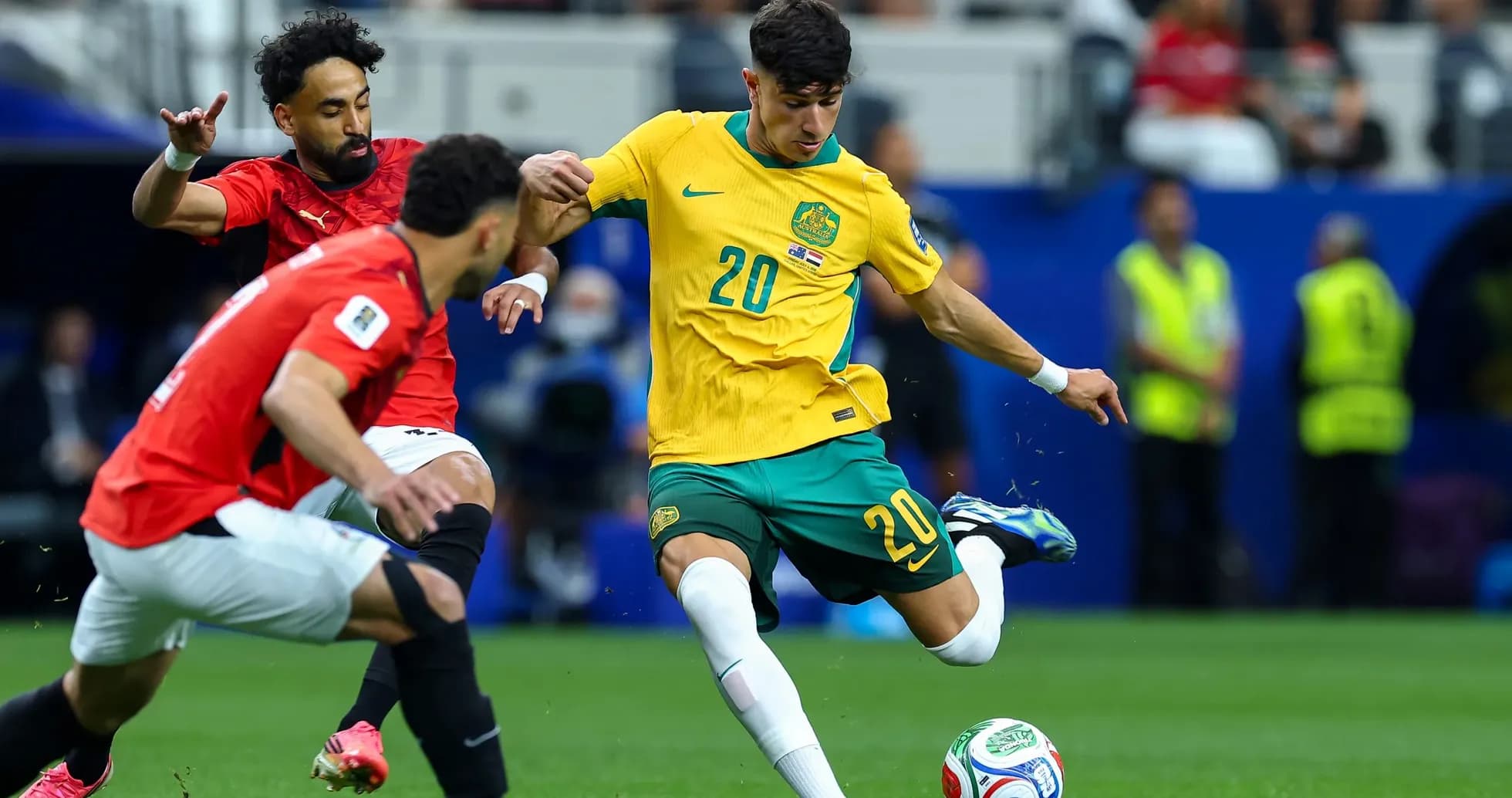
Australia vs Egypt: A Tactical Showdown in the World Cup
The lights have long since dimmed at AT&T Stadium, but the Round of 32 between Australia and Egypt will linger as one of those World Cup nights where structure, discipline and small margins eclipsed spectacle. After 120 minutes locked at 1–1, Egypt’s 4–2 success in the shootout felt like the logical conclusion of a game defined by control rather than chaos.
I. The Big Picture – Two Different World Cup Identities Collide
Heading into this game, both sides arrived with sharply contrasting group-stage profiles. Australia came out of Group D as runners-up with 4 points from 3 matches, a perfectly balanced goal difference of 0 after scoring and conceding 2 overall. Their World Cup campaign to this point had been built on tight margins: across all venues they had played 4 fixtures, winning 1, drawing 2 and losing 1. At home in this tournament context they had scored 3 goals and conceded just 1, an average of 1.5 goals for and 0.5 against, suggesting a side that could be efficient and secure when the environment suited them.
Egypt’s path from Group G was more expansive. They also finished second, but with 5 points from 3 matches and a goal difference of 2, built from 5 goals scored and 3 conceded overall. Over 4 fixtures in total they had yet to lose, with 1 win and 3 draws. On their travels they had been productive, scoring 5 away goals at an average of 1.7 per game and conceding 3 at an average of 1.0, a profile of a team that carried consistent attacking threat but always left a window open at the back.
This clash, then, was set up as Australia’s compact, pragmatic tournament football against an Egypt side that had shown more attacking fluency but less defensive austerity.
II. Tactical Voids – Who Was Missing and What It Meant
The squads were not at full strength, and the absences subtly reshaped the tactical landscape.
Australia were without M. Leckie, sidelined by a hamstring injury, and J. Italiano, out with ankle problems. In a 3-4-2-1 that already demands a lot from its wide and advanced players, losing an experienced forward option like Leckie reduced Tony Popovic’s ability to stretch Egypt late or rotate his front line. It placed greater creative and transitional responsibility on the trio of N. Irankunda, C. Volpato and C. Metcalfe.
Egypt’s list of absentees was longer and more structural. Hossam Abdelmaguid was suspended through a sports court decision, while Hamdi Fathy was ruled out by a muscle bruise. Mohanad Lasheen, a high-impact midfielder with a reputation as a ball-winner and yellow-card magnet, missed out through suspension, and both Ahmed Abou El Fotouh and Mohamed Abdelmonem were unavailable with hamstring and ankle problems respectively. That stripped Hossam Hassan of both a first-choice defender and two influential midfield stabilisers.
The consequence was a back four anchored by Yasser Ibrahim and Rami Rabia, with Mohamed Hany and Karim Hafez as full-backs, and a midfield where Emam Ashour and Mohamed Attia had to shoulder more defensive responsibility without Fathy and Lasheen. Given that Lasheen had already collected 2 yellow cards in this World Cup and was a key enforcer, his absence tilted the engine room balance in Australia’s favour on paper.
Discipline was always going to matter. Australia’s season card profile showed a clear late-game trend: 40.00% of their yellow cards arrived between 76 and 90 minutes, indicating a tendency to suffer under late pressure. Egypt, by contrast, spread their cautions more evenly but had notable spikes: 25.00% of their yellows came between 16 and 30 minutes and another 25.00% between 31 and 45, with a further 25.00% in extra time from 91 to 105 minutes. This painted a picture of a side that could be rash in the early exchanges and then again in the first half of extra time.
III. Key Matchups – Hunter vs Shield, and the Battle for the Middle
The headline duel was obvious: Mohamed Salah against Australia’s three-man defensive line. Officially listed as a forward in this fixture but operating with the creative influence of a playmaker, Salah arrived as one of the World Cup’s most productive attacking leaders. Across the tournament he had 4 appearances, all starts, logging 338 minutes with a rating of 7.25. He had contributed 1 goal and 2 assists, taken 6 shots with 4 on target, and created 16 key passes from 113 total passes at 77% accuracy. Add 13 dribble attempts with 6 successes and 9 fouls drawn, and you have a player who bends defensive shapes around him.
Facing him, Harry Souttar anchored a back three flanked by A. Circati and L. Herrington. Australia’s broader tournament numbers suggested a back line comfortable in low-scoring games: overall they had conceded only 3 goals in 4 matches, an average of 0.8 per game across all venues. At home they had been even more miserly, allowing just 1 goal in 2 matches. The plan was clear: compress the central spaces where Salah likes to receive and combine, forcing him wide or back into traffic.
Egypt’s “shield” against Australian counters was weakened without Lasheen and Fathy, but Yasser Ibrahim emerged as a key figure. Across the tournament he had played 4 times (3 starts), logging 376 minutes with a rating of 6.78. His 7 tackles, 3 successful blocks and 2 interceptions underlined his willingness to defend aggressively on the front foot, and he had already picked up 2 yellow cards. In Dallas, his task was to step out to confront Irankunda and Volpato between the lines, trusting Rabia to cover behind.
In midfield, Australia’s double axis of J. Irvine and A. O’Neill was tasked with exploiting Egypt’s reconfigured core. With Australia’s season form reading WLDD, they had become adept at grinding control rather than chasing chaos. Egypt, undefeated with a DWDD form line, were more accustomed to dictating rhythm. The tactical question was whether Ashour and Attia could both protect the back four and connect with the front quartet of O. Marmoush, Salah and M. Ziko in a 4-4-2 that often morphed into a 4-2-3-1 in possession.
IV. Statistical Prognosis – Why Penalties Felt Inevitable
From a season-long statistical lens, a tight knockout was always on the cards. Australia’s overall goals for and against averages both sat at 0.8 per game, suggesting equilibrium rather than volatility. Egypt’s profile was more expansive – 1.5 goals for and 1.0 against overall – but still within a range that pointed to one- or two-goal margins rather than a shootout.
Neither side had taken a penalty in this World Cup prior to this fixture; both had 0 penalties awarded, 0 scored and 0 missed. There was no historical edge from the spot in this tournament data. What the numbers did suggest, however, was that Egypt were more accustomed to games that stayed open – they had never failed to score, home or away, across 4 matches – while Australia had already failed to score twice overall, both times on their travels.
In Dallas, the match settled into the pattern the data hinted at: Egypt carried the more consistent attacking threat, Australia clung to structure and moments. The 1–1 scoreline after 120 minutes was a statistical compromise between Egypt’s higher scoring tendencies and Australia’s defensive parsimony.
Following this result, the narrative is one of Egypt’s resilience and Australia’s limitations in turning control into cutting edge. Egypt’s undefeated run, their capacity to navigate multiple draws, and the individual brilliance of Salah as a creator all converged in a penalty triumph that felt like an extension of their tournament identity. Australia, brave and organised in their 3-4-2-1, were ultimately undone not by a collapse in open play, but by the cold arithmetic of the shootout – a fitting, if cruel, end to a campaign built on fine margins.
Related News

Thomas Tuchel Reflects on England's 10-Man World Cup Triumph and a Surprising Regret
Robert Moreno Takes Over as Interim South Korea Coach After World Cup Setback

Jude Bellingham Returns to Form with Real Madrid After World Cup Success

Chloe Kelly, Beth Mead & 13 Lionesses Who Must Shine in the Upcoming WSL Season for England’s 2027 World Cup Bid
Barcelona Cancels World Cup Tribute Amid Political Tensions
Messi Breaks Record for Most Penalties Taken and Missed in FIFA World Cup History