
Australia's Tactical Masterclass in 2-0 Win Over Türkiye
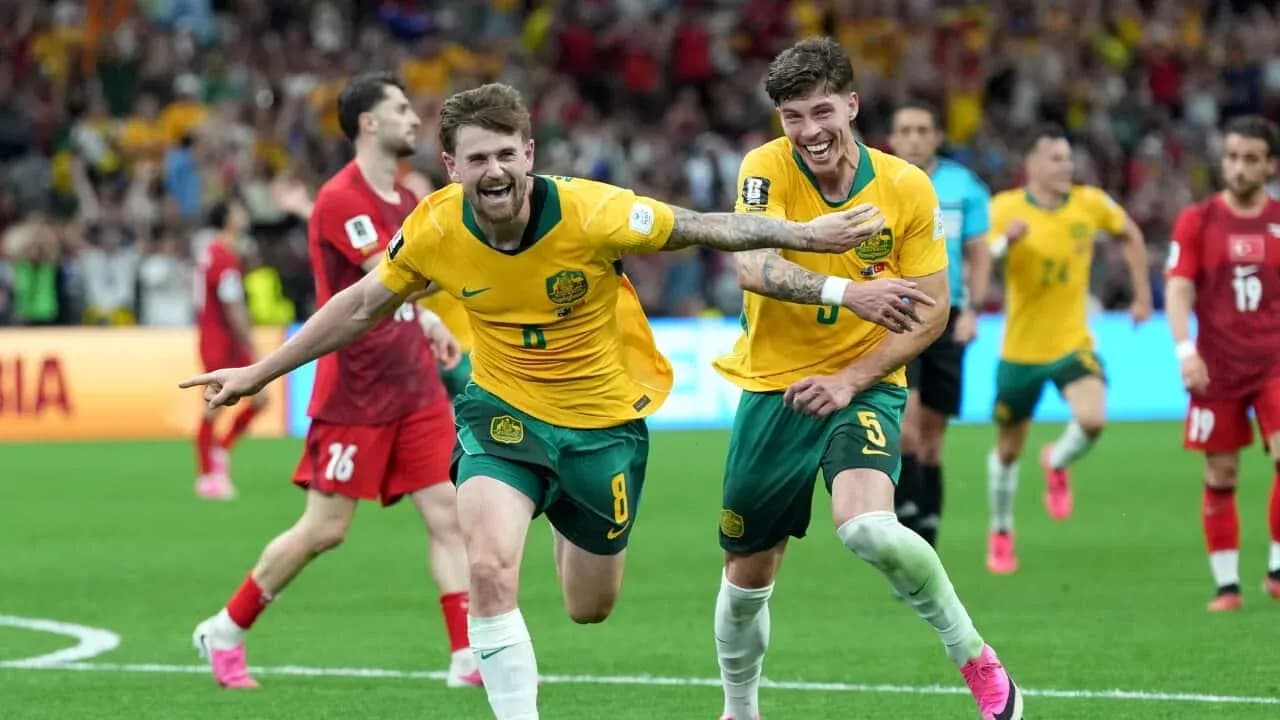
Australia’s 2-0 win over Türkiye at BC Place was a textbook example of a low-possession, structurally disciplined game plan executed with clarity. In a World Cup group opener where Türkiye had 72% of the ball and a 30–9 shot advantage, Australia leaned fully into a 5-4-1 block, vertical transitions, and ruthless efficiency in the final third to secure the points.
Executive Summary
Australia, set up by Tony Popovic in a 5-4-1, accepted long defensive phases and trusted their back five and central screen to absorb pressure. Türkiye, in Vincenzo Montella’s 4-2-3-1, dominated territory and circulation but struggled to convert volume into clear chances, finishing with higher xG (1.33 to 0.77) yet no goals. Two transition-driven strikes – first from Nestory Irankunda, then from Connor Metcalfe – punished Turkish structural risks and defensive imbalances.
Scoring Sequence & Disciplinary Log
The opener came on 27': Nestory Irankunda (Australia) finished a fast Australian move, assisted by Paul Okon-Engstler, capitalizing on space behind Türkiye’s advanced full-backs. That goal framed the rest of the match: Australia could now sit even deeper, forcing Türkiye to chase the game against a reinforced block.
After half-time, Montella moved early. At 46', Barış Alper Yılmaz (OUT) was replaced by Kenan Yıldız (IN), adding a more creative, inside-forward profile from the left to attack the half-spaces.
Australia’s second was the decisive tactical blow. On 75', Connor Metcalfe (Australia) struck for 2-0, with no assist credited. Again, the context was key: Australia transitioned out of pressure and found Metcalfe arriving from midfield, exploiting a Türkiye side stretched by aggressive pursuit of an equaliser.
Substitutions intensified around the hour mark. At 61', Nestory Irankunda (OUT) made way for Nishan Velupillay (IN), a like-for-like wide runner to maintain transition threat. At 62', Orkun Kökçü (OUT) was replaced by Yunus Akgün (IN), shifting Türkiye towards a more vertical, wing-oriented attacking profile.
On 74', Mohamed Touré (OUT) was replaced by Tete Yengi (IN), giving Australia fresh legs and a more physical reference up front. Simultaneously, Jacob Italiano (OUT) was replaced by Jason Geria (IN), a defensive-minded full-back to protect the right side against mounting Turkish pressure.
Montella’s late double switch at 81' targeted both the pivot and right-back zones: İsmail Yüksek (OUT) was replaced by Salih Özcan (IN), and Zeki Çelik (OUT) by Mert Müldür (IN), trying to inject energy and more direct passing from deep. Popovic responded on 84' with a defensive lock: Jordan Bos (OUT) was replaced by Aziz Behich (IN), and Paul Okon-Engstler (OUT) by Jackson Irvine (IN), adding experience, aerial presence, and defensive volume to see out the lead.
At 85', Kerem Aktürkoğlu (OUT) was replaced by Deniz Gül (IN), a final attacking roll of the dice for Türkiye. The only card of the match arrived at 86': Yunus Akgün (Türkiye) received a yellow card — Roughing — reflecting Turkish frustration as Australia ran down the clock inside their compact structure.
Card totals: Australia 0, Türkiye 1, Total 1.
Tactical Breakdown & Personnel
Popovic’s 5-4-1 was built on a narrow, vertically compact block. The back three of Alessandro Circati, Harry Souttar, and Cameron Burgess stayed tight, with wing-backs Jordan Bos and Jacob Italiano initially aggressive on the flanks but gradually dropping deeper to form a back five. In front, Aiden O’Neill and Connor Metcalfe provided a double screen, with Paul Okon-Engstler and Nestory Irankunda as wide midfielders who tucked in to crowd central lanes and then sprang forward on transition.
Australia’s attacking pattern was simple but coherent: win the ball in the middle third, find Okon-Engstler or Irankunda early, and use Mohamed Touré’s runs to drag the Turkish centre-backs away from the ball. The first goal encapsulated this: Okon-Engstler’s involvement between the lines and Irankunda’s directness into space punished Türkiye’s high full-backs and wide gaps between their centre-backs and holding midfielders.
After going 1-0 up, Australia deliberately ceded even more territory. The wing-backs dropped, the front line stopped pressing high, and the distances between lines shrank. The introduction of Geria and Behich further tilted the side towards a pure low block, while Irvine’s entry added a third-ball winner and set-piece defender.
Türkiye’s 4-2-3-1 had the right territorial logic but lacked penalty-box clarity. Ferdi Kadıoğlu and Zeki Çelik pushed high to create width, while Hakan Çalhanoğlu and İsmail Yüksek controlled circulation from the double pivot. Arda Güler and Orkun Kökçü floated between lines, with Barış Alper Yılmaz and Kerem Aktürkoğlu stretching the last line. However, Australia’s compactness forced Türkiye into many shots from suboptimal positions, reflected in the high volume but modest xG.
The substitutions were structurally coherent: Kenan Yıldız and Yunus Akgün offered more direct 1v1 threat, while Salih Özcan added forward-driving passes from deep. Yet Australia’s adjustment to a deeper 5-4-1/5-3-2, with fresh legs and defensive specialists, meant Türkiye’s final-third combinations rarely broke the last line cleanly.
In goal, Patrick Beach (Australia) was decisive: he made 8 saves, matching Türkiye’s 8 shots on target and anchoring the defensive game plan. At the other end, Uğurcan Çakır (Türkiye) made 2 saves; Australia’s efficiency meant that four shots on goal produced two goals, underlining the clinical nature of their transitions.
The Statistical Verdict
The statistical profile underlines how extreme the tactical trade-off was. Türkiye’s 72% possession, 707 total passes, and 90% passing accuracy (638 accurate) show a side in total control of the ball but not of the scoreboard. Their 30 total shots, 8 on goal, and 12 blocked shots reflect sustained siege-like pressure against a deep block. An xG of 1.33 suggests they created enough to reasonably expect at least one goal, but poor finishing and Beach’s interventions undermined that.
Australia, with just 28% possession and 270 total passes (202 accurate, 75%), built their entire performance around efficiency and defensive resilience. Nine total shots, four on goal, and an xG of 0.77 producing two goals is the hallmark of a counter-punching side executing at a high level. Their 12 fouls to Türkiye’s 4 also illustrate a willingness to break rhythm and protect their structure.
Both goalkeepers registered negative goals prevented (-0.95 each), indicating that, in pure shot-quality terms, each conceded more than the model would expect. Yet context matters: Beach (Australia) faced far more volume and emerged as the practical match-winner behind a disciplined 5-4-1, while Çakır (Türkiye) was exposed by his team’s structural risks and Australia’s ruthless finishing.
Related News

Thomas Tuchel Reflects on England's 10-Man World Cup Triumph and a Surprising Regret

Robert Moreno Takes Over as Interim South Korea Coach After World Cup Setback

Jude Bellingham Returns to Form with Real Madrid After World Cup Success

Chloe Kelly, Beth Mead & 13 Lionesses Who Must Shine in the Upcoming WSL Season for England’s 2027 World Cup Bid

Barcelona Cancels World Cup Tribute Amid Political Tensions
Messi Breaks Record for Most Penalties Taken and Missed in FIFA World Cup History