
Atletico Madrid Dominates Real Sociedad 3-0 at Reale Arena
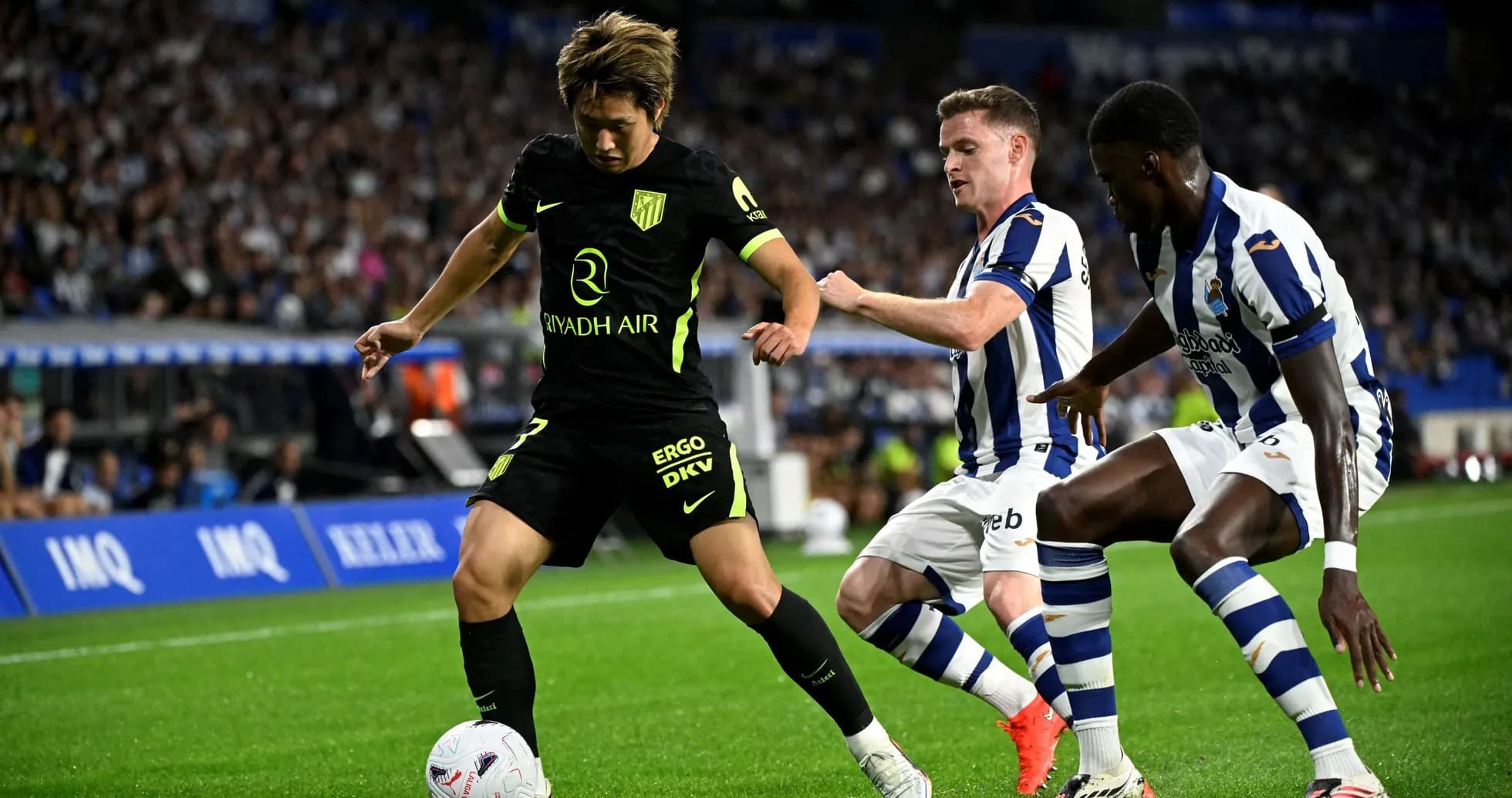
The Reale Arena had barely settled into its early autumn rhythm when this fixture underlined just how far apart these two projects currently are. In La Liga’s Regular Season - 5, Real Sociedad, 12th in the table heading into this game, were dismantled 3–0 at home by a ruthless Atletico Madrid side that arrived in San Sebastián already looking like a fully formed contender, sitting 5th and tracking a Europa League league stage place.
The scoreline felt like the logical collision of two seasonal trajectories. Overall this campaign, Real Sociedad had scored 6 and conceded 11 in 6 matches, a goal difference of -5 that already hinted at structural fragility. At home, they came in averaging just 0.7 goals for and 1.3 against, and that lack of punch combined with a porous back line was brutally exposed by an Atletico side that had been scoring 2.0 goals per game both at home and on their travels, while conceding only 1.2 overall.
I. The Big Picture – Shapes, context and intent
P. Matarazzo doubled down on Real Sociedad’s primary identity, rolling again with the 4-2-3-1 that has been their most-used setup this season (4 league matches). Álex Remiro started behind a back four of J. Aramburu, Luken Beitia, M. Sarr and Sergio Gómez. In front, Y. Herrera and Carlos Soler formed the double pivot, with Barrenetxea, L. Sučić and Gonçalo Guedes supporting Mikel Oyarzabal as the lone forward.
On paper, it was an XI built to have the ball and combine between the lines. In practice, it was an XI stripped of some of its defensive leadership. Jon Martín, a young defender who had already collected a red card this season, was suspended. I. Zubeldia’s injury and A. Odriozola’s knee problem further thinned the defensive pool. The result was a back line lacking its usual hierarchy and a bench heavy on youth – Jon Pacheco, Aihen Muñoz and Héctor Fort among the defensive alternatives, with J. Ochieng and O. Óskarsson offering late attacking energy.
Diego Simeone answered with something more experimental but no less coherent: a 3-4-2-1 that has been used only once this league campaign, layered over a season otherwise dominated by a back four. J. Oblak anchored a back three of Marc Pubill, C. Romero and D. Hancko, with a fluid midfield line of G. Simeone, Marcos Llorente, M. Hjulmand and Álex Grimaldo. Ahead of them, Lee Kang-In and Álex Baena floated as dual creators behind A. Lookman.
This was not a conservative Atletico. With 10 goals scored and 6 conceded overall across 5 games before kick-off, they have been more open, but also more incisive. The selection of Baena, one of the league’s more efficient attacking midfielders so far with 3 goals and 1 assist in 5 appearances, and the inclusion of G. Simeone as a wide-running midfielder, signalled an intent to press high and attack the channels around Real Sociedad’s full-backs.
II. Tactical Voids – Absences, discipline and emotional balance
Real Sociedad’s absentees mattered. Martín’s red card earlier in the campaign is part of a broader disciplinary pattern: the team’s yellow cards are spread fairly evenly across the match, with a noticeable cluster between 16–30 minutes, 46–60 minutes and 61–75 minutes (each 21.43% of their yellows). The single red card arriving between 61–75 minutes underlines how their aggression can spike just as matches open up.
Without Martín and Zubeldia, the responsibility for defensive duels fell heavily on Aramburu and Sarr. Aramburu, already one of the league’s most carded players with 3 yellows, walks a permanent tightrope; his 95 duels contested and 24 fouls committed show a defender constantly living on the edge. Y. Herrera, also on 3 yellows and prominent in both yellow and red card leaderboards, is another who can tilt the emotional temperature of a match. Matarazzo’s choice to pair him with Soler in the pivot risked volatility in central zones if Atletico managed to drag them into transitions.
Atletico’s own disciplinary profile is more controlled but not spotless. Their yellows are most frequent in the 31–45 and 46–60 minute ranges (22.22% each), suggesting a side that pushes the line either side of half-time. The single red card this season belongs to Robin Le Normand, who started this match on the bench – a reminder that even Simeone’s experienced defenders can overstep when defending deep for long spells.
III. Key Matchups – Hunter vs Shield, Engine Room battles
The “Hunter vs Shield” duel here was less about a single striker and more about a collective threat. Atletico arrived with Baena as a top scorer (3 goals), G. Simeone on 2, and a structure that shares goals and chance creation. Against a Real Sociedad defence that had conceded 7 goals on their travels and 4 at home heading into this round, the question was whether the makeshift central pairing could handle the variety of movements from Lookman, Baena and Lee.
Baena’s profile is telling: 8 shots, 4 on target, 10 key passes and a 7.34 average rating. He drifts into half-spaces, combining with overlapping wing-backs or wide midfielders. Here, his natural zone overlapped with Sergio Gómez’s flank and the inside-right channel where Sarr and Beitia had to coordinate. Without Zubeldia’s experience, that coordination was always likely to be tested.
In the “Engine Room”, M. Hjulmand’s task was to screen Atletico’s back three and control the rhythm against Herrera and Soler. Herrera’s numbers – 226 passes at 87% accuracy, 9 tackles, 51 duels and 8 fouls committed – paint him as a combative, all-action midfielder. But that same edge can be weaponised by Atletico’s technicians. Lee Kang-In and Baena, constantly receiving between the lines, forced Herrera and Soler to choose between stepping out or protecting the space in front of Beitia and Sarr. Every time they stepped, Llorente and G. Simeone threatened to run beyond.
Out wide, Aramburu’s duel with Grimaldo and G. Simeone was central to Real Sociedad’s defensive survival. Aramburu has already blocked shots, won 52 of 95 duels and attempted 8 dribbles, but his 24 fouls committed and 3 yellows underline the risk when he is overloaded. Atletico’s 3-4-2-1 was designed precisely to create those overloads, with Grimaldo underlapping and G. Simeone stretching the line.
IV. Statistical Prognosis – Why a 0–3 felt baked into the numbers
When you align the seasonal data with the tactical shapes, the 3–0 away win reads less as a surprise and more as an almost inevitable outcome. Real Sociedad came into the match with only 1 clean sheet overall and having failed to score in 3 of their 6 league games. At home they had scored just 2 in 3 matches and failed to score twice. Atletico, by contrast, had kept 2 clean sheets overall, failed to score only once, and were averaging 2.0 goals per game both at home and away.
Defensively, Real Sociedad’s overall average of 1.8 goals conceded per game, combined with Atletico’s 2.0 goals for, pointed towards the visitors creating high-quality chances even without detailed xG data. Atletico’s ability to share the creative load – Baena’s 10 key passes, Hancko’s 2 assists from deep, Grimaldo’s natural crossing threat – meant they were never reliant on a single outlet.
Layer in Real Sociedad’s disciplinary spikes in the middle third of matches and the absence of key defenders, and the script becomes clear: Atletico’s structured aggression and superior attacking metrics were always likely to overwhelm a fragile, reshuffled back line. A 0–3 scoreline at Reale Arena, harsh as it looks on the night, is entirely consistent with the underlying patterns these two teams brought into Round 5.
Related News

LaLiga 2026-27 Season Schedule Released: Kickoff on August 15, Clásico on October 25
Atletico Madrid vs Real Madrid: Head-to-head Stats and Past Meetings
Real Madrid Dominates Rayo Vallecano in La Liga Clash
Atletico Madrid Dominates Real Sociedad 3-0 at Reale Arena

Sevilla vs Barcelona Stats: Head-to-Head Record and Past Meetings
Barcelona vs Racing Santander Predicted Lineups and Team News