
Arsenal’s Tactical Control in 1-0 Win Over Burnley
Arsenal’s 1-0 win over Burnley at Emirates Stadium was a controlled, possession‑heavy performance built on structure rather than volume of chances. Mikel Arteta’s side used their 4-3-3 to dominate territory and rhythm, posting 61% possession and 510 passes, with 440 accurate (86%). The single breakthrough came on 37 minutes, when K. Havertz finished a move created by B. Saka, and from there Arsenal managed the game with ball circulation and rest defence rather than chasing a second goal.
Burnley, in Mike Jackson’s 4-2-3-1, accepted a low‑block, counter‑oriented role but never turned their shape into real threat: 0 shots on goal from 5 total attempts and an xG of just 0.21 underline how effectively Arsenal suffocated transitions and central spaces.
Defensively, Arsenal’s line of C. Mosquera, W. Saliba, Gabriel and R. Calafiori played high and compact, with D. Rice anchoring in front to prevent Burnley’s No. 10 Z. Flemming from receiving between the lines. The hosts allowed only 2 shots inside the box and blocked 1 of Burnley’s 5 efforts, which, combined with “0” Goalkeeper Saves for D. Raya, shows how rarely the visitors penetrated into genuinely dangerous zones. Arsenal’s defensive control is further reflected in their goals prevented figure of 0.85: the underlying models suggest Burnley’s few situations carried limited threat, and the structure in front of Raya neutralised most danger before it could test him.
In possession, Arsenal’s 4-3-3 had clear positional reference points. D. Rice (No. 41) operated as the single pivot, dropping between or alongside the centre‑backs to start build‑up, while M. Odegaard and E. Eze formed the advanced interiors. R. Calafiori and C. Mosquera pushed high and wide to pin Burnley’s wide midfielders, allowing Saka and L. Trossard to come inside and occupy half‑spaces. With 9 shots inside the box out of 13 total, Arsenal’s positional play consistently generated entries into the penalty area, even if the final action lacked volume in terms of clear‑cut chances (xG 1.03).
The decisive goal encapsulated Arsenal’s attacking idea: patient circulation to shift Burnley’s block, then a quick vertical action. After sustained pressure, Saka received in the right half‑space and combined to release K. Havertz, who converted for 1-0 at 37'. The move showed the value of Saka’s interior positioning and Havertz’s timing between centre‑back and full‑back.
Out of possession, Arsenal’s pressing was measured rather than manic. With only 7 Fouls and a single Yellow Card (Kai Havertz, 67', “Foul”), they pressed in organised waves, often allowing Burnley’s centre‑backs to have the first pass before locking onto midfield targets. D. Rice screened passes into Florentino and L. Ugochukwu, forcing Burnley to play wide and long, where Saliba and Gabriel dominated aerially and in duels. The low foul count, combined with Burnley’s 16 Fouls and 3 Yellow Cards, highlights the contrast in control: Arsenal dictated the tempo; Burnley chased.
Burnley’s 4-2-3-1 defensive scheme aimed to protect the middle with Florentino and L. Ugochukwu screening the back four, while L. Tchaouna and J. Anthony dropped alongside them to form a 4-4-1-1 without the ball. However, Arsenal’s circulation and positional rotations dragged these lines apart. The visitors’ 325 passes (254 accurate, 78%) show a team that could keep the ball in safer zones but struggled to progress; they rarely broke Arsenal’s first and second pressing lines in a structured way.
In goal, M. Weiss was busy enough to register 2 Goalkeeper Saves and, crucially, a goals prevented figure of 0.85, which suggests that, relative to the quality of Arsenal’s chances, he kept the scoreline respectable. Arsenal’s 3 Shots on Goal from 13 Total Shots indicates that Burnley’s last‑line defending and Weiss’s positioning forced a number of efforts into less optimal angles or blocked lanes (3 Blocked Shots conceded).
The substitution pattern from both coaches underlined the tactical story. For Burnley, Mike Jackson tried to inject energy and verticality: Z. Amdouni (IN) came on for H. Mejbri (OUT) at 70', J. Laurent (IN) for L. Ugochukwu (OUT) at 71', J. Ward-Prowse (IN) for Florentino (OUT) at 78', J. Bruun Larsen (IN) for L. Tchaouna (OUT) at 82', and B. Humphreys (IN) for M. Esteve (OUT) also at 82'. These changes tilted Burnley slightly more towards progressive passing and late crosses, but Arsenal’s structure absorbed the adjustments.
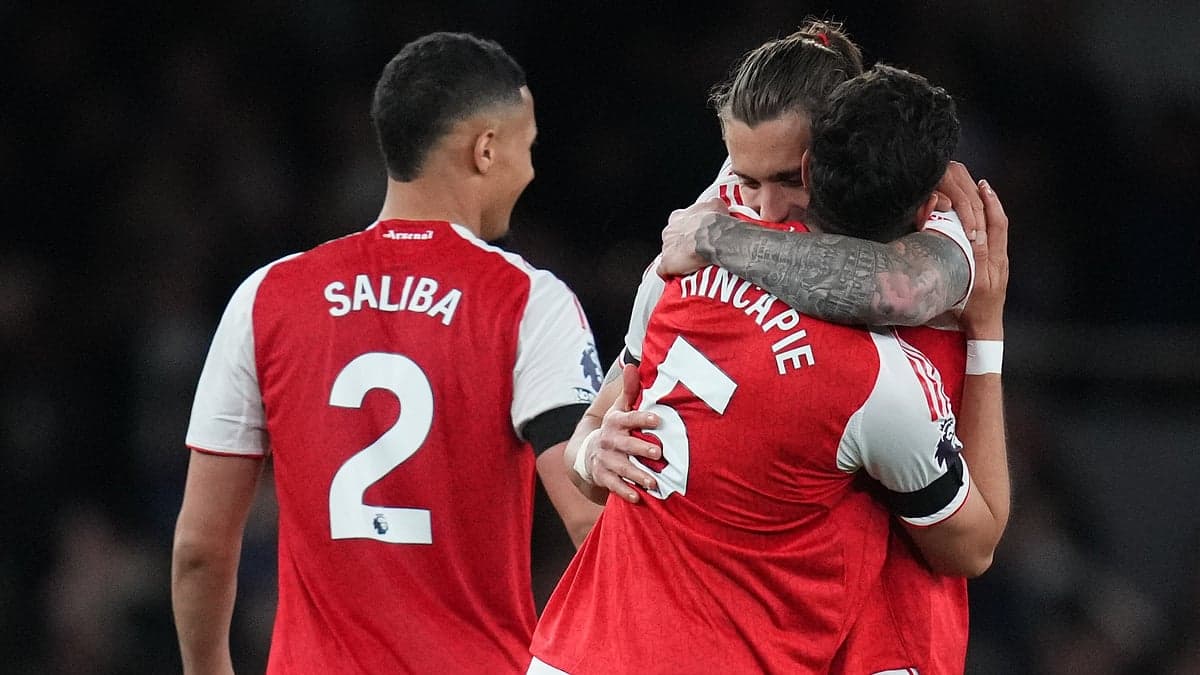
Arteta’s changes were primarily about game management and physical freshness. P. Hincapie (IN) came on for R. Calafiori (OUT) at 72', adding a left‑footed defender comfortable stepping into midfield. V. Gyökeres (IN) replaced K. Havertz (OUT) at 73', offering depth running to stretch Burnley’s back line and relieve pressure. M. Lewis-Skelly (IN) for E. Eze (OUT) at 73' added legs and defensive work in midfield. In stoppage time, G. Martinelli (IN) for L. Trossard (OUT) and M. Zubimendi (IN) for M. Odegaard (OUT), both at 90+3', were clear signals of protecting the lead, adding ball retention and counter‑pressing capacity.
Discipline played a subtle tactical role. Burnley’s first Yellow Card came early: 28' Hannibal Mejbri — Time wasting, hinting at a strategy to slow the game once under pressure. Late on, as Burnley chased an equaliser and Arsenal managed the clock, two more cards reflected rising desperation: 90+1' Zian Flemming — Foul, and 90+4' Lucas Pires — Foul. Arsenal’s lone booking, 67' Kai Havertz — Foul, came in a phase where Burnley briefly threatened to transition quicker, but it did not destabilise Arsenal’s control.
Statistically, the verdict is clear. Arsenal’s 61% Ball Possession, higher pass volume and accuracy, 9 Shots inside the box, and xG of 1.03 point to a team that translated structural dominance into a steady, if unspectacular, stream of opportunities. Burnley’s 0 Shots on Goal, 5 Total Shots, and xG of 0.21 show that their attacking plan never truly materialised against Arsenal’s Defensive Index on the day.
The narrow 1-0 scoreline slightly flatters Burnley given the territorial and qualitative gap. Yet from Arsenal’s perspective, the match showcased maturity: once in front, they prioritised control over risk, trusted their rest defence, and used substitutions to lock down the result rather than chase margin. In a late‑season Premier League context, this was a professional, tactically coherent home win rather than a statement attacking performance.
Related News

Brighton vs Arsenal Predicted Lineups: Team News and Match Insights

Manchester City vs Sunderland Predicted Lineups: Team News and Match Analysis
Bournemouth vs Liverpool Prediction: Key Stats and Betting Tips
Tottenham vs Aston Villa Predicted Lineups: Team News for Premier League Clash
Brighton vs Arsenal: Premier League Clash Preview

Manchester City vs Sunderland: Premier League Clash Preview