

Argentina's Tactical Dominance Over England in 1-2 Semi-Final
England’s 1-2 defeat to Argentina at Mercedes-Benz Stadium was shaped by a clear territorial imbalance and a late tactical swing rather than a chaotic endgame. England led from the 55th minute but were gradually pinned back by Argentina’s structure and ball circulation, with the South Americans’ control of space and tempo ultimately reflected in both the scoreline and the underlying numbers.
Thomas Tuchel’s England set up in a 4-2-3-1, but functionally it was a mid-to-low block 4-4-2 out of possession. Harry Kane and Jude Bellingham formed the first line, trying to screen Leandro Paredes and the central lanes, while Elliot Anderson and Morgan Rogers narrowed in alongside Declan Rice to compress the middle. The intention was clear: concede possession, protect the half-spaces, and break quickly through Anthony Gordon and Rogers.
That approach explains England’s 36% possession and low shot volume: 5 total shots, with 2 on goal and 2 blocked. Their 0.53 xG underscores a plan built on selective, high-value moments rather than sustained pressure. The key success of this strategy came on the 55th-minute goal: Gordon’s strike, assisted by Rogers, was the product of England’s verticality from their 4-2-3-1 shell, exploiting a transition window rather than elaborate build-up.
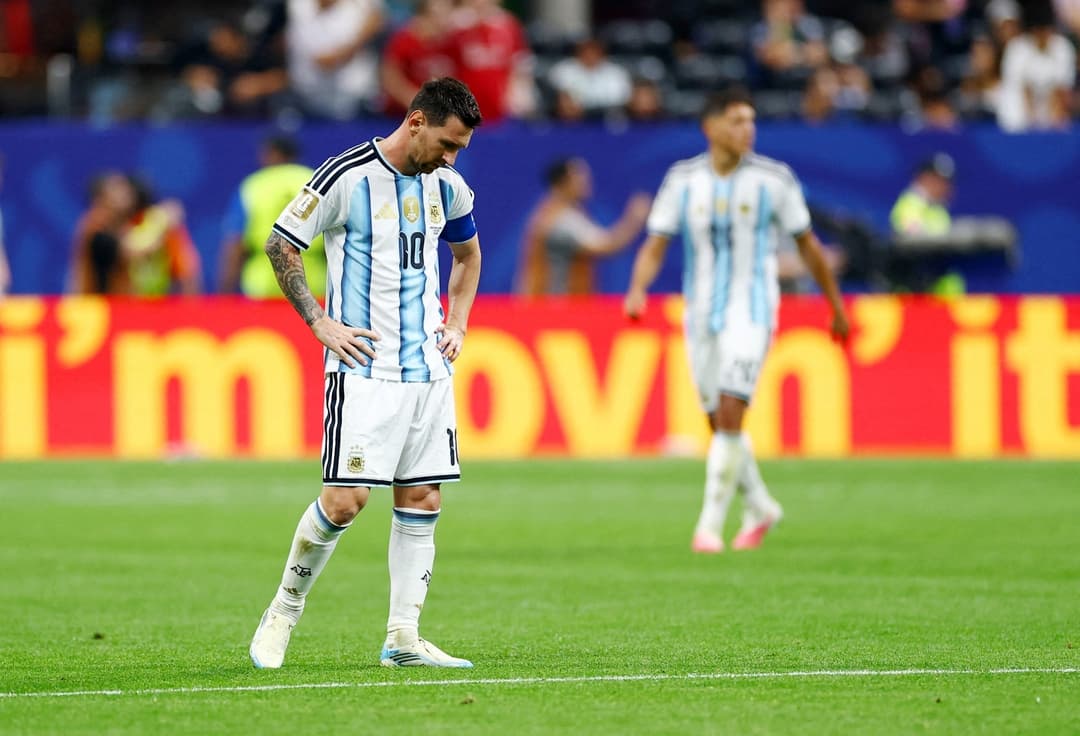
Argentina, by contrast, operated from a 4-4-2 that often resembled a 4-3-3 in possession. With Lionel Messi and Julián Álvarez up front, and Enzo Fernández and Alexis Mac Allister stepping inside from midfield, they created a numerical superiority in central areas. Their 64% possession, 590 total passes, and 537 accurate passes at 91% show a side comfortable circulating the ball, re-setting attacks, and patiently probing England’s block.
The shot profile reinforces that territorial dominance: 15 total shots, 5 on goal, 3 blocked, with 7 attempts inside the box and 8 from outside. An xG of 1.84 suggests Argentina created a steady stream of medium-quality chances rather than a single overwhelming opportunity, gradually wearing down England’s defensive structure.
Out wide, England’s full-backs Reece James and Djed Spence (before being replaced late) were conservative, rarely overlapping aggressively. This limited England’s ability to stretch Argentina’s back four and contributed to their meagre 1 corner. With only 324 total passes (272 accurate at 84%), England simply did not have the volume of possession or field position to sustain pressure; most of their passing was about exiting their half and finding Kane or the advanced midfield line quickly.
Argentina’s full-backs, Nahuel Molina and Nicolás Tagliafico, were more proactive, especially as the game wore on. Their willingness to push high helped lock England in, contributing to Argentina’s 6 corners and sustained presence in the final third. When Lionel Scaloni went to his bench around the 64th and 72nd minutes, the pattern intensified: Nicolás González and later Lautaro Martínez added direct running and penalty-box presence, while Rodrigo De Paul’s introduction gave Argentina an extra passer and presser in midfield.
Defensively, England’s 11 fouls and single yellow card (Elliot Anderson for “Foul”) reflect a side that generally stayed within control, relying more on compactness than disruptive aggression. Argentina’s 15 fouls and 3 yellow cards (Lisandro Martínez and Cristian Romero both for “Foul”, Rodrigo De Paul for “Argument”) show a more assertive, sometimes cynical approach to counter-pressing and game management, especially once they fell behind and then later sought to protect their lead.
The decisive tactical story, however, lies in how both sides managed the final third and their defensive boxes.
Jordan Pickford (England) faced 5 shots on goal and made 3 saves, with goals prevented measured at 0.02. Statistically, that suggests he performed roughly to expectation: Argentina’s finishing quality eventually matched their chance creation. His workload was a direct consequence of Argentina’s territorial control and the volume of entries into England’s box, rather than individual errors.
Emiliano Martínez (Argentina), by contrast, had a quieter but crucial night. He faced just 2 shots on goal, making 1 save, with goals prevented also at 0.02. That single goal conceded was England’s main attacking success, but the key tactical point is how little he was asked to do: Argentina’s structure ahead of him, and their ability to keep England to 5 total shots and 2 inside the box, meant Martínez (Argentina) spent long stretches as a sweeper and organiser rather than a shot-stopper under siege.
Once England led 1-0, their already conservative approach deepened. Substitutions such as Ezri Konsa for Anthony Gordon and Dan Burn for Reece James indicated a tilt toward preserving the lead and shoring up the defensive line, rather than chasing a second goal. That invited more pressure, and with Argentina’s xG climbing, the probability of conceding grew correspondingly.
The late goals for Argentina were the logical tactical outcome of that pressure arc. Enzo Fernández’s equaliser and Lautaro Martínez’s winner, both assisted by Messi, reflected the cumulative effect of Argentina’s midfield overloads and box occupation against an England side increasingly pinned back and losing the ability to counter with numbers.
Statistically, the verdict is stark. Argentina’s 64% possession, 15 shots to 5, 6 corners to 1, and 1.84 xG to England’s 0.53 all point to a game where the eventual 1-2 scoreline matched the pattern of play more than the timing of the goals might suggest. England’s plan nearly succeeded in compressing a low-xG game into a narrow win, but their inability to relieve pressure or generate additional chances after going ahead left them exposed to exactly the kind of late turnaround Argentina produced.
In tactical terms, Argentina’s control of central zones, superior passing volume and accuracy, and more aggressive use of full-backs and bench options outweighed England’s compact 4-2-3-1 and transitional threat. The semi-final was decided less by chaos than by the steady accumulation of territorial and chance-creation advantages that, in the final minutes, finally broke England’s resistance.
Related News

Thomas Tuchel Reflects on England's 10-Man World Cup Triumph and a Surprising Regret

Robert Moreno Takes Over as Interim South Korea Coach After World Cup Setback

Jude Bellingham Returns to Form with Real Madrid After World Cup Success

Chloe Kelly, Beth Mead & 13 Lionesses Who Must Shine in the Upcoming WSL Season for England’s 2027 World Cup Bid

Barcelona Cancels World Cup Tribute Amid Political Tensions
Messi Breaks Record for Most Penalties Taken and Missed in FIFA World Cup History