
Argentina vs England: World Cup Semifinal Sparks Diplomatic Row
The World Cup semifinal between Argentina and England was supposed to be about football. Ninety minutes, a place in the final, another chapter in a long sporting rivalry. Instead, it has detonated a familiar diplomatic row over an old and bitter wound.
A Banner, A War, And A Fresh Flashpoint
When the final whistle went and Argentina had beaten England, the players gathered for the usual celebrations. Then came the banner.
“Las Malvinas son Argentinas.”
Four words, held aloft on the pitch, instantly dragging the night out of the realm of sport and straight into the South Atlantic. The slogan — “The Falkland Islands are Argentinian” — has echoed through Argentine politics for decades. On Wednesday, it echoed through a World Cup stadium and across the world.
In London, the reaction was swift. British Business Secretary Peter Kyle branded the display “entirely inappropriate” and called on FIFA to investigate. Prime Minister Keir Starmer’s spokesperson went further, snapping back: “The World Cup might not be ours, but the Falkland Islands definitely are.”
The football had barely stopped. The sovereignty dispute was already in full flow.
Milei Turns Up The Volume
If England’s exit had stung, Argentina’s president made sure the political aftershocks would sting even more.
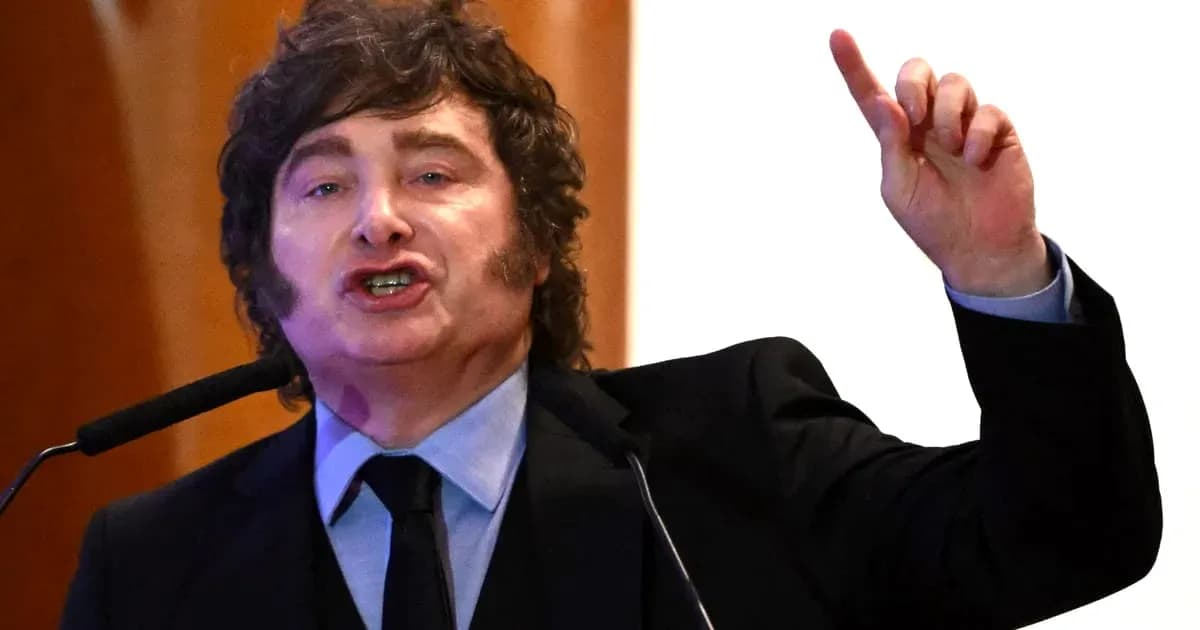
On Thursday, Javier Milei took to X and declared that his government is “getting closer every day” to recovering sovereignty over the Falkland Islands. The timing was no coincidence. The message was unmistakable.
He mocked what he saw as British outrage over the celebrations, deriding the reaction as “tantrums befitting a terminally mononeuronal teenager.” Then he set out his own framing of the moment: while others fumed, Argentina, he claimed, was advancing “through the diplomatic route” toward the recovery of the Malvinas, South Georgia, the South Sandwich Islands, and the surrounding maritime space.
It was a direct escalation, delivered in Milei’s trademark confrontational style.
From Dressing Room To Diplomatic Arena
The spark for this latest flare-up came from a football pitch, but it did not stay there.
FIFA confirmed on Thursday that its independent disciplinary committee is reviewing the match reports and the circumstances around the banner before deciding whether to open a case. Argentina’s football association has been here before: it was fined in 2014 for displaying the same slogan ahead of a friendly against Slovenia.
British ministers want more than a review. They want punishment. Argentina, for its part, is presenting the banner as an expression of national sentiment, not a breach of sporting protocol.
Milei has thrown his weight firmly behind the players. Speaking to Radio El Observador, he called the message a legitimate outpouring of feeling. “The Malvinas are Argentine, we are going to recover them and we are going to do it at the diplomatic level,” he said.
The irony is hard to miss. Just a day earlier, Milei had urged Argentines not to mix football with the sovereignty dispute, dismissing such gestures as “cheap” patriotism. Now, with the world watching, he has seized on exactly that moment to sharpen his stance.
Old Wounds, New Stage
The Falklands — the Malvinas in Argentina — have sat at the heart of a fraught sovereignty dispute for generations. In 1982, Britain and Argentina fought a brief but brutal war over the islands. London retained control; the political scars never really faded.
In Buenos Aires, the islands remain a potent symbol. In London, they are treated as non-negotiable British territory. Every few years, a moment like this drags the issue back into the headlines: a speech, a vote at the United Nations, a flare-up over oil exploration. This time, it is a World Cup semifinal and a banner on a pitch.
The rhetoric around the game only sharpened the edges. Before kick-off, Argentine Vice President Victoria Villarruel had already raised the temperature, branding Britain “usurping pirates.” The match, loaded with historical and emotional baggage even before the first whistle, became the perfect stage for a political message.
Once the players unfurled that banner, the line between sport and statecraft vanished.
Washington Drawn Into The Crossfire
The row has not stayed confined to Buenos Aires and London either.
Milei’s post on X came in response to Marc Zell, chair of the U.S. Republican Party’s branch in Israel, who had urged the Trump administration to rethink long-standing U.S. policy on the Falklands and back Argentina’s sovereignty claim. It was a reminder that the issue still has the power to pull in outside actors and test old alliances.
For now, Washington’s official stance remains unchanged. Yet the fact that senior political figures in the U.S. orbit are publicly prodding the question shows how quickly the Falklands dispute can resurface in unexpected places when emotions are running high.
Football, Flags, And The Next Flashpoint
So a semifinal that should have been remembered for tactics, saves, and goals has become another chapter in a dispute that refuses to die.
On one side, a British government insisting that the islands “definitely” belong to the United Kingdom. On the other, an Argentine president claiming he is edging closer, “every day,” to recovering them by diplomatic means, even as his players turn a victory lap into a political statement.
FIFA will decide whether the banner merits sanctions. Britain and Argentina will return to their entrenched positions. The islands will remain where they have always been, in the South Atlantic, and at the heart of two nations’ competing identities.
The real question is not whether this row fades. It will, at least until the next flashpoint. The question is what happens when the next banner goes up, the next chant rings out, and football once again becomes the loudest megaphone in a dispute that never really leaves the pitch.
Related News
Ilia Topuria Accuses Justin Gaethje After UFC Defeat

Tyson Fury vs Anthony Joshua Fight Date and Venue Confirmed
Switzerland Calls Up In-Form Sion Striker Winsley Boteli for Nations League
Bournemouth Secures Historic 2-1 Win Over Real Sociedad in Spain
Portugal Announces Squad for 2026 UEFA Nations League; Cristiano Ronaldo Expected to Play
Raphinha Channels Ronaldo Nazario as Barcelona's Leading Striker After Position Change