
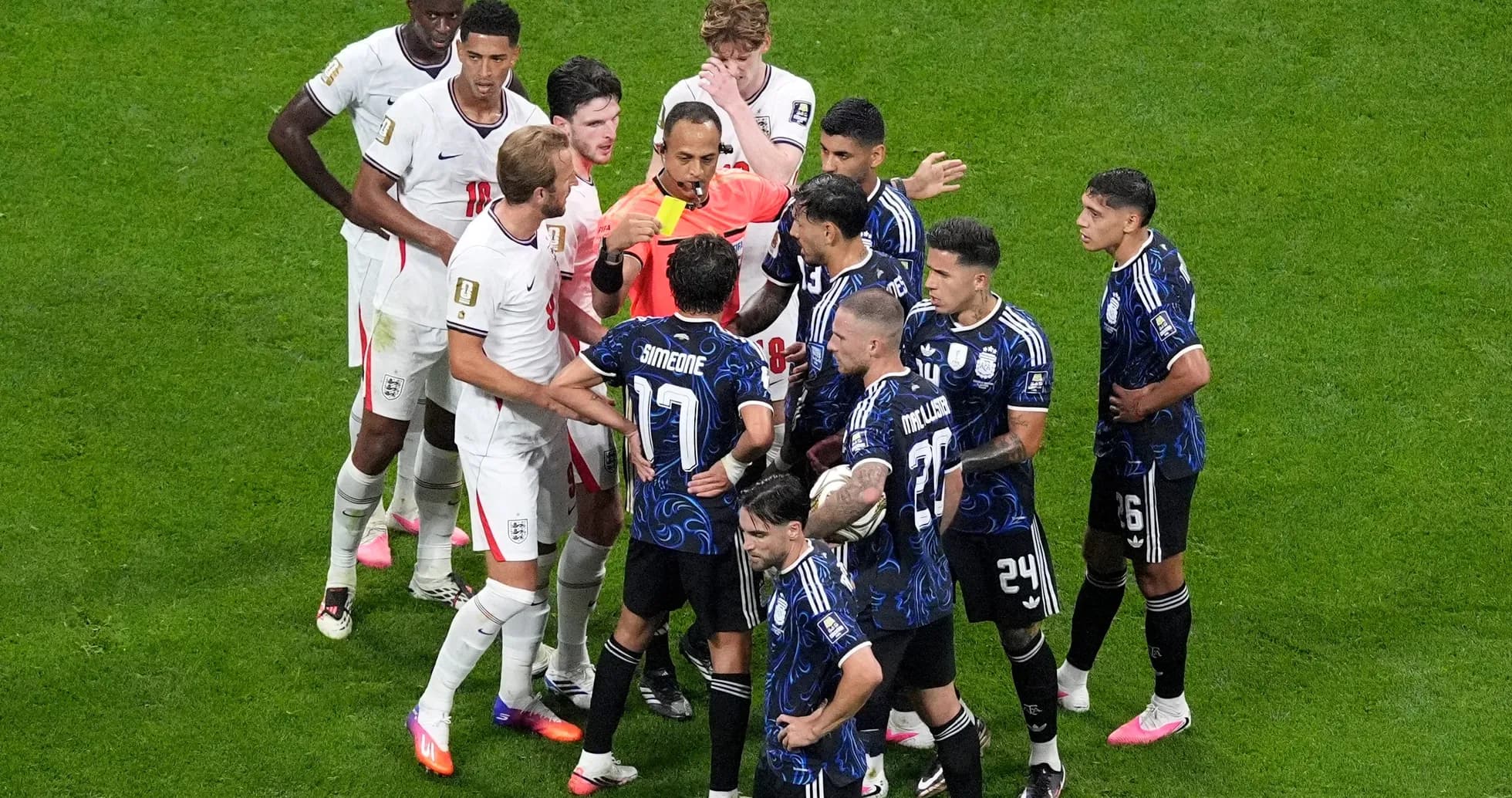
Argentina Edges England in World Cup Semi-Final
Under the closed roof of Mercedes-Benz Stadium, the semi-finals of the World Cup brought together two teams whose entire campaigns seemed to be converging on this night: England, methodical and increasingly expansive under Thomas Tuchel, and Argentina, a relentless winning machine powered by the enduring genius of L. Messi. The scoreboard at full time read 1–2, Argentina edging a classic that felt less like a single match and more like the culmination of two carefully constructed journeys.
I. The Big Picture – Two Paths to the Same Summit
Heading into this game, both sides had been near-flawless. England arrived as Group L winners, first in their pool with 7 points, a goal difference of 4 from 6 goals scored and 2 conceded in 3 group matches. Argentina had been even more ruthless in Group J: 3 wins from 3, 9 points, a goal difference of 7 with 8 scored and only 1 conceded.
Across the entire tournament, England’s profile was one of balance and controlled risk. In total they had played 7 fixtures: 4 at home-designated venues, 3 on their travels. Overall they had 5 wins, 1 draw and just 1 defeat. In total this campaign they scored 14 goals and conceded 8. The averages tell the story of a side that can raise the tempo when needed: at home they averaged 1.8 goals for and 1.3 against; on their travels they were even more incisive, with 2.3 goals for and 1.0 against, giving an overall scoring rate of 2.0 and 1.1 conceded.
Argentina, by contrast, arrived in Atlanta with a perfect record. In total they had 7 wins from 7, 5 at home-designated venues and 2 away, with 19 goals scored and 7 conceded. At home they averaged 2.8 goals for and 1.0 against; on their travels 2.5 for and 1.0 against, an overall 2.7 scored and 1.0 conceded. Their goal difference overall stood at 12, a reflection of a side that marries attacking ambition with enough defensive resilience to absorb pressure.
The formations mirrored their identities. Tuchel’s England went with the now-familiar 4-2-3-1: J. Pickford behind a back four of R. James, J. Stones, M. Guehi and D. Spence; D. Rice and E. Anderson as the double pivot; a creative band of three in M. Rogers, J. Bellingham and A. Gordon behind H. Kane. Argentina, under Lionel Scaloni, shifted into a 4-1-4-1: E. Martinez in goal; N. Molina, C. Romero, L. Martinez and N. Tagliafico across the back; L. Paredes anchoring; G. Simeone, E. Fernandez, A. Mac Allister and J. Alvarez across midfield; and Messi as the nominal lone forward, free to roam.
II. Tactical Voids – Suspensions, Discipline and Emotional Edges
England’s squad sheet carried one notable absence: J. Quansah, ruled out by suspension through the sports court. His red card earlier in the tournament, added to a yellow, painted him as a high-impact, high-risk defender. With 1 red and 1 yellow in just 117 minutes, his aggression had already shaped England’s disciplinary profile. Tuchel’s choice of M. Guehi alongside J. Stones, and the presence of D. Burn, T. Chalobah and E. Konsa on the bench, underlined how England had quietly built depth at the back to absorb such losses.
Discipline had been a subtle subplot in England’s run. In total, their yellow cards had been spread across the match, but with a clear spike in the 31–45 and 61–75 minute windows, each accounting for 25.00% of their cautions. That pattern spoke of a side that often tightened the screw as halves drew to a close, sometimes tipping into cynicism. Red cards were rare but costly: the only sending-off had come between 46–60 minutes, a reminder that England’s intensity straight after half-time could edge into danger.
Argentina’s disciplinary curve was stranger, and more ominous in the context of knockout football. Their yellow cards clustered heavily in extra-time scenarios: 44.44% between 91–105 minutes and 22.22% between 106–120. In regulation time they were relatively clean, with just 11.11% of their yellows in each of the 31–45, 46–60 and 76–90 ranges. That profile suggested a team that keeps its head for 90 minutes but is prepared to go to the dark places if the game stretches beyond. In this semi-final, with no extra-time required, that extra edge never needed to be fully unleashed.
From a penalty perspective, England had been perfect: 2 penalties in total, both scored, a 100.00% conversion rate that reinforced H. Kane’s reliability from the spot. Argentina, remarkably, were the opposite. They had been awarded 3 penalties in total but scored only 1, missing 2 for a conversion rate of 33.33%. The twist: Messi himself had missed 2 penalties in the tournament, a rare blemish in an otherwise historic campaign. Any pre-match tactical preview had to acknowledge that if this semi-final became a penalty shootout, the psychological advantage might tilt towards England despite Argentina’s aura.
III. Key Matchups – Hunter vs Shield, and the Engine Room
The headline duel was inescapable: L. Messi against England’s defensive structure. Messi arrived as the World Cup’s top scorer, with 8 goals and 4 assists in 7 appearances, a rating of 9.07 across 620 minutes. He had taken 28 shots, 18 on target, and completed 24 dribbles from 35 attempts. His 26 key passes and 314 total passes at 81% accuracy framed him not just as a finisher but as the primary architect of Argentina’s attacks.
Facing him was a back line fronted by D. Rice, England’s shield and one of the tournament’s most influential holding midfielders. Rice had played 481 minutes, with 240 passes at 91% accuracy and 15 key passes, a surprisingly creative output for a player whose first job was to protect. He had already taken 4 shots, 2 on target, and chipped in with 2 blocked shots. Yet his card record – 2 yellows in 6 appearances – underlined how often he operated on the edge. England’s yellow-card distribution, with a quarter of their cautions in each of the late first-half and early second-half windows, made the Rice–Messi zone feel like a pressure cooker.
Behind Rice, J. Stones and M. Guehi had to manage Messi’s drifting. With Argentina setting up in a 4-1-4-1, J. Alvarez and A. Mac Allister often occupied the half-spaces, allowing Messi to drop between the lines or peel into channels. England’s full-backs, R. James and D. Spence, were therefore caught between stepping out to the Argentine wide midfielders and staying compact to deny Messi the inside pockets he thrives in.
At the other end, England’s own “hunter” pairing came from deeper on the pitch. J. Bellingham and H. Kane both arrived with 6 goals in total this campaign. Bellingham, from midfield, had 6 goals and 1 assist in 618 minutes, with 15 shots and 11 on target, plus 8 key passes and 21 dribbles attempted. Kane, the classic nine, had 6 goals and 1 assist in 654 minutes, 18 shots with 12 on target, and a 70% pass accuracy that masked his underrated link play: 5 key passes and 2 successful penalty conversions.
Argentina’s shield against that duo was more collective than individual. L. Paredes sat as the single pivot, but C. Romero and L. Martinez were the real bulwark. Argentina’s overall defensive record – 7 goals conceded in 7 matches, 1.0 per game both at home and on their travels – suggested a unit comfortable with conceding territory but not chances. Their clean sheet count, 2 in total, was modest, but they rarely allowed games to become chaotic.
On England’s left, A. Gordon was the wild card. With 1 goal and 3 assists in 412 minutes, plus 6 key passes and 25 dribble attempts, his directness had become a key release valve. Up against N. Molina and the right side of Argentina’s defence, Gordon’s ability to isolate his marker and draw fouls (10 fouls drawn in the tournament) was a potential route to set-pieces and, perhaps, another penalty.
The “engine room” duel, though, ran through Bellingham and E. Fernandez. Bellingham’s blend of ball-carrying, pressing and late box entries had been England’s emotional barometer. Fernandez, starting in the inside right midfield slot of Argentina’s four, offered progression, tempo control and the capacity to break England’s first line. Between them, and with A. Mac Allister drifting into pockets, the central third became a chessboard of rotations and counters.
IV. Statistical Prognosis – Why the Margins Tilted Argentina’s Way
On the numbers alone, this semi-final always looked like a razor-edge contest. In total this campaign, England’s attacking output of 2.0 goals per game met Argentina’s 2.7. Defensively, England’s 1.1 conceded per match was marginally looser than Argentina’s 1.0. England had 2 clean sheets in total, matching Argentina’s 2, but Argentina carried the heavier offensive artillery and the longer winning streak: 7 consecutive victories compared to England’s best run of 4 straight wins.
The underlying patterns hinted at how the game might be decided. England’s tendency to pick up cards in the 31–45 and 61–75 minute windows suggested that as halves wore on, their duels grew more desperate. Against a player like Messi, who thrives on drawing contact – 16 fouls drawn in the tournament – that was a risk. Every time Rice or a centre-back stepped in late, the spectre of a dangerous free-kick or a booking loomed.
Argentina’s own weakness from the spot, with 2 penalties missed in total, meant that any reliance on penalties – in-game or in a shootout – would have been a tactical gamble. Tuchel’s England, with Kane’s 2 scored from 2, might have welcomed that path. But Argentina’s plan was always to settle it in 90 minutes, leveraging their superior goal output and Messi’s capacity to create something from nothing in open play.
From a notional xG perspective, the profiles suggested Argentina would generate slightly higher-quality chances. Their higher scoring rate on both home and away designations, combined with Messi’s shot volume and accuracy, pointed to a side that routinely turned possession into dangerous opportunities. England, by contrast, spread their threat across Kane, Bellingham and the wide players, often requiring more structured build-up to arrive in the box.
In the end, the 2–1 scoreline felt like the logical intersection of those arcs. England’s 4-2-3-1 gave them phases of control, with Bellingham and Rice anchoring long spells of possession. But Argentina’s 4-1-4-1, with Messi at its apex, offered the more decisive cutting edge. The hunter–shield duels tilted just enough in Argentina’s favour: Messi found spaces Rice could not always close, while at the other end Romero and L. Martinez contained Kane and limited the chaos in their own box.
Following this result, Argentina’s perfect record extended to 8 wins from 8, their aura of inevitability intact. England, who had built a campaign on balance, adaptability and the rising stars of Bellingham and Gordon around the established menace of Kane, fell one step short. Tactically, the margins were slim; statistically, they were predictable. In a semi-final defined by detail, the team with the sharper edge in both penalty areas – even with missed penalties in their past – advanced, and the World Cup’s grand narrative moved on with Messi still at its centre.
Related News

Thomas Tuchel Reflects on England's 10-Man World Cup Triumph and a Surprising Regret

Robert Moreno Takes Over as Interim South Korea Coach After World Cup Setback

Jude Bellingham Returns to Form with Real Madrid After World Cup Success

Chloe Kelly, Beth Mead & 13 Lionesses Who Must Shine in the Upcoming WSL Season for England’s 2027 World Cup Bid

Barcelona Cancels World Cup Tribute Amid Political Tensions
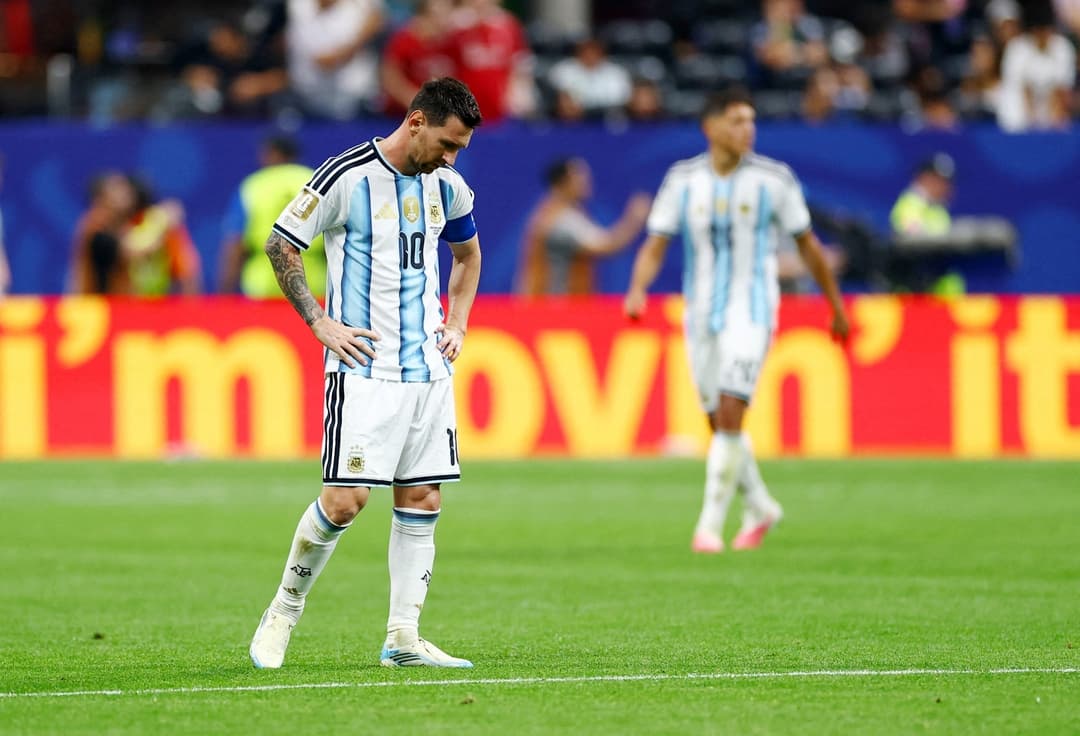
Messi Breaks Record for Most Penalties Taken and Missed in FIFA World Cup History