

Argentina vs Cape Verde Islands: A World Cup Knockout Clash
The World Cup moved from group-stage geometry to knockout jeopardy at Hard Rock Stadium, and this Round of 32 tie between Argentina and Cape Verde Islands stretched all the way to 120 minutes before the holders finally imposed their will. The 2–1 score after extra time mirrored the broader seasonal pattern: Argentina’s ruthless efficiency against Cape Verde’s stubborn resistance.
I. The Big Picture – Two Identities Colliding
Heading into this game, Argentina arrived as the tournament’s most convincing machine. They topped Group J with 9 points from 3 matches, a perfect record built on 8 goals scored and just 1 conceded overall. Their overall goal difference of 7 was the product of that 8–1 balance, and the season profile in this World Cup only reinforced the picture: 4 wins from 4 fixtures in total, 11 goals for and 3 against. That yields an overall attacking average of 2.8 goals per match and just 0.8 conceded.
Cape Verde Islands came from the opposite end of the stylistic spectrum. They reached the Round of 32 by drawing all 3 of their group matches in Group H, finishing with 3 points and an overall goal difference of 0, courtesy of 2 goals scored and 2 conceded. In the wider tournament sample of 4 fixtures, they still had no wins: 3 draws and 1 defeat in total, with 4 goals for and 5 against. Their overall averages – 1.0 goal scored and 1.3 conceded per match – told of a side that lives on the margins, surviving via compact structure and game management rather than attacking volume.
The formations underlined that contrast. Argentina stayed loyal to their 4-4-2, the shape they have used in all 4 matches. Cape Verde Islands remained equally consistent in a 4-1-4-1 that has also been their default in all 4 fixtures, a single pivot shielding a back four, with a mobile line of four in front.
II. Tactical Voids and Discipline – The Edges of Risk
There were no listed absentees, so both coaches had their full squads. That made the tactical choices even more revealing.
Lionel Scaloni’s back four of N. Molina, C. Romero, L. Martinez (defender) and F. Medina sat in front of E. Martinez in goal. In midfield, R. de Paul and A. Mac Allister flanked the central pairing of E. Fernandez and T. Almada, with L. Messi and L. Martinez (forward) forming a classic two-man strike force.
Pedro Leitao Brito answered with a 4-1-4-1 built for suffering without the ball. Vozinha started in goal, protected by S. Moreira, R. Lopes, D. Borges and S. Lopes Cabral. In front of them, K. Lenini anchored as the lone holding midfielder. Ahead, R. Mendes, L. Duarte, D. Duarte and J. Cabral formed a hard-working band of four behind N. Da Costa as the isolated forward.
Disciplinary profiles hinted at how the game might feel in the duels. Argentina’s yellow-card map this tournament is heavily back-loaded: 33.33% of their cautions have arrived between 76–90 minutes, another 33.33% between 91–105, and 33.33% between 106–120. They tend to play cleaner early, then accumulate cards as the tension rises late and into extra time – exactly the script that unfolded in Miami as the tie stretched beyond 90.
Cape Verde Islands, by contrast, front-load their aggression. In total this campaign, 40.00% of their yellow cards have come in the first 15 minutes, with another 20.00% between 16–30 and 20.00% between 61–75, plus 20.00% between 91–105. That profile describes a side that starts on the edge, pressing high and tackling hard early to unsettle technically superior opponents, then reverts to bursts of intensity as legs tire.
On penalties, Argentina carried a subtle psychological weight. In total this campaign they have won two spot-kicks but scored only one; the other was missed, a 50.00% conversion rate that prevents any notion of infallibility from twelve yards. Cape Verde Islands, on the other hand, have not taken a penalty in this World Cup so far, with zero scored and zero missed.
III. Key Matchups – Hunter vs Shield, Engine Room vs Enforcer
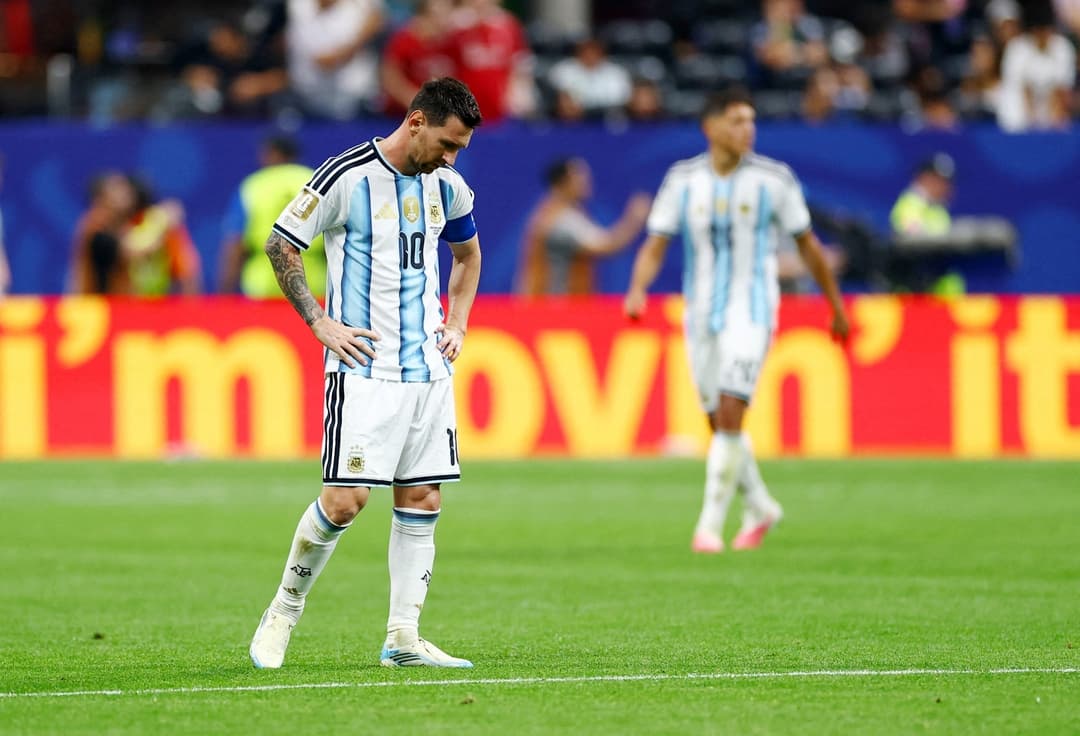
The headline duel was always going to be L. Messi against Cape Verde’s defensive block. Messi came into this tie as the competition’s outstanding attacking force: 7 goals in total from 4 appearances, supported by 22 shots (15 on target) and 10 key passes. His overall rating of 9.28 reflects a player dictating games both as finisher and creator.
Cape Verde Islands’ defensive numbers were respectable but not elite. On their travels they have conceded 5 goals in 3 away fixtures, an away average of 1.7 goals against per match, while scoring 4 (an away average of 1.3). That away defensive figure, combined with their overall 1.3 goals conceded per match, suggested a unit that can hold a shape but will eventually bend under sustained, high-level pressure.
The “Hunter vs Shield” dynamic therefore revolved around how R. Lopes and D. Borges could manage Messi’s half-spaces, with K. Lenini screening in front. The 4-1-4-1 was designed to compress central lanes, forcing Argentina’s forwards to receive with their backs to goal or drift wide. Yet Messi’s numbers this tournament – 11 dribble attempts with 5 successes, 11 fouls drawn – implied that even in crowded zones he would drag defenders out of position and win set-pieces.
In midfield, the “Engine Room” clash pitted Argentina’s trio of R. de Paul, A. Mac Allister and E. Fernandez against K. Lenini and the Cape Verde interior pairing of L. Duarte and D. Duarte. De Paul’s role as shuttler, linking defense to attack, and Mac Allister’s capacity to receive between lines were central to breaking Cape Verde’s first line of pressure. T. Almada’s presence as a nominal wide midfielder but natural playmaker added another interior threat, overloading the pockets around Lenini.
Cape Verde’s route out was always going to be transitional. J. Cabral and R. Mendes, starting from wide midfield roles, needed to carry the ball into space to connect with N. Da Costa. But Argentina’s overall defensive record – just 3 goals conceded in 4 matches in total, with 2 clean sheets at home – signaled that E. Martinez, C. Romero and L. Martinez (defender) were comfortable defending large spaces behind an aggressive press.
IV. Statistical Prognosis – Why Extra Time Favored Argentina
From a statistical lens, this tie was always tilted toward Argentina, even if Cape Verde Islands’ draw-heavy profile made extra time plausible.
Argentina’s overall attacking average of 2.8 goals per match against Cape Verde’s overall defensive average of 1.3 conceded suggested that, over 90 minutes, the South Americans were likely to generate superior xG and chances. At the other end, Cape Verde’s overall attacking average of 1.0 goal per game ran into an Argentina defense allowing only 0.8 in total – a clash that favored the holders in both territory and shot quality.
The late-card patterns also mattered. Argentina’s tendency to collect yellows in the 76–120 minute window reflects a side still pressing and engaging physically deep into matches, rather than retreating. Cape Verde’s early-card profile hints at a front-loaded intensity that is hard to sustain across 120 minutes against a deep, technically secure squad.
Layer on the psychological factor of Messi’s form – 7 goals in total, 141 completed passes and 10 key passes so far – and the narrative becomes clear. Over a long match, Argentina’s repeated waves of possession and combination play were always more likely to crack Cape Verde’s structure than vice versa. Even with the memory of a missed penalty earlier in the tournament tempering any sense of inevitability, the underlying numbers pointed toward Argentina eventually converting their superiority.
In the end, that is exactly what unfolded in Miami: Cape Verde Islands dragged the champions into extra time through organization and resilience, but over 120 minutes the weight of Argentina’s attacking structure, led by Messi and supported by a balanced 4-4-2 spine, bent the contest decisively in their favor.
Related News

Thomas Tuchel Reflects on England's 10-Man World Cup Triumph and a Surprising Regret

Robert Moreno Takes Over as Interim South Korea Coach After World Cup Setback

Jude Bellingham Returns to Form with Real Madrid After World Cup Success

Chloe Kelly, Beth Mead & 13 Lionesses Who Must Shine in the Upcoming WSL Season for England’s 2027 World Cup Bid

Barcelona Cancels World Cup Tribute Amid Political Tensions
Messi Breaks Record for Most Penalties Taken and Missed in FIFA World Cup History