
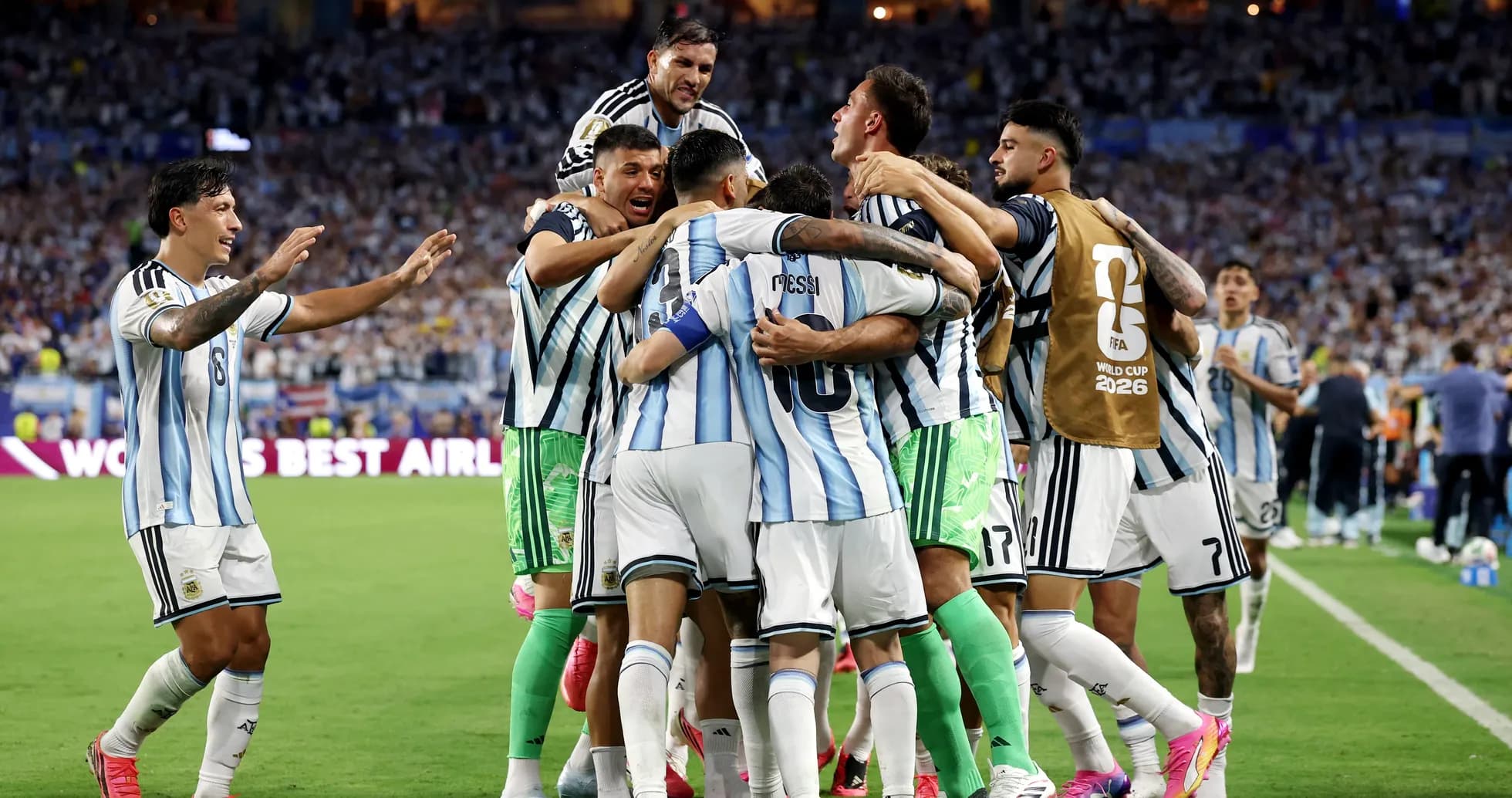
Argentina's Tactical Victory Over Cape Verde Islands in World Cup Clash
Argentina’s 2-1 extra-time win over Cape Verde Islands at Hard Rock Stadium in this World Cup Round of 32 tie was a contest defined by territorial dominance against compact resistance, eventually decided by a defensive error under severe structural pressure. Across 120 minutes, Argentina imposed their positional game and passing control, while Cape Verde Islands oscillated intelligently between a low and mid-block, countering selectively and staying alive deep into extra time.
Argentina lined up in a 4-4-2 under Lionel Scaloni, but in possession it behaved more like a 2-3-5 or 3-2-5 depending on full-back height. Nahuel Molina and Facundo Medina pushed high and wide, with Enzo Fernández and Alexis Mac Allister forming the central circulation hub and Rodrigo De Paul often stepping into the right half-space. Lionel Messi and Lautaro Martínez operated as a fluid front pair: Messi dropped between the lines to connect and dictate tempo, while Lautaro pinned the Cape Verde Islands centre-backs, threatening depth.
The statistical profile reflects that structure: 64% possession, 849 passes with 779 accurate (92%), and 22 total shots, 10 on goal and 7 blocked. Argentina consistently established long spells of possession in the opposition half, using width to stretch Cape Verde Islands’ 4-1-4-1 and isolate the single pivot, Kevin Lenini. The high volume of shots inside the box (15) underlines how effectively Argentina progressed into dangerous central zones, rather than relying on low-value long-range attempts.
Cape Verde Islands, in contrast, were built around Pedro Leitao Brito’s compact 4-1-4-1. Out of possession, the wingers Jovane Cabral and Ryan Mendes dropped to form a narrow midfield four in front of Lenini, leaving Nuno Da Costa as the lone outlet. The aim was clear: concede wide areas, protect the central lane, and break quickly once the ball was recovered. With 36% possession and 476 passes (408 accurate, 86%), their approach was pragmatic, prioritising verticality and transition rather than sustained build-up. Their 16 shots, with 5 on goal and 6 blocked, show they managed to turn limited ball time into a respectable attacking output, especially through quick switches and second balls.
First Half
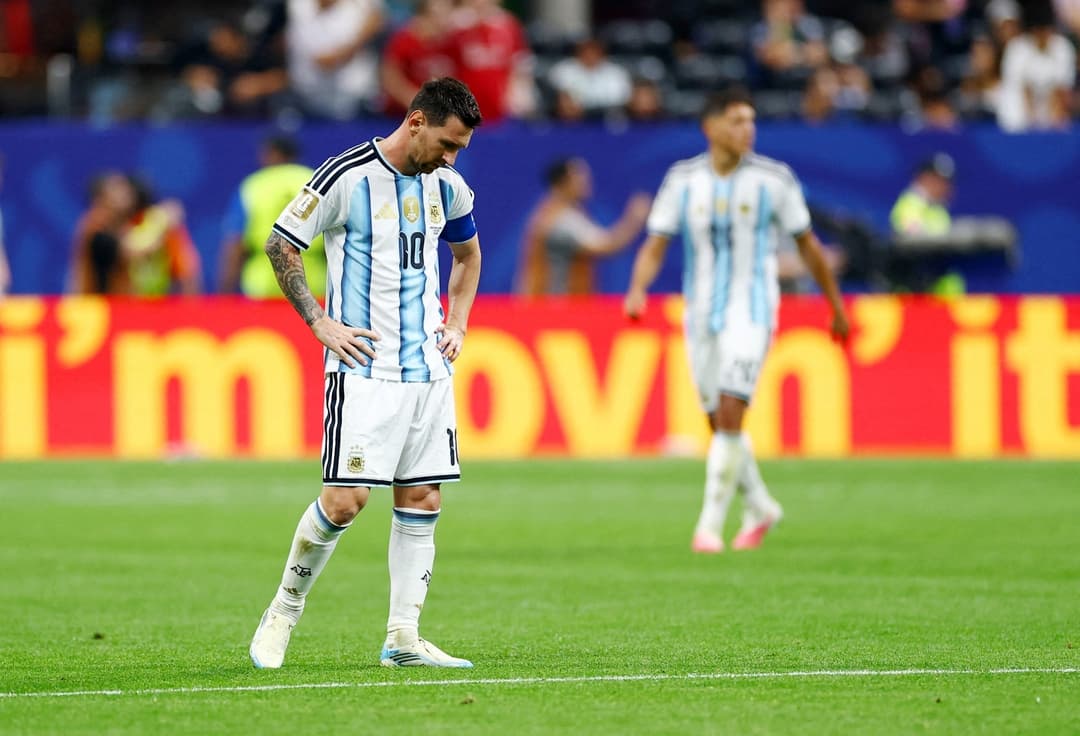
The opening goal at 29' from Messi, assisted by Lisandro Martínez, was the logical product of Argentina’s territorial control. With Cape Verde Islands’ block compressed centrally, Argentina’s repeated recycling from side to side eventually disorganised the back line just enough for Messi to find a pocket. Lisandro stepping forward from defence into a playmaking role epitomised Argentina’s aggressive rest-defense: centre-backs were encouraged to break lines when space appeared, trusting the collective structure behind them.
Cape Verde Islands’ equaliser at 59', scored by Deroy Duarte from a Ryan Mendes assist, highlighted their transition threat. After withstanding pressure, they exploited an Argentine moment of structural vulnerability: with full-backs advanced and midfield stretched, Mendes found room to drive at the back line and feed Duarte. It was a reminder that Argentina’s high line and aggressive positioning always carried counter-risk, especially if the counter-press was broken.
Second Half Substitutions
Scaloni’s double change at 63' — Nicolás González (IN) for Thiago Almada (OUT) and Julián Alvarez (IN) for Lautaro Martínez (OUT) — tilted the attacking dynamic. González offered more direct wide running and depth from the flank, while Alvarez added relentless pressing and diagonal movements off Messi. This shifted Argentina from a more controlled positional front two to a higher-energy, more vertical front line, increasing the volume of box entries and chaotic moments around the Cape Verde Islands area.
Pedro Leitao Brito’s response at 67' — Dailon Rocha Livramento (IN) for Nuno Da Costa (OUT) and Jamiro Monteiro (IN) for Laros Duarte (OUT) — was aimed at refreshing legs in midfield and attack to maintain transition threat. Yet the Yellow Card to Kevin Lenini at 68' for “Foul” underlined the strain on the Cape Verde Islands pivot, repeatedly exposed by Argentina’s rotations between De Paul, Mac Allister and Messi.
As the game moved into the final phase of normal time, Cape Verde Islands added Hélio Varela (IN) for Jovane Cabral (OUT) and Willy Semedo (IN) for Ryan Mendes (OUT) at 80', seeking fresh pace wide. Argentina, for their part, introduced Leandro Paredes (IN) for Rodrigo De Paul (OUT) at 84' to stabilise circulation and Nicolàs Tagliafico (IN) for Facundo Medina (OUT) at 86' to keep full-back energy high on the left.
Extra Time
The extra-time period became a test of structural resilience. Argentina’s second goal at 93', scored by Lisandro Martínez from an Alexis Mac Allister assist, came from sustained pressure and set-positional superiority. Mac Allister’s timing between the lines and Lisandro’s advanced positioning again showed Argentina’s centre-backs being used as additional attackers in settled possession.
Cape Verde Islands, however, refused to fold. At 100', Gilson Tavares (IN) replaced Kevin Lenini (OUT) and Yannick Semedo (IN) replaced Deroy Duarte (OUT), subtly reshaping the midfield and adding fresh legs in central and attacking roles. The equaliser at 103', scored by Sidny Lopes Cabral, emerged from that renewed energy and Argentina’s fatigue: with the defensive line repeatedly pushed back, a moment of disorganisation allowed Sidny Lopes Cabral to capitalise, again underlining Cape Verde Islands’ efficiency when they reached the final third.
Scaloni’s final defensive adjustment saw Gonzalo Montiel (IN) for Nahuel Molina (OUT) at 104', a move likely intended to add fresh defensive solidity and experience on the right as legs tired. Ironically, the decisive moment came from the Cape Verde Islands back line: an own goal by Diney Borges at 111' under intense Argentine pressure. It was the culmination of Argentina’s volume of crosses, cut-backs and second-phase attacks — the kind of error that emerges when a back four spends long stretches defending its own box.
Discipline and Goalkeeping
Discipline stayed relatively controlled: Cape Verde Islands finished with 1 Yellow Card (Kevin Lenini, 68', “Foul”), Argentina also with 1 Yellow Card (Gonzalo Montiel, 115', “Foul”). The late booking for Montiel reflected the attritional nature of the closing stages, with Argentina protecting their narrow extra-time lead.
From a goalkeeping and defensive standpoint, Emiliano Martínez (Argentina) faced 5 shots on goal and made 3 saves according to the team statistics, with goals prevented rated at -0.6, suggesting he conceded slightly more than the modelled expectation of the chances faced. His role, though, was as much about sweeping and supporting a high line as pure shot-stopping. Vozinha (Cape Verde Islands) endured far heavier pressure: 10 shots on goal against and 8 saves, also with goals prevented at -0.6, indicating that while he made a high number of stops, the two goals conceded aligned with the overall shot quality Argentina produced.
The expected goals underline the tactical story: Argentina’s xG of 2.16 against Cape Verde Islands’ 0.45 reflects sustained, high-quality chance creation versus more sporadic, lower-probability efforts. Argentina’s 8 corner kicks to Cape Verde Islands’ 8 show parity in set-piece volume, but within open play Argentina’s 7 blocked shots reveal how often Cape Verde Islands’ low block got bodies in front of efforts, even as they were territorially dominated.
Overall, Argentina’s superior structure, passing accuracy and depth of attacking options eventually broke Cape Verde Islands’ resistance. Yet Cape Verde Islands’ ability to stay in the game with limited possession, strike twice, and force extra time speaks to a disciplined, well-drilled 4-1-4-1 that maximised transitions and nearly stretched a heavyweight into a penalty shootout.
Related News
Thomas Tuchel Reflects on England's 10-Man World Cup Triumph and a Surprising Regret
Robert Moreno Takes Over as Interim South Korea Coach After World Cup Setback

Jude Bellingham Returns to Form with Real Madrid After World Cup Success

Chloe Kelly, Beth Mead & 13 Lionesses Who Must Shine in the Upcoming WSL Season for England’s 2027 World Cup Bid
Barcelona Cancels World Cup Tribute Amid Political Tensions
Messi Breaks Record for Most Penalties Taken and Missed in FIFA World Cup History