
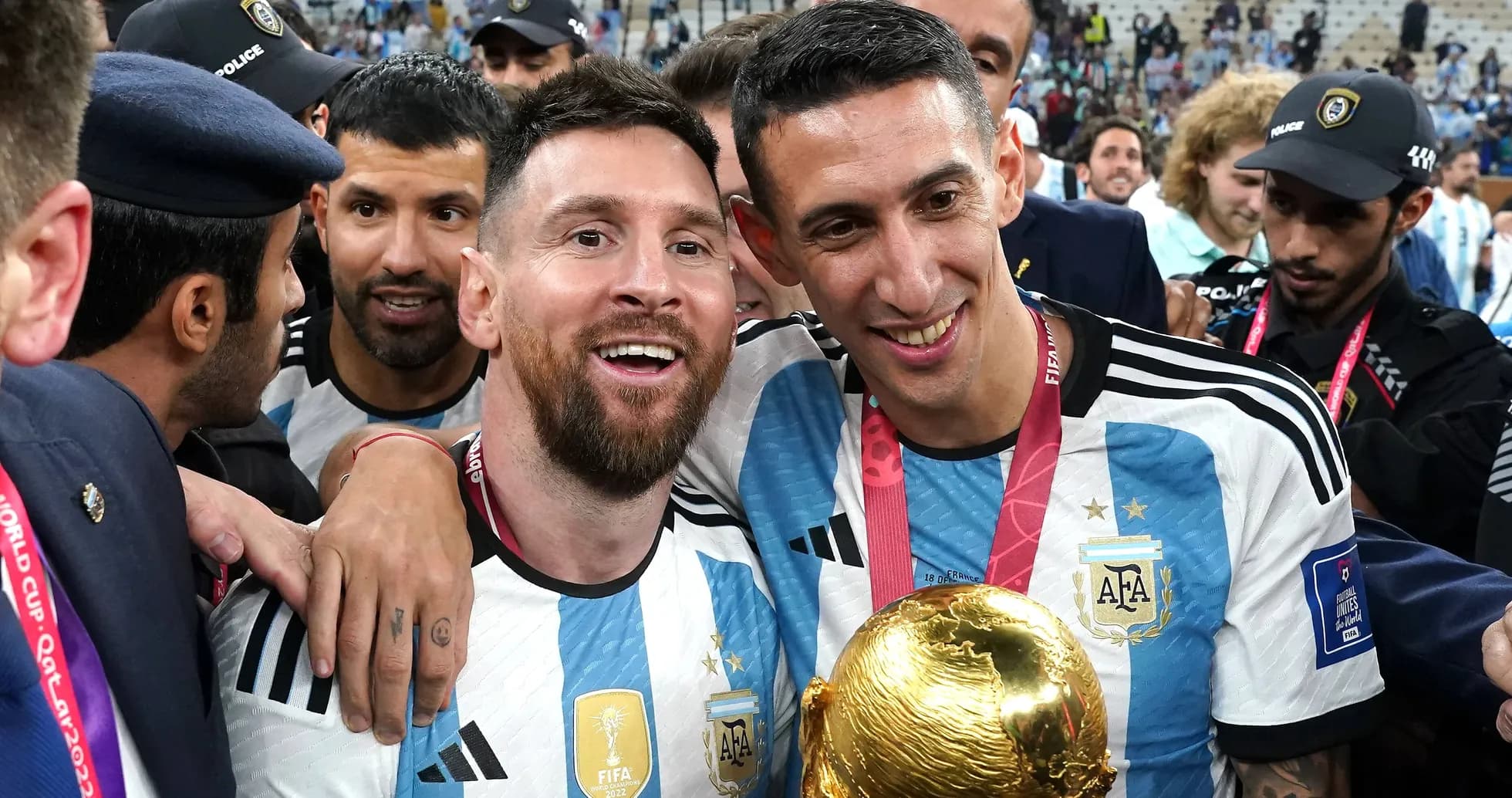
Ángel Di María Defends Messi's Future: 'He Has No Ceiling'
Ángel Di María has never been one for half-measures. Not on the pitch, and certainly not when he talks about Lionel Messi.
Days after Argentina’s emotional run at the 2026 World Cup came to an end, the veteran winger delivered a message that cut through all the speculation swirling around his long-time captain and friend: Messi is not done.
The setting was modest enough – Rosario Central’s 2-1 defeat to Belgrano – but Di María’s words carried the weight of a decade and a half shared in the national shirt.
“Leo has to keep going as long as he wants,” Di María said, refusing to entertain the idea that the 39-year-old’s time at the top is winding down. “I think he can continue for many more years. At 39, he's shown that he's one of the best and that he can continue to be one of the best in history. He has no ceiling, there's nothing more for him.”
In other words, if Messi is close to the end, it will be on his terms, not because his level has dropped.
Messi’s future, on his own terms
Di María’s stance lands at a delicate moment for Argentina. Leandro Paredes recently revealed that Messi had framed the 2026 World Cup final as his farewell to the international stage, a line in the sand that instantly fuelled debate about what comes next for the Albiceleste.
Di María, though, pushed back against the idea that the story is already written. For him, the evidence is simple: even at 39, Messi remains decisive, influential, and still operating in the rarefied air he has occupied for almost two decades.
The implication is clear. Age is a number; the standard is not.
Scaloni, the anchor of a golden era
Di María did not stop at defending Messi’s future. He turned quickly to another pillar of Argentina’s recent success: Lionel Scaloni.
If Messi is the genius on the pitch, Scaloni is the architect on the touchline. Under his watch, Argentina have stitched together a golden era – a World Cup, two Copa Américas, and the Finalissima. Four major trophies that reshaped the identity of a team once haunted by near-misses.
“Scaloni is the leader of the national team, I hope he stays for everyone's sake,” Di María said. “He's developing a good generation of young players who are coming through now, and every little bit helps. I hope he stays; it's his decision. Scaloni, better than anyone, knows what he wants, but obviously, as an Argentine, I'd like him to continue.”
That line about the “good generation of young players” is no throwaway remark. Argentina’s dressing room has already begun to turn over, with a new wave trying to grow under the shadow of Messi, Di María and the other veterans who finally delivered the World Cup. Scaloni, in Di María’s eyes, is the one holding that transition together.
A group that changed everything
The winger also allowed himself a moment to look back, to take stock of what this group has already done for their country.
“They deserve more than just applause for everything they've achieved and have continued to achieve,” he said. “Beating England was the culmination of all that. For me, the World Cup ended there, and we gave the country its greatest joy, and that's the most beautiful thing for everyone.”
It is a revealing admission. For Di María, that victory – that cathartic, emotionally charged win over England – became the emotional peak of the tournament. The rest, including the final heartbreak, could not erase what had already been given to the people back home.
He spoke like a man who has lived every high and low in an Argentina shirt. Finals lost. Finals won. Goals, injuries, tears. And now, perspective.
Suffering, pride, and what comes next
Di María described how he experienced this World Cup from within the camp, the tension of each knockout game, the thin margins that separate joy from despair.
“I suffered through every match, but in the end they drew on their inner strength and that's what led to victories,” he said. “Finals are finals; sometimes you win, sometimes you don't. This time it wasn't our turn, but I think the lads did the national team proud.”
There was no attempt to sugar-coat the pain of defeat. Yet there was no hint of regret either. Pride, rather than frustration, framed his assessment of a squad that has already carved its place into football history.
So the questions now hang over Argentina’s future. Will Messi walk away after calling that final his goodbye, or listen to voices like Di María urging him to carry on? Will Scaloni decide he has taken this project as far as he can, or stay to guide the next generation?
For Di María, the answers are simple: keep Messi, keep Scaloni, keep the core of a culture that has turned talent into trophies.
Argentina’s golden era may have reached one of its natural turning points. Whether it becomes the end of a cycle or the start of a new chapter depends on two men who, for now, still hold their own destiny in their hands.
Related News
Ilia Topuria Accuses Justin Gaethje After UFC Defeat
Tyson Fury vs Anthony Joshua Fight Date and Venue Confirmed
Switzerland Calls Up In-Form Sion Striker Winsley Boteli for Nations League
Bournemouth Secures Historic 2-1 Win Over Real Sociedad in Spain
Portugal Announces Squad for 2026 UEFA Nations League; Cristiano Ronaldo Expected to Play
Raphinha Channels Ronaldo Nazario as Barcelona's Leading Striker After Position Change