
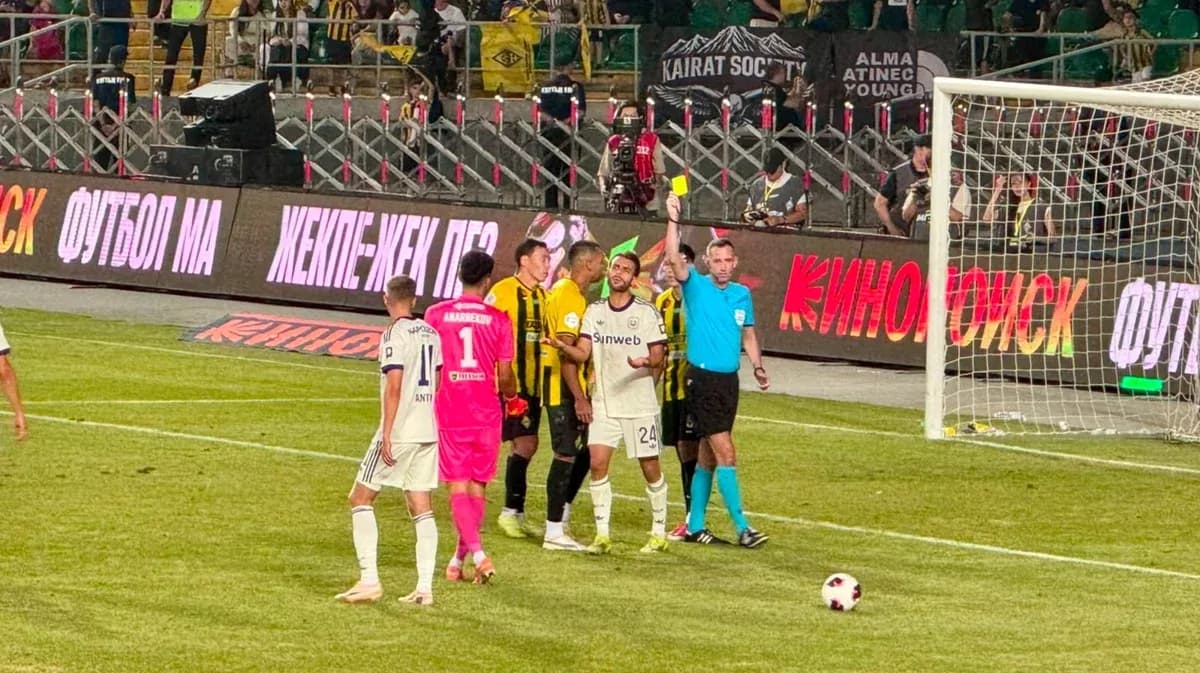
Anderlecht's Tactical Domination Over Kairat Almaty
Kairat Almaty’s 4-4-1-1 at Central Stadium was structurally conservative but quickly collapsed under Anderlecht’s high-possession 4-3-3 and a disastrous start. With Anderlecht finishing 3-0 up and controlling 67% of the ball, the tactical story is one of a dominant positional side exploiting early errors and then managing the game with maturity against ten men.
Out of possession, Kairat’s nominal back four of E. Tapalov, A. Shirobokov, Lucas Africo and L. Mata was supported by a flat midfield band featuring A. Mrynskiy, Jaakko Oksanen, G. Mendonsa and O. Jukkola, with M. Gual underneath Edmilson. The idea was clearly to compress central spaces and leave the lone striker to contest direct balls. However, the own goal by Oksanen in the 2nd minute shattered the game plan: chasing a low situation in their box so early forced Kairat to open lines they were not built to defend.
Anderlecht’s 4-3-3, with C. Coosemans behind a back four of L. Augustinsson, G. Biancone, L. Petrot and A. Maamar, and a midfield triangle of L. Ambros, M. Kana and E. Llansana, was geared for territorial control. The front three of M. Cvetkovic, D. Sikan and J. Nga Kana stretched Kairat horizontally, pinning full-backs and creating interior lanes for Ambros to advance. The numbers back that up: Anderlecht produced 4 shots on goal and 5 blocked shots, reflecting sustained pressure and repeated entries into shooting zones, even if the total shots figure is not specified.
The key tactical breakpoint came on 39 minutes, when A. Shirobokov’s red card left Kairat with ten men. Up to that point, they were already under strain, but the dismissal effectively removed any realistic chance of sustained pressing or counter-attacking. With 33% possession overall, Kairat were pushed into a deep, reactive block, relying on emergency defending rather than structured pressure. Their 2 shots on goal and 2 shots off goal show that even transitions were rare; they could not consistently progress the ball through the thirds.
Anderlecht’s second and third goals underline how their structure overwhelmed Kairat’s. L. Ambros’s strike in the 24th minute came in a phase where the visitors were already dictating rhythm, and his role as a midfield runner was central: starting deeper but arriving late into spaces that Kairat’s midfield could not track while also screening passing lanes. The third goal, by D. Sikan on 45 minutes from an Ambros assist, typified the 4-3-3’s vertical threat: Ambros stepping between the lines, then feeding the central forward exploiting the gap between the centre-backs and a retreating midfield.
Discipline further shaped the tactical landscape. Anderlecht committed 17 fouls and took 4 yellow cards, a by-product of aggressive counter-pressing and tactical interruptions to Kairat’s rare breaks. Kairat, with 11 fouls, carried 1 yellow and 1 red; the red card transformed their 4-4-1-1 into a lopsided 4-4-1, with one line permanently pinned around their own box. The single Kairat yellow to Oksanen at 64 minutes came as they tried to disrupt Anderlecht’s control in midfield, but by then the match was already in game-management mode for the visitors.
Set plays and territorial occupation reinforced the imbalance. Anderlecht earned 8 corner kicks to Kairat’s 2, evidence of repeated attacking sequences ending in last-ditch blocks or clearances rather than controlled exits. Kairat’s 1 offside versus Anderlecht’s 2 suggests the visitors were more consistently playing on the shoulder and attacking the depth, while Kairat’s attacks were sporadic and more cautious.
The substitution patterns also reveal each side’s tactical priorities. At 46 minutes, Kairat adjusted with O. Baybek (IN) coming on for A. Mrynskiy (OUT), likely seeking more energy and ball-carrying from midfield to survive the second half a man down. Simultaneously, Anderlecht brought on T. Degreef (IN) for M. Cvetkovic (OUT), a move that hinted at fresh legs in the attacking line while maintaining the same structural shape.
Around the hour mark, Kairat made a double change: A. Tuyakbaev (IN) for M. Gual (OUT) and I. Bekbolat (IN) for Edmilson (OUT) at 60 minutes. These moves effectively reset the forward line, chasing more running power and perhaps a more direct out-ball, but with 33% possession and a numerical deficit, those forwards were largely isolated. At 72 minutes, L. Kurgin (IN) for L. Mata (OUT) and A. Sadybekov (IN) for J. Oksanen (OUT) further refreshed the back line and midfield, signalling damage limitation rather than a structural gamble.
Anderlecht, by contrast, used their bench to maintain intensity without changing the basic 4-3-3 dynamics. O. Antman (IN) replaced J. Nga Kana (OUT) on 63 minutes, adding fresh legs wide. At 74 minutes, M. Winkler (IN) for A. Maamar (OUT) and N. Ojea (IN) for E. Llansana (OUT) allowed Vitor Bruno to rotate full-back and midfield roles, preserving pressing triggers and defensive cover. Finally, at 84 minutes, A. Bertaccini (IN) for D. Sikan (OUT) ensured the central forward position still had the capacity to press and run channels, even with the result effectively secure.
Defensively, Anderlecht’s back four benefited from the match state. With Kairat rarely able to string passes together, the visitors’ defenders could hold a high line and compress the pitch, which is reflected in Kairat’s low attacking volume despite trailing from the 2nd minute. Kairat’s defenders, by contrast, were constantly retreating, and once reduced to ten men, their lateral compactness improved but at the cost of any meaningful threat on the break.
Overall, the tactical breakdown is clear: Anderlecht’s superior possession structure, aggressive pressing and intelligent use of their 4-3-3 overwhelmed a Kairat side that was built to be compact but was destabilized early by an own goal and then crippled by a first-half red card. The statistical profile—67% possession, more corners, more shots on goal and a heavier foul count from Anderlecht—matches the eye test of a dominant away performance managed with control after establishing a decisive first-half lead.
Related News
Francesco Totti Reveals Offers from Top European Leagues at Age 48
Benfica Dominates AC Milan in UEFA Europa League Opener
Levski Sofia vs Red Bull Salzburg: Europa League Defeat Analysis
Five Europa League Players to Watch in the 2026/27 Season

Celje vs Red Bull Salzburg Predicted Lineups and Team News

Anderlecht vs Red Bull Salzburg Predicted Lineups and Team News