
Anderlecht's Tactical Masterclass: 3-1 Comeback Against Hammarby FF
Anderlecht’s 3-1 comeback over Hammarby FF at Lotto Park was built on a clear territorial and shot-volume dominance, underpinned by aggressive second-half adjustments from Vitor Bruno. Across 90 minutes of the UEFA Europa League 2nd Qualifying Round tie, the hosts generated 21 total shots to Hammarby’s 6 and forced 10 corners while conceding none, turning early adversity into a controlled, methodical turnaround.
Team Structures
Structurally, Anderlecht started in a 4-4-2 that often behaved like a 4-2-3-1 in possession. C. Coosemans (Anderlecht) was protected by a back four of L. Augustinsson, G. Biancone, L. Petrot and A. Maamar. Ahead of them, E. Llansana and M. Kana formed the central platform, with K. Nga and L. Ambros nominally wide but frequently stepping inside to overload midfield. J. Onia Seke supported central forward D. Sikan, giving Anderlecht two players regularly between the lines and in the last line.
Hammarby FF, by contrast, lined up in a 4-2-3-1 with W. Hahn (Hammarby FF) in goal behind a defence of N. Persson, F. Winther, V. Eriksson and H. Skoglund. The double pivot of T. Tekie and M. Karlsson sat under a three of M. Madjed, O. Johansson and V. Lind, supporting lone striker P. Abraham. Their early 2' goal through Abraham allowed them to collapse into a more compact, low-to-mid block, but the lack of attacking transitions was reflected in just 6 total shots and 0 corners.
First Half
The first half was defined by Hammarby’s efficiency versus Anderlecht’s volume without incision. Anderlecht pushed full-backs high, especially Augustinsson on the left, and used Llansana as a distributor to recycle attacks. However, their 21-shot tally was built gradually, and before the interval Hammarby’s narrow block protected the central lane well enough to limit clear looks at Hahn’s goal. Abraham’s early strike gave the visitors a platform to defend deeper, and his 27' yellow card for “Foul” reflected the physical edge Hammarby were willing to bring to disrupt Anderlecht’s build-up.
Second Half
The break became the turning point. Vitor Bruno made a double change at 46', with M. N’Diaye (IN) coming on for L. Augustinsson (OUT) and M. Cvetkovic (IN) for K. Nga (OUT). Functionally, this rebalanced the left flank and injected more direct threat in the final third. N’Diaye’s introduction allowed Anderlecht to maintain width and defensive solidity on that side, while Cvetkovic added vertical running and penalty-box presence.
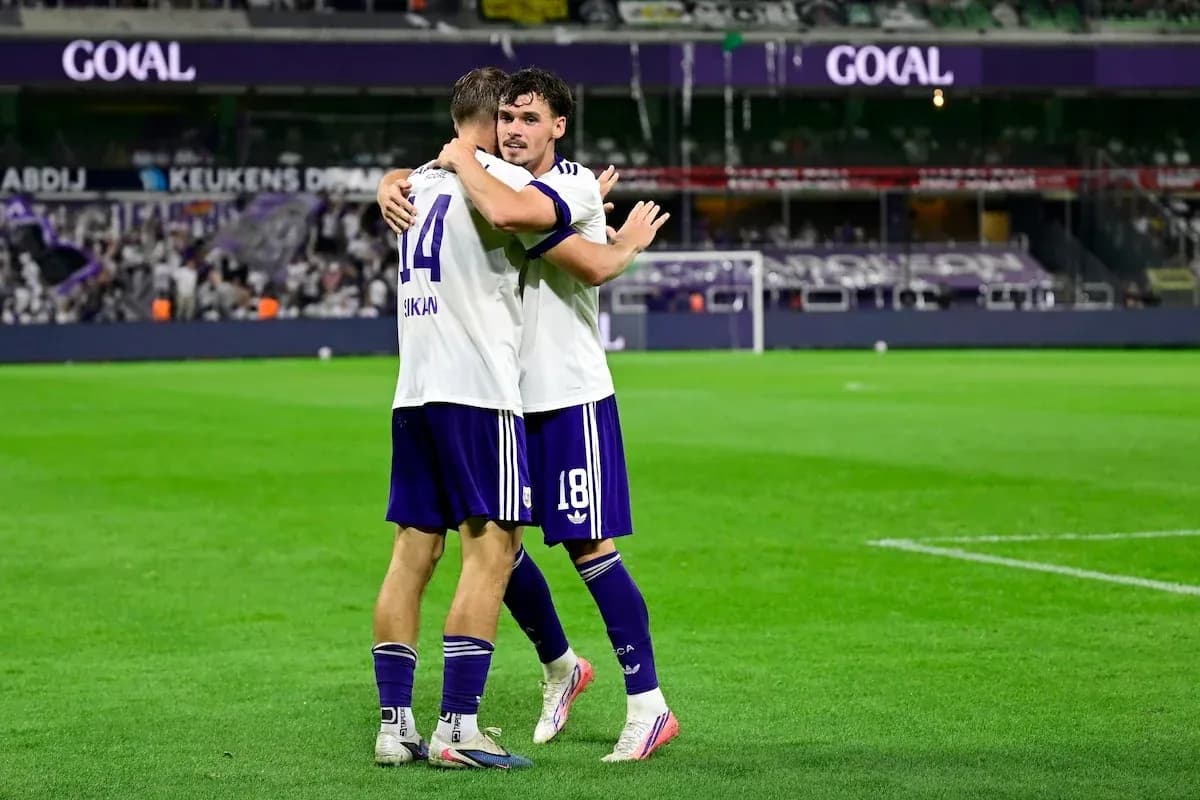
The impact was immediate. At 47', D. Sikan finished from an A. Maamar assist, the right-back stepping high and delivering the decisive ball. Tactically, this sequence captured Anderlecht’s second-half pattern: full-backs pushed aggressively, wide midfielders tucked in, and the front players attacked the half-spaces and box in numbers. With the game level, Hammarby’s earlier compactness started to look more like passivity.
Hammarby’s response was limited. V. Eriksson’s 55' yellow for “Handling” underlined how often Anderlecht were forcing defensive errors near the box. The visitors tried to adjust on 66' with a double substitution — A. Boudri (IN) for P. Abraham (OUT) and N. Besara (IN) for M. Madjed (OUT) — seeking fresh legs and a different profile between the lines. But by then, Anderlecht had full control of territory and tempo.
Discipline also tilted. Anderlecht’s own yellow cards — M. Cvetkovic at 65' for “Roughing” and J. Onia Seke at 66' for “Unsportsmanlike conduct” — reflected their aggressive counter-pressing and emotional edge as they chased and then protected the lead. Hammarby’s third booking, M. Karlsson at 73' for “Holding”, came as he tried to break up another Anderlecht progression, symptomatic of a midfield increasingly on the back foot.
Bruno’s bench management continued to shape the game. Onia Seke made way for A. Bertaccini at 68', adding yet another fresh attacker between the lines. Hammarby, meanwhile, rotated their front four further at 76' with I. Fofana (IN) for V. Lind (OUT) and E. Kabore (IN) for O. Johansson (OUT), but the structural issues remained: they could not secure possession high enough to relieve pressure or generate their own final-third presence.
Decisive Phase
The decisive phase arrived in the last 10 minutes. At 81', Cvetkovic, who had already changed the game’s attacking dynamics, capped his contribution with a goal to put Anderlecht 2-1 up. This was a product of sustained pressure: by that stage, Anderlecht’s 10 corners to Hammarby’s 0 told the story of wave after wave of attacks. Shortly after, T. Degreef (IN) came on for Sikan (OUT) at 84', a like-for-like change that preserved central forward energy for the closing stages.
Hammarby’s final substitution — F. Adjei (IN) for V. Eriksson (OUT) at 87' — slightly reshuffled their back line and midfield, but they never managed to reassert control. Instead, Anderlecht killed the tie at 89' when Degreef scored to make it 3-1, rewarding Bruno’s decision to refresh the striker position. Z. Keita (IN) then replaced L. Ambros (OUT) at 90+2', a late move that helped see out the result and maintain intensity in the press.
Statistical Perspective
From a statistical perspective, Anderlecht’s attacking dominance is unambiguous. They produced 21 total shots to Hammarby’s 6, with a 6–3 edge in shots on goal and a 3–0 margin in blocked shots. The 10–0 corner count underscores how deeply they pinned Hammarby back, particularly after half-time. Defensively, Anderlecht committed 12 fouls to Hammarby’s 10, in line with their proactive, front-foot approach.
In goal, C. Coosemans (Anderlecht) made 2 saves, reflecting Hammarby’s limited shot volume after the early strike. W. Hahn (Hammarby FF) registered 3 saves but was ultimately overwhelmed by the quality and quantity of Anderlecht’s chances as the game wore on. Both sides finished with no red cards, but the yellow distribution — Anderlecht 2, Hammarby 3 — mirrored the narrative of a home side relentlessly forcing defensive interventions and an away team increasingly stretched and reactive.
Overall, Anderlecht’s tactical evolution from a first-half of sterile dominance to a second-half of ruthless, structured pressure — supported by precise substitutions and full-back aggression — fully justified their 3-1 turnaround and leaves them well-positioned in this 2nd Qualifying Round tie.
Related News

Celje vs Red Bull Salzburg Predicted Lineups and Team News

Anderlecht vs Red Bull Salzburg Predicted Lineups and Team News
NEC Nijmegen vs Benfica Predicted Lineups: Team News for UEFA Europa League
Plzen vs Benfica Predicted Lineups: Team News Ahead of UEFA Europa League
Benfica vs Lech Poznan Predicted Lineups and Team News

Benfica vs OFI: Predicted Lineups and Team News for UEFA Europa League