
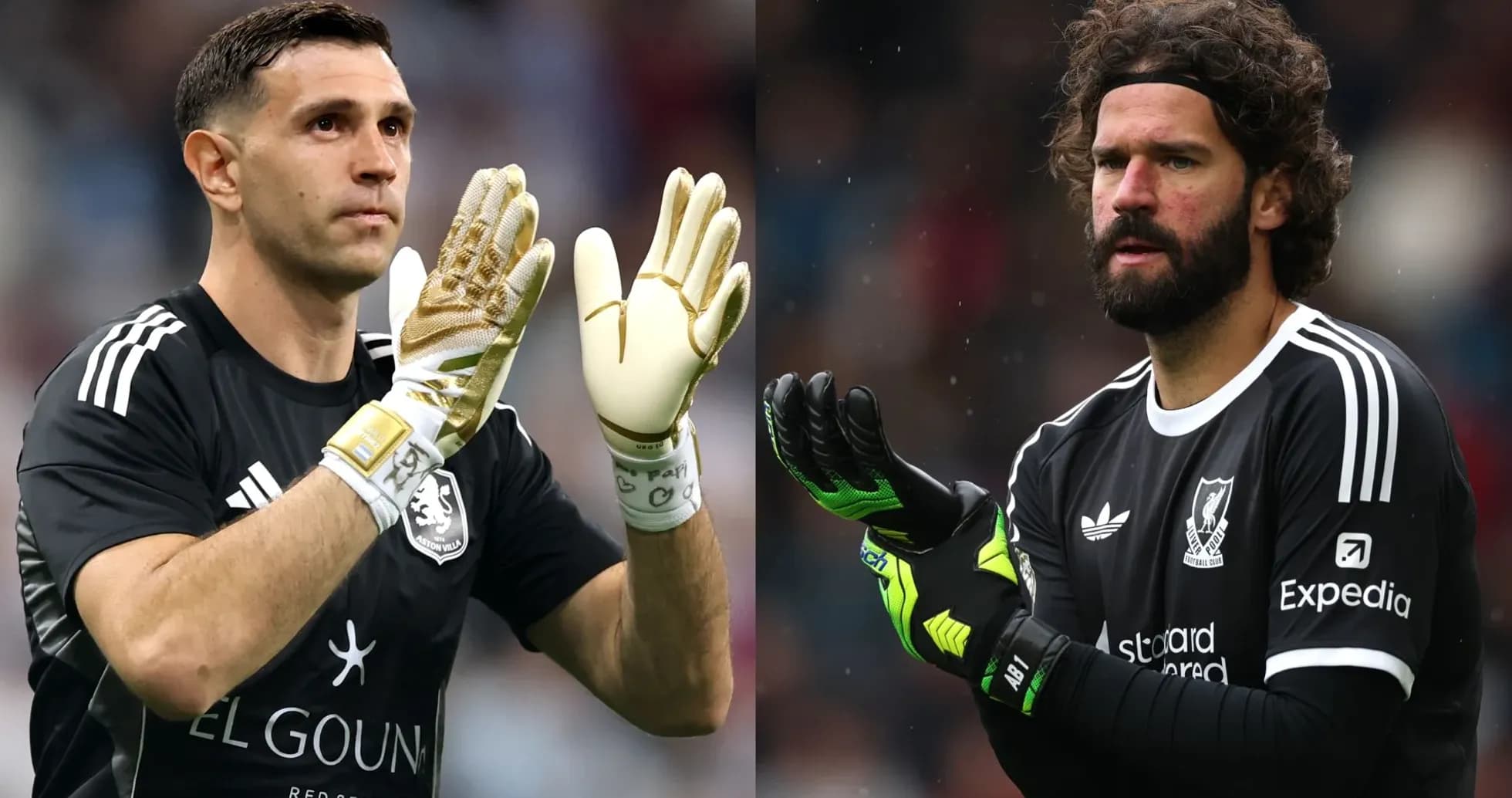
Alisson Becker: Liverpool's Unreplaceable Guardian
For six years now, Liverpool’s most reassuring sight has not been a forward wheeling away in celebration or a centre-half roaring at the Kop. It has been Alisson Becker, gloves raised, shoulders broad, quietly shutting the door.
Since arriving from Roma in 2018, the Brazilian has been the calm heartbeat of a chaotic sport. He solved a problem that had haunted Anfield for a decade and helped turn Jürgen Klopp’s thrilling side into serial winners. Two Premier League titles. A Champions League. FA Cup. League Cup. A ledger of 333 games that reads like the career of a club legend, because that is exactly what it is.
Now comes the jolt: he is 33, and his contract has just 12 months left to run.
That single detail changes the conversation. With time running down, Liverpool face the most uncomfortable of calculations – keep a generational goalkeeper and risk losing him for nothing, or cash in while they still can. Whispers from Italy suggest major clubs are watching closely, aware that truly elite goalkeepers rarely hit the market with this kind of pedigree.
For Liverpool, any sale would not just be a transfer. It would be an amputation.
Harder to replace than Salah?
The idea of anyone eclipsing Mohamed Salah’s importance at Anfield feels almost sacrilegious. The “Egyptian King” has scored 257 goals for the club and dragged Liverpool through season after season with his relentlessness in front of goal.
Yet former Reds keeper Brad Friedel believes Alisson’s exit could cut even deeper for the new regime.
“From Arne Slot’s perspective, possibly,” Friedel told GOAL, in association with MrQ, when asked if losing Alisson would hit harder than Salah’s departure. He pointed to a relationship between Slot and Salah that was “starting to become a little bit like oil and water”, suggesting the dynamic was far from perfect by the end. Salah’s decade of output, Friedel stressed, has been “truly remarkable” and his loss “huge”.
But in goal, you don’t just lose numbers. You lose certainty.
“Alisson would be one of the hardest goalkeepers to replace in global football if he were to go,” Friedel said. “I think it’d be very difficult for Liverpool to replace him.”
This is not nostalgia talking. It is the cold reality of trying to swap out one of the best in the world at the most unforgiving position on the pitch.
A standard few can touch
Friedel speaks both as a former professional and as a Liverpool supporter, and the tone shifts when he talks about Alisson’s influence.
“I would hate to see him go, professionally speaking, and as a Liverpool supporter, I would be particularly devastated if he left because of how good he’s been for the club,” he said.
The praise is specific, not sentimental. Alisson has never dragged the club into disrepute. He owns his rare mistakes. He dominates one-on-one situations in a way that, in Friedel’s eyes, puts him among the very best to ever play the game.
“I think those types of goalkeepers, even as they decline in their age, even with maybe a couple of injuries, are still better than almost everyone in the world,” he added. “I think that replacing him would be tough, really tough.”
This is the dilemma. Even a slightly older, slightly slower Alisson might still be superior to almost every alternative on the market. Letting that walk out of the door is not a decision Liverpool can afford to get wrong.
Who could possibly follow?
If Liverpool are backed into a corner and a sale becomes unavoidable, the next question is brutal in its simplicity: who comes in?
Names inevitably surface. One of them is James Trafford, the 23-year-old England international currently stuck behind Gianluigi Donnarumma at Manchester City. Young, talented, highly regarded. On paper, the profile fits.
Friedel, though, sounded a note of caution when asked if Trafford could be the answer.
“Possibly,” he said, but then laid out the reality of the role. Liverpool do not just need a good goalkeeper. They need someone “with a skin of leather”, someone who can walk into a dressing room expecting – not hoping – to win the Champions League, Premier League, FA Cup and League Cup. Every season. Every competition. No excuses.
“It’s a different type of mentality that you need when you’re a goalkeeper at these top clubs,” Friedel said. Trafford, he added, is “a really good goalkeeper” that he likes a lot, but loading that level of responsibility on a 23-year-old would be a huge ask.
So the focus turns to a different profile: a proven, battle-hardened No.1.
“Maybe the likes of an Emi Martínez, someone like that,” Friedel suggested – a keeper who can absorb the full weight of a season, take every game, every criticism, every plaudit, and stay upright. A personality as big as the job.
But that, too, underlines the scale of the task. “There aren’t many out there that you can just pinpoint and say: ‘He’s our guy’,” Friedel admitted. “That’s a hard decision.”
A defining call for the Slot era
Liverpool have rebuilt before. They have sold icons and found new ones. Yet swapping a 257-goal phenomenon on the wing is one kind of challenge. Replacing the man who has underpinned an entire defensive structure is another.
Alisson’s future now sits at the intersection of finance, ambition and fear. Let him stay and you may lose a fee. Let him go and you may lose the safety net that has allowed Liverpool to play on the edge for years.
Some decisions shape a season. This one might shape the Slot era.
Related News

Raphinha’s Hat-Trick Powers Barcelona to 7-2 Victory Over Racing Santander
Carabao Cup Fourth Round Draw: Liverpool Set to Clash with Chelsea, Arsenal to Face Fleetwood Town
Key Football Matches to Watch in Azerbaijan This Autumn
Raphinha's Hat-Trick Drives Barcelona to 7-2 Triumph Over Racing Santander
Hansi Flick Leads Barcelona to Record-Breaking Seven Wins in a Row

Gavi Reflects on Injury Return as Barcelona Dominate Racing Santander 7-2