
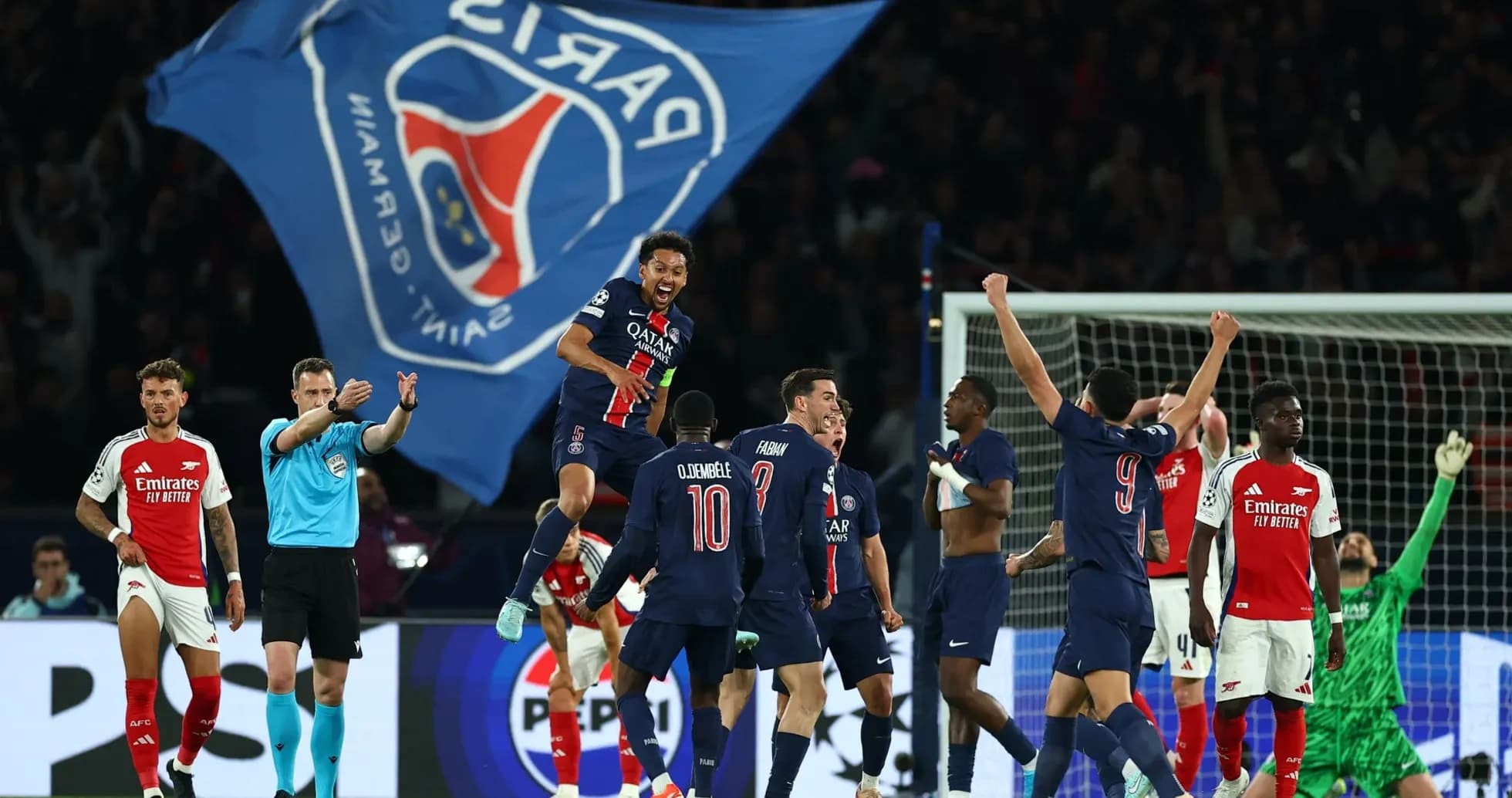
UEFA Champions League Final: Arsenal vs Paris Saint Germain
At Puskas Arena in Budapest, Paris Saint Germain and Arsenal meet in the UEFA Champions League Final, a one-off game that will define their entire 2025 campaign. In the league phase, Arsenal arrive as the dominant benchmark, sitting 1st with a perfect 24 points from 8 matches and a +19 goal difference (23 scored, 4 conceded), while Paris Saint Germain come in from a more turbulent path, ranked 11th with 14 points, 21 goals scored and 11 conceded. This final is therefore a clash between the competition’s most consistent league-phase side and a high-scoring but less stable challenger, with the result set to shape both clubs’ continental narratives for years ahead.
Head-to-Head Tactical Summary
The recent head-to-head history is rich and competitive, with several high-stakes UEFA Champions League meetings. On 7 May 2025 at Parc des Princes in Paris, in the UEFA Champions League Semi-finals, Paris Saint Germain beat Arsenal 2-1 (HT 1-0), overturning the tie after an earlier defeat. Just days before, on 29 April 2025 at Emirates Stadium in London, Arsenal had won 1-0 (HT 0-1) in the first leg of that Semi-finals matchup, built on control and defensive solidity. Earlier in the same competition cycle, on 1 October 2024 in the League Stage - 2 at Emirates Stadium, Arsenal defeated Paris Saint Germain 2-0 (HT 2-0), underlining their ability to establish an early lead and then manage the game.
Looking further back, on 28 July 2018 at The National Stadium (Singapore) in the International Champions Cup Regular Season - 2, Arsenal recorded a 5-1 win over Paris Saint Germain (HT 1-0), a friendly context but still indicative of Arsenal’s capacity to punish defensive lapses. On 23 November 2016 at Emirates Stadium in a UEFA Champions League Group Stage - 5 match, the sides drew 2-2 (HT 1-1), showing how finely balanced this pairing can be in a competitive European setting. Across these meetings, Arsenal have often controlled games in London and neutral venues, while Paris Saint Germain’s most recent success came at home in Paris, making this neutral-site final a tactical decider between Arsenal’s structured control and PSG’s more volatile attacking threat.
Global Season Picture
- League Phase Performance: In the league phase, Paris Saint Germain’s 11th-place finish with 14 points from 8 matches reflects a high-output but imperfect profile: 21 goals for and 11 against, a strong attack but a defense that can be exposed (goal difference +10). Arsenal’s league phase has been elite: 1st place, 24 points from 8 wins in 8, with 23 goals scored and only 4 conceded, a dominant blend of efficiency and control (goal difference +19).
- Season Metrics: Scope detection shows team_statistics games played (PSG 16, Arsenal 14) exceed league-phase totals (8 each), so these numbers apply across all phases of the competition. Across all phases of the competition, Paris Saint Germain average 2.8 goals scored per match (44 in 16) and concede 1.4 (22 in 16), indicating a very aggressive but defensively vulnerable side. Arsenal, across all phases of the competition, average 2.1 goals scored per match (29 in 14) and concede just 0.4 (6 in 14), pointing to a highly controlled, defensively secure team. Disciplinary data also hint at different risk profiles: PSG’s yellow cards cluster late (42.86% between minutes 76-90), suggesting rising defensive strain, while Arsenal’s bookings spike between minutes 61-75 (31.82%), often in game-management phases. Both teams use a 4-3-3 base structure regularly, with Arsenal also deploying 4-2-3-1 in several games, adding flexibility in how they control central spaces.
- Form Trajectory: In the league phase, Paris Saint Germain’s form string of DLDWL underlines inconsistency: only 2 wins in the last 5, with 2 defeats and 1 draw, aligning with their mixed defensive record (11 conceded). Arsenal’s league-phase form is WWWWW, five straight wins, mirroring their perfect 8/8 record and microscopic 4 goals conceded. The trajectory is clear: Arsenal come into the final on a sustained upward curve of results and defensive dominance, while PSG arrive more battle-tested but less predictable, capable of high-scoring wins and costly slips.
Tactical Efficiency
Across all phases of the competition, Paris Saint Germain’s attacking efficiency is high-volume and high-variance: 2.8 goals per match, with their biggest away win being 2-7, and only 1 match where they failed to score. This points to a very aggressive attacking index, but their defensive efficiency lags, with 1.4 goals conceded per match and only 5 clean sheets in 16 games. Arsenal’s tactical efficiency is more balanced and controlled: 2.1 goals scored per match with a top away win of 0-3, but crucially only 0.4 goals conceded per match and 9 clean sheets in 14. That defensive record, combined with an unbeaten run (11 wins, 3 draws, 0 losses across all phases of the competition), suggests a superior defensive index and a more sustainable attacking-to-defensive ratio.
Interpreting these metrics alongside the head-to-head pattern, Arsenal’s model is built on suppressing opponent xG and limiting shots, then converting at a steady, controlled rate. PSG’s model is closer to a high-risk, high-reward profile: they can overwhelm opponents offensively but leave more space and transitions, as reflected in their higher goals-against average. In a single final, this contrast typically favors the side with the stronger defensive index and cleaner game management, especially against a team that tends to accumulate late yellow cards and occasionally red cards under pressure.
The Verdict: Seasonal Impact
This UEFA Champions League Final is season-defining for both clubs, but in different ways. For Arsenal, who dominated the league phase (1st place, 24 points, 23-4 goals), lifting the trophy would validate a near-perfect European campaign and confirm them as the continent’s benchmark side in 2025. Failure to win, despite an unbeaten record across all phases and a defensive profile of just 0.4 goals conceded per match, would turn a statistically outstanding year into a narrative of missed opportunity, raising questions about their ability to convert structural dominance into ultimate prizes.
For Paris Saint Germain, who only ranked 11th in the league phase (14 points, 21-11 goals), victory would reframe a patchy campaign into a triumphant peak, reinforcing the value of knockout resilience over league-phase consistency. It would also mitigate concerns about their 1.4 goals conceded per match across all phases of the competition by showing they can defend well enough in the highest-stakes environment. A defeat, however, would cement the picture of a spectacular but unbalanced side: prolific going forward yet short of the defensive control and consistency that Arsenal have displayed. In forward-looking terms, this final will either crown Arsenal’s methodical, defensively anchored project as the new standard in Europe, or give PSG the platform to double down on their high-ceiling attacking model, even if it remains structurally more volatile.
Related News

Vincent Kompany's Bayern Munich Future Not Tied Solely to Champions League Outcome
Barcelona's Camp Nou Chosen for 2029 Champions League Final, Munich Set for 2028
Allianz Arena to Host 2028 UEFA Champions League Final
Allianz Arena to Host 2028 Champions League Final for Third Time
Barcelona's Nou Camp Chosen for 2029 UEFA Champions League Final Over Wembley and Dortmund
Five English Clubs Secure Wins in Champions League Opening Round