
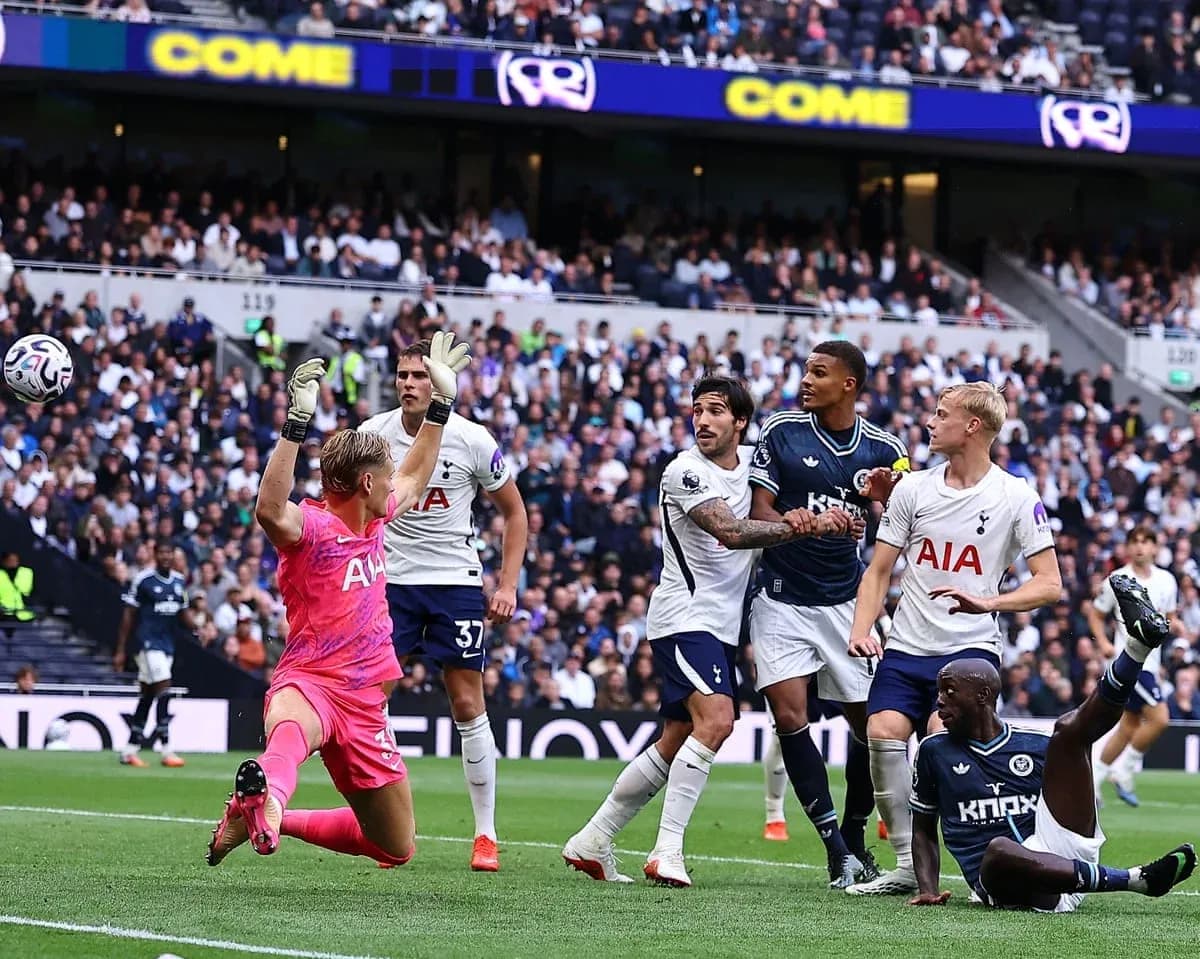
Tottenham vs Newcastle: A Clash of Early Season Fortunes
Under the grey London sky at Tottenham Hotspur Stadium, this fixture felt less like Round 2 of a long Premier League season and more like an early stress test of two projects heading in opposite directions. Tottenham, beaten 0-2 here and 3-0 on their travels, came into the day bottom of the table in 20th, with 0 points and a goal difference of -5 after 2 matches. Newcastle arrived as a side already humming: 5th in the standings, unbeaten with 4 points, 4 goals scored and only 2 conceded overall, and a clear tactical identity under Matthias Jaissle.
Both managers doubled down on a 4-2-3-1, but the similarities ended on the whiteboard.
I. The Big Picture: Structures and Season DNA
Roberto De Zerbi’s Tottenham lined up with A. Kinsky in goal behind a back four of A. Robertson, M. van de Ven, J. P. van Hecke and A. Gray. In front, the double pivot of S. Tonali and R. Bentancur was tasked with knitting together a new-look attacking band: P. Porro and M. Tel flanking M. Fernandes, with O. Marmoush as the lone forward.
Statistically, heading into this game, Tottenham’s season profile was stark. Overall they had played 2, lost 2, failed to score in both, and conceded 5 goals in total. At home they had played 1, lost 1, with 0 goals for and 2 against; on their travels, 1 defeat with 0 for and 3 against. Their average goals scored were 0.0 overall, while they conceded an average of 2.0 at home and 3.0 away, 2.5 in total. The clean-sheet column was empty; the “failed to score” column read 2 out of 2.
Newcastle’s 4-2-3-1 had a more settled feel. L. Hornicek started in goal, shielded by A. Dedic, M. Thiaw, S. Botman and L. Hall. The double pivot of Nico and L. Miley provided balance behind an attacking trio of A. Elanga, J. Willock and H. Barnes, with Y. Wissa leading the line. Their season numbers backed up the eye test: overall 2 matches, 1 win, 1 draw, 4 goals for and 2 against. At home they had drawn 2-2; away they had already posted a 2-0 victory, giving them an away record of 1 win, 0 draws, 0 losses, with 2 goals scored and none conceded. Their overall scoring average stood at 2.0 goals per game, with 1.0 conceded.
If Tottenham’s early-season DNA was fragility and bluntness, Newcastle’s was efficiency and cutting edge.
II. Tactical Voids: Absences and Discipline
Tottenham’s squad sheet was scarred by absences that went straight through the spine of their creative play. D. Kulusevski (knee injury), J. Maddison (knock), W. Odobert (knee injury), P. M. Sarr (injury) and X. Simons (knee injury) were all listed as missing this fixture. That is an entire layer of ball progression and final-third invention stripped out, forcing De Zerbi to lean heavily on Tonali’s distribution and Marmoush’s movement, with Porro and Tel asked to provide width and penetration.
Newcastle were not untouched by misfortune either. D. Burn (ankle injury), Joelinton (injury), V. Livramento (hamstring injury) and W. Osula (injury) were all unavailable, removing height, physicality and some of their usual rotational options. Yet their structure and early-season form suggested a squad better able to absorb those losses.
Disciplinary trends hinted at the emotional tone of the contest. Tottenham’s yellow cards so far were concentrated early: 50.00% of their cautions came between 0–15 minutes and another 50.00% between 31–45 minutes. That pattern points to a side that starts tense and can become ragged as the first half wears on. Newcastle’s bookings were more spread out but spiked late: 28.57% of their yellows arrived between 76–90 minutes, with further cards in every other 15-minute band from 0–15, 16–30, 31–45, 61–75 and even 91–105. They are aggressive and persistent, but also willing to push the line in closing stages to protect a result.
III. Key Matchups: Hunter vs Shield, Engine Room Battles
The most obvious “Hunter vs Shield” duel came on Newcastle’s attacking right. A. Elanga, one of the league’s early standout performers, carried 2 goals from 2 appearances into this game. He had taken 4 shots with 3 on target, completed 2 of 3 dribbles and won 9 of 14 duels, a blend of directness and efficiency. His zone overlapped with Tottenham’s left flank of A. Robertson and M. van de Ven, a pairing asked to both progress the ball and contain pace.
Behind Elanga, A. Dedic offered a different threat profile. He had already contributed 1 assist and 2 key passes in 2 matches, with 47 passes at 89% accuracy and 4 tackles made, plus 2 successful blocks. His overlapping runs and ability to block shots at the other end made him a two-way force. The onus was on Tel and Robertson to stop those underlaps and overlaps from turning Tottenham’s left side into a permanent overload.
Centrally, the “Engine Room” fight pitted Tonali and Bentancur against Nico and L. Miley. With Tottenham starved of their usual creators, Tonali’s role as tempo-setter and vertical passer became critical. But Newcastle’s pivot had been quietly effective: Nico offering bite and screening, Miley supplying range and calmness in possession. If Newcastle’s double pivot could suffocate Tottenham’s build-up, Marmoush would be left isolated, with Porro and Fernandes forced into low-percentage shots and crosses.
Higher up, Y. Wissa embodied Newcastle’s hybrid threat. Officially listed as a midfielder but deployed here as the central forward, he arrived with 1 goal and 1 assist in 2 games, plus 6 shots, 2 on target, and 32 duels contested with 18 won. He is as much a reference point for counters and long diagonals as he is a finisher. Against a Tottenham defence that had already conceded 5 goals overall and kept 0 clean sheets, his movement between van de Ven and van Hecke promised to be a constant stress test.
On the bench, Newcastle’s depth of impact options stood out. J. Murphy and J. Ramsey, each already on a yellow card this season, had combined for 50 minutes of high-intensity cameos, with Ramsey adding 23 accurate passes at 91% and 2 tackles plus 1 interception. N. Woltemade, with 1 assist from just 24 minutes, and the injured but influential W. Osula (also on the assist chart before this game) underlined how many different profiles Jaissle could call upon to change the rhythm.
Tottenham’s bench, by contrast, was more about potential reconfiguration than proven end product. M. Kudus and C. Gallagher offered energy and ball-carrying from midfield, while D. Solanke and M. Moore were options to shift Marmoush wide or go to a front two. But with no league goals scored overall, any attacking reshuffle remained more theoretical than statistically grounded.
IV. Statistical Prognosis: Control vs Chaos
From a numbers perspective, the direction of travel was clear heading into this match. Newcastle were averaging 2.0 goals scored overall and conceding 1.0, with a clean sheet already on their travels and a 2-0 away win as their biggest result. Tottenham, by contrast, had failed to score in either of their first two matches, conceded 2.0 at home and 3.0 away on average, and had 0 clean sheets.
Without explicit xG values, the proxy indicators still point towards a Newcastle side whose attacking patterns are already well-defined. Elanga’s 2 goals from 4 shots, Wissa’s combined 2 goal involvements and the creative contributions of Dedic and Woltemade suggest a team that turns possession into chances with regularity. Defensively, their ability to shut out opponents away from home, as shown by 0 goals conceded on their travels so far, contrasts sharply with Tottenham’s porous record and the absence of a settled attacking core.
The disciplinary data adds a final layer: Tottenham’s tendency to pick up early cards hints at a side that can be dragged into emotional battles if Newcastle’s front four start fast. Newcastle’s late-booking profile suggests they are comfortable defending a lead and willing to absorb pressure with tactical fouls in the final quarter of an hour.
Taken together, the tactical shapes, squad availability and early-season statistics frame a contest tilted towards Newcastle’s control and clarity. Tottenham’s path back into relevance in this campaign will depend on how quickly De Zerbi can coax fluency from a patched-together attacking unit and tighten a defence that, so far, has been asked to absorb too much and protect too little.
Related News

Nottingham Forest vs Tottenham Stats: Head-to-Head Record Ahead of September Match

Liverpool and Nottingham Forest Share Spoils in Thrilling 2-2 Draw
Manchester City Dominates Crystal Palace 4–1 at Selhurst Park

Ipswich vs Liverpool Stats: Head-to-Head Record and Past Meetings

Aston Villa vs Arsenal Predicted Lineups and Team News

Aston Villa vs Arsenal: Premier League Clash Preview