

Sturm Graz Dominates Hearts 4-0 with Tactical Mastery
Sturm Graz’s 4-0 win over Heart Of Midlothian at Merkur Arena was a clinic in vertical, high‑impact football: low possession, high penetration. In a 2nd Qualifying Round tie where Hearts saw 67% of the ball and led most passing metrics, it was Sturm’s 4-4-2 structure, direct running and ruthlessly exploited transitions that decided the game. The Austrians generated 20 total shots to Hearts’ 19 despite having only 221 passes to 438, repeatedly turning regains into quick attacks that shredded a stretched 4-2-3-1.
Team Structure
Structurally, Fabio Ingolitsch kept Sturm Graz in a clear 4-4-2. D. Khudyakov (Sturm Graz) anchored behind a back four of J. Heil and E. Soglo as full-backs with A. Vallci and J. Mitchell as the centre-backs. The midfield band of four – S. Seidl, J. Gorenc Stankovic, L. Weinhandl and J. Hodl – worked more as a compact, narrow unit than classic wingers, inviting Hearts onto them and then springing the front two, S. Wlodarczyk and S. Jatta, into the channels. This compactness explains how Sturm accepted a 33% possession share yet still produced 16 shots inside the box and 5 blocked efforts: they defended deep but in a tight block that was immediately ready to surge forward.
Out of Possession
Out of possession, Sturm’s 4-4-2 shifted into a 4-4-1-1, with one striker dropping to screen Hearts’ double pivot of O. McEntee and B. Spittal. The key was central congestion: Gorenc Stankovic and Weinhandl stayed narrow, forcing Hearts’ build-up wide and away from central combinations. The cost was territorial dominance for Hearts, but the benefit was control of dangerous zones. Sturm committed 18 fouls to Hearts’ 13, a reflection of their willingness to break rhythm and stop Hearts’ progress before it reached the defensive third.
In Possession
In possession, the pattern was almost the mirror image of Hearts. Sturm rarely circulated at the back; instead, they used early forward passes into the front two or into the half-spaces for Hodl and Weinhandl. The first goal at 4' – J. Gorenc Stankovic finishing from a J. Mitchell assist – encapsulated this: a defender stepping in, playing vertically, and a midfielder arriving into a gap Hearts’ 4-2-3-1 left between lines. The second goal at 38' (scorer not specified in the data) again came from Sturm’s ability to reach the box quickly rather than through prolonged possession, underlining how their shot profile (16 inside the area) came from direct entries rather than crafted, slow attacks.
Hearts’ Strategy
Hearts, by contrast, had the ball but not the same penetration. Wouter Vrancken’s 4-2-3-1 with A. Schwolow (Heart Of Midlothian) behind a back four of C. Borchgrevink, M. Fagan-Walcott, J. McCart and H. Milne, and an attacking band of C. Miller, C. Braga and A. Kyziridis behind P. Kabore, was designed to dominate the ball. They completed 351 of 438 passes (80%), but much of this circulation remained in front of Sturm’s block. While Hearts matched Sturm for shots on goal (6-6) and total shots (19-20) and had 12 corners to Sturm’s 4, they could not convert territorial and set-piece superiority into goals.
Second Half Changes
The second half highlighted the tactical divergence even more. Ingolitsch’s first change at 46' – O. Kiteishvili (IN) came on for S. Seidl (OUT) – added extra creativity between the lines without sacrificing the compact 4-4-2 shell. Kiteishvili’s impact was immediate: at 50', J. Mitchell scored with Kiteishvili providing the assist, a centre-back stepping into advanced space as Hearts’ structure stretched to chase the game. Just three minutes later at 53', L. Weinhandl struck from a J. Hodl assist, again exploiting the space Hearts left around their double pivot when they pushed full-backs on.
Hearts’ response at 59' was triple substitution: S. Kerjota (IN) for C. Miller (OUT), A. Ba-Sy (IN) for P. Kabore (OUT) and S. Guendouz (IN) for A. Kyziridis (OUT). The intention was clear: add fresh legs and more direct threat in the final third. Yet in the same minute, Sturm added a fourth, J. Heil scoring from a L. Weinhandl assist. That sequence captured the tactical story: every time Hearts tried to tilt the game further forward, Sturm punished the transition moments behind them.
Game Management
From 70' onward, Ingolitsch managed the game through controlled rotation without altering the core shape. R. Fosso (IN) for J. Hodl (OUT), N. Weiper (IN) for S. Jatta (OUT) and A. Kayombo (IN) for S. Wlodarczyk (OUT) at 70' maintained the 4-4-2 structure but refreshed both the wide and forward lines for pressing and counter threats. Later, A. Malic (IN) for E. Soglo (OUT) at 79' added defensive security on the flank. Hearts’ final changes – T. Renaud (IN) for B. Spittal (OUT) at 75' and T. Magnusson (IN) for O. McEntee (OUT) at 84' – could not meaningfully alter the dynamic.
Goalkeeping and Box Management
Goalkeeping and box management were decisive. A. Schwolow (Heart Of Midlothian) made 2 saves, a low figure that reflects both Sturm’s clinical finishing and the quality of their chances: when they reached the box, they tended to produce shots that beat the keeper rather than speculative efforts. At the other end, D. Khudyakov (Sturm Graz) made 6 saves, matching Hearts’ shots on target and underlining how, despite the 4-0 scoreline, he had to be sharp to preserve the clean sheet. Sturm’s back line blocked 5 shots and repeatedly forced Hearts to shoot from less favourable positions, as indicated by Hearts’ 8 shots from outside the box.
Discipline and Tactical Intent
Discipline also reveals tactical intent. Hearts collected 2 yellow cards – Oisin McEntee for “Foul” at 47' and Amadou Ba-Sy for “Foul” at 86' – typically in moments of chasing back after turnovers. Sturm’s single booking went to Jon Gorenc Stanković for “Foul” at 56', emblematic of the midfield’s readiness to stop transitions at source. The earlier VAR intervention at 39', when a potential penalty involving Szymon Włodarczyk was cancelled, could have made the margin even more severe; its cancellation did not derail Sturm’s momentum, which instead came from the clarity of their game plan.
Statistical Summary
Statistically, Hearts’ 67% possession and superior passing numbers tell the story of territorial control, but Sturm’s 20 shots, 16 in the box, and 4 goals from 6 shots on target show a side perfectly set up to exploit that control. The 4-4-2 versus 4-2-3-1 battle was not about who had more of the ball, but who used space better. On this evidence, Sturm Graz’s compact block, vertical passing and well-timed substitutions provided a tactically coherent blueprint for knockout football, while Heart Of Midlothian’s ball dominance lacked the structural balance and box presence to threaten the tie.
Related News

Vincent Kompany's Bayern Munich Future Not Tied Solely to Champions League Outcome

Barcelona's Camp Nou Chosen for 2029 Champions League Final, Munich Set for 2028
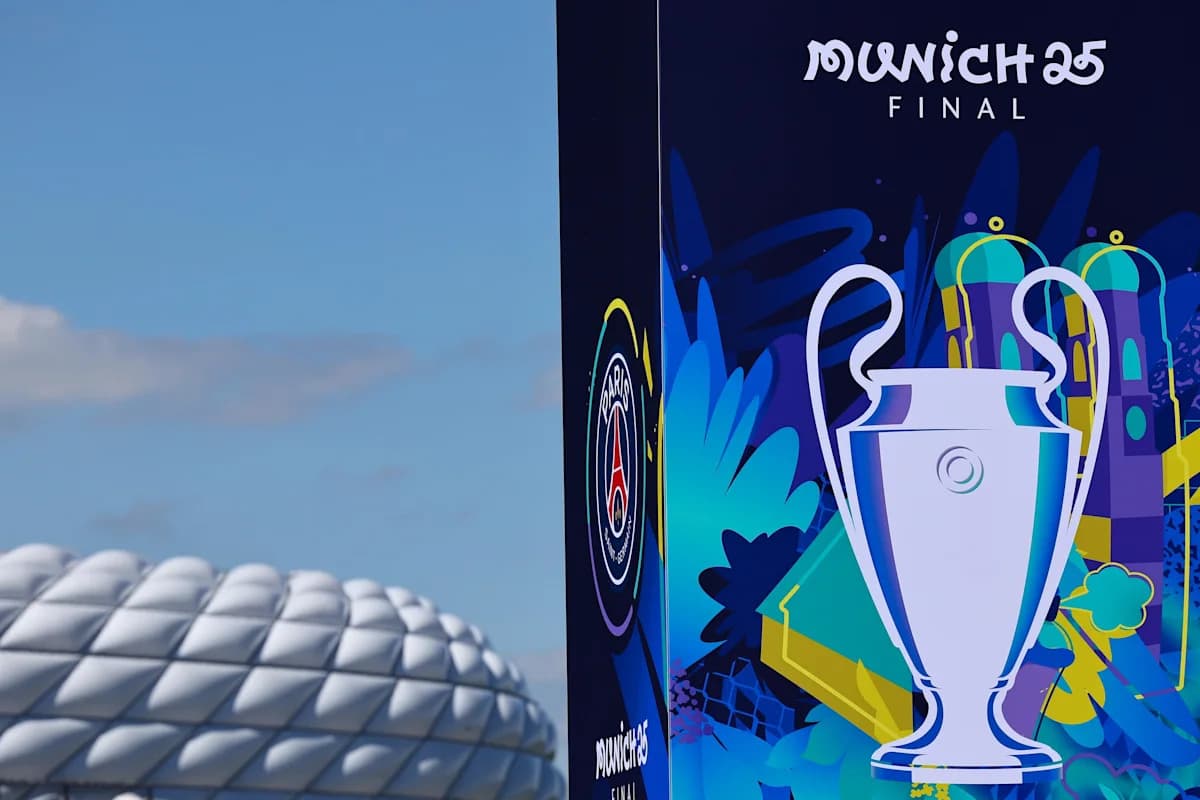
Allianz Arena to Host 2028 UEFA Champions League Final

Allianz Arena to Host 2028 Champions League Final for Third Time

Barcelona's Nou Camp Chosen for 2029 UEFA Champions League Final Over Wembley and Dortmund

Five English Clubs Secure Wins in Champions League Opening Round