
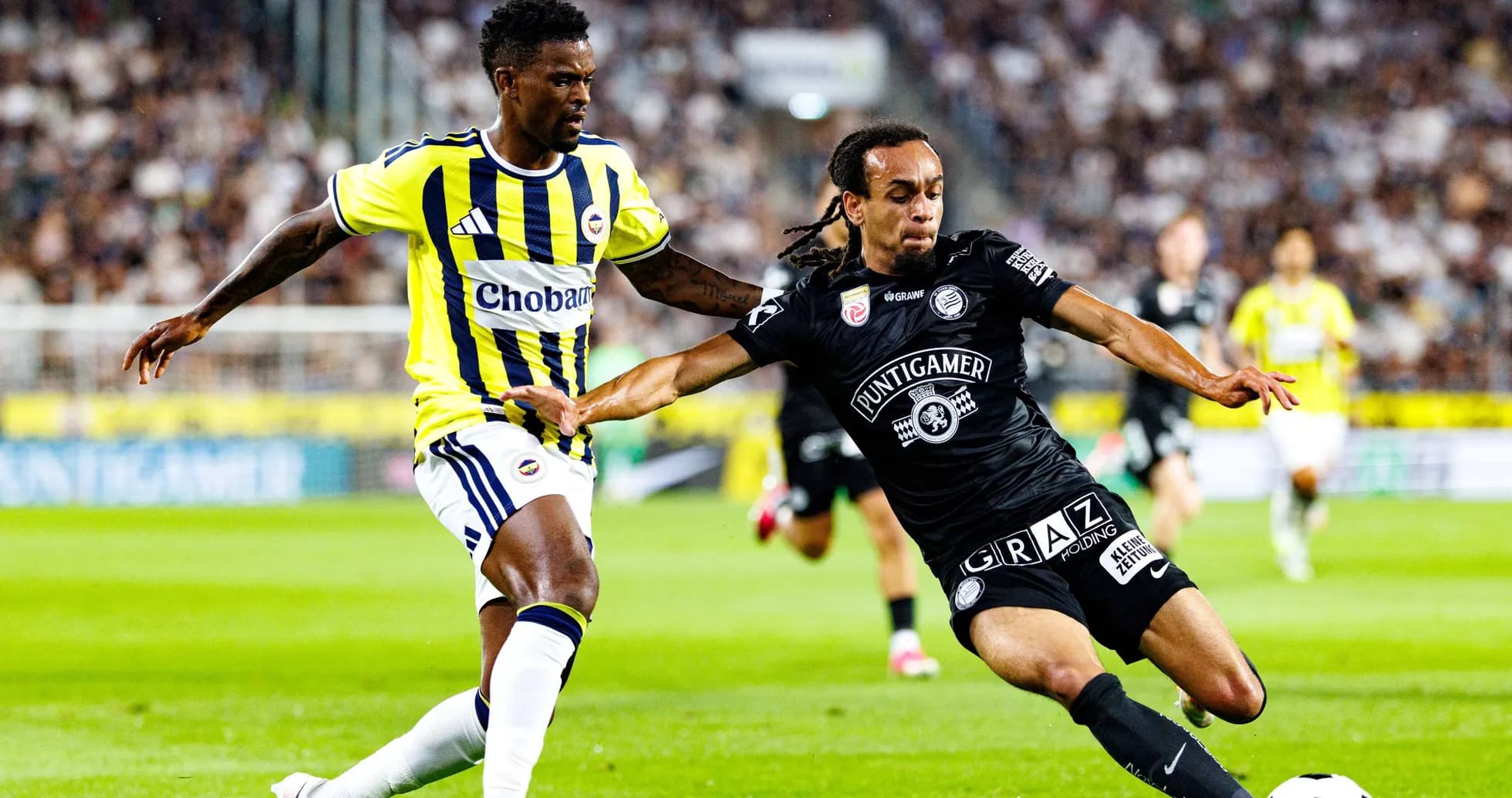
Sturm Graz vs Fenerbahçe: Tactical Breakdown of the 4-4-2 and 4-2-3-1
Sturm Graz’s 4-4-2 at Merkur Arena was built around volume and verticality, but it ran into a Fenerbahçe 4-2-3-1 that controlled the key spaces and punished a single decisive moment. The 1-0 away win, decided by Talisca’s 66' penalty, emerged from a contrast between territorial pressure and structural control.
Sturm’s shape under Fabio Ingolitsch was a classic, fairly flat 4-4-2. A back four of E. Soglo, P. Petrovic, J. Mitchell and A. Malic sat behind a midfield line of J. Hodl, L. Weinhandl, J. Gorenc Stankovic and S. Seidl, with A. Kayombo and S. Jatta up front. The plan was clear in the numbers: 19 total shots to Fenerbahçe’s 11, and 9 blocked efforts underline how aggressively Sturm tried to work shooting positions around the box. However, only 2 of those 19 were on target, reflecting an attack that reached the final third but struggled to convert possession into clean looks.
The distribution profile supports that reading. Sturm completed 311 of 383 passes (81%), essentially matching Fenerbahçe’s 318 of 397 (80%), with possession split 50–50. This was not a low-block counter game; it was an even-possession contest where Sturm accepted risk to generate volume. Their 7 corner kicks to Fenerbahçe’s 6 show a side repeatedly forcing play into crossing and second-ball situations rather than slicing through centrally.
Ismail Kartal’s 4-2-3-1 for Fenerbahçe was far more control-oriented. The double pivot of N. Kante and M. Guendouzi screened a high-quality back four of A. Brown, N. Ake, M. Skriniar and N. Semedo, with a technically strong three of K. Akturkoglu, M. Asensio and M. Greenwood operating behind Talisca. Despite having the same 50% share of the ball, Fenerbahçe produced 6 shots on goal from just 11 total attempts, a striking contrast to Sturm’s inefficiency. Their 8 shots inside the box versus Sturm’s 6 underline a more selective, higher-quality shot profile.
The turning point came around the hour, coinciding with a flurry of substitutions that reshaped both sides’ structures. At 61', Sturm made three simultaneous changes: B. Beganovic (IN) came on for S. Jatta (OUT), J. Heil (IN) came on for A. Malic (OUT), and N. Weiper (IN) came on for A. Kayombo (OUT). Ingolitsch effectively refreshed both the front line and the right side, chasing more penetration and energy. But these changes also disrupted the initial back-four cohesion, with a new full-back and forward pairing needing to adjust on the fly.
Fenerbahçe’s response was more targeted. At 62', M. Muldur (IN) came on for N. Semedo (OUT), stabilizing the right defensive lane after Nélson Semedo had already been booked. At 63', Fred (IN) replaced M. Asensio (OUT), and O. Aydin (IN) came on for M. Greenwood (OUT), injecting fresh legs and slightly more vertical threat and ball-carrying into the attacking midfield band. This sequence tilted the game towards Fenerbahçe’s transitions and helped them attack a Sturm side that had just restructured.
The penalty at 66', converted by Talisca for 0-1, was the tactical hinge: Fenerbahçe, already more efficient in the box, now had a scoreline to sit on. Kartal then doubled down on control. At 73', I. Yuksek (IN) replaced N. Kante (OUT), maintaining the double-pivot balance and defensive intensity. At 77', V. Muriqi (IN) came on for Talisca (OUT), turning the lone striker role into a more classic target-man outlet to relieve pressure and contest long balls as Sturm pushed forward.
Sturm’s last major structural tweak came at 70', when R. Fosso (IN) replaced J. Gorenc Stankovic (OUT), adding a more forward-thinking presence in central midfield. At 79', P. Koller (IN) came on for P. Petrovic (OUT), another defensive change that slightly reconfigured the back line. The late-game pattern was thus set: Sturm in a more attacking, risk-prone version of their 4-4-2, cycling the ball (383 passes, 81% accuracy) and firing from range (13 shots outside the box), against a Fenerbahçe block content to compress the central lane and protect the penalty area.
Defensively, Fenerbahçe’s structure and individual quality were decisive. They committed 13 fouls to Sturm’s 12, absorbing pressure and interrupting rhythm when needed. Three yellow cards — Nélson Semedo (40', Foul), Archie Brown (45', Foul), and Kerem Aktürkoğlu (89', Foul) — show how often their wide and full-back units were asked to defend aggressively against Sturm’s flanks and counters. Yet the back line and double pivot largely prevented Sturm from turning their 7 corners and repeated entries into clear chances.
On the other side, Sturm’s single booking for Jeyland Mitchell at 84' (Foul) reflects a team that defended with reasonable discipline but was ultimately undone by one key defensive sequence in their own box. Their 5 goalkeeper saves indicate that M. Gunok (Fenerbahçe) faced only 2 shots on target, while D. Khudyakov (Sturm Graz) had to deal with 6 on-target efforts, a clear marker of the difference in chance quality.
In pure statistical terms, the match reads as a clash between volume and efficiency. Sturm Graz: 19 total shots, 2 on goal, 9 blocked, 6 inside the box, 13 outside, 7 corners, 383 passes with 311 accurate (81%). Fenerbahçe: 11 total shots, 6 on goal, 2 blocked, 8 inside the box, 3 outside, 6 corners, 397 passes with 318 accurate (80%). With xG values not provided, the best proxy is this shot profile: Fenerbahçe consistently worked the ball into closer, clearer positions, while Sturm were forced into lower-quality attempts, many of which were smothered before reaching the target.
Tactically, Fenerbahçe’s 4-2-3-1 showed superior control of central zones and game state management after going ahead, while Sturm Graz’s 4-4-2 delivered pressure and volume without the precision in the final third to match it. Over two legs in a UEFA Champions League 3rd Qualifying Round context, this kind of structural and efficiency edge can be decisive.
Related News
Lamine Yamal Shares What Barcelona Must Do to Triumph in the Champions League
Luis Díaz Confident Bayern Munich Can Win Champions League
Insights from AFC Champions League Matchday One: K League Clubs’ Strategies
Vincent Kompany's Bayern Munich Future Not Tied Solely to Champions League Outcome
Barcelona's Camp Nou Chosen for 2029 Champions League Final, Munich Set for 2028
Allianz Arena to Host 2028 UEFA Champions League Final