
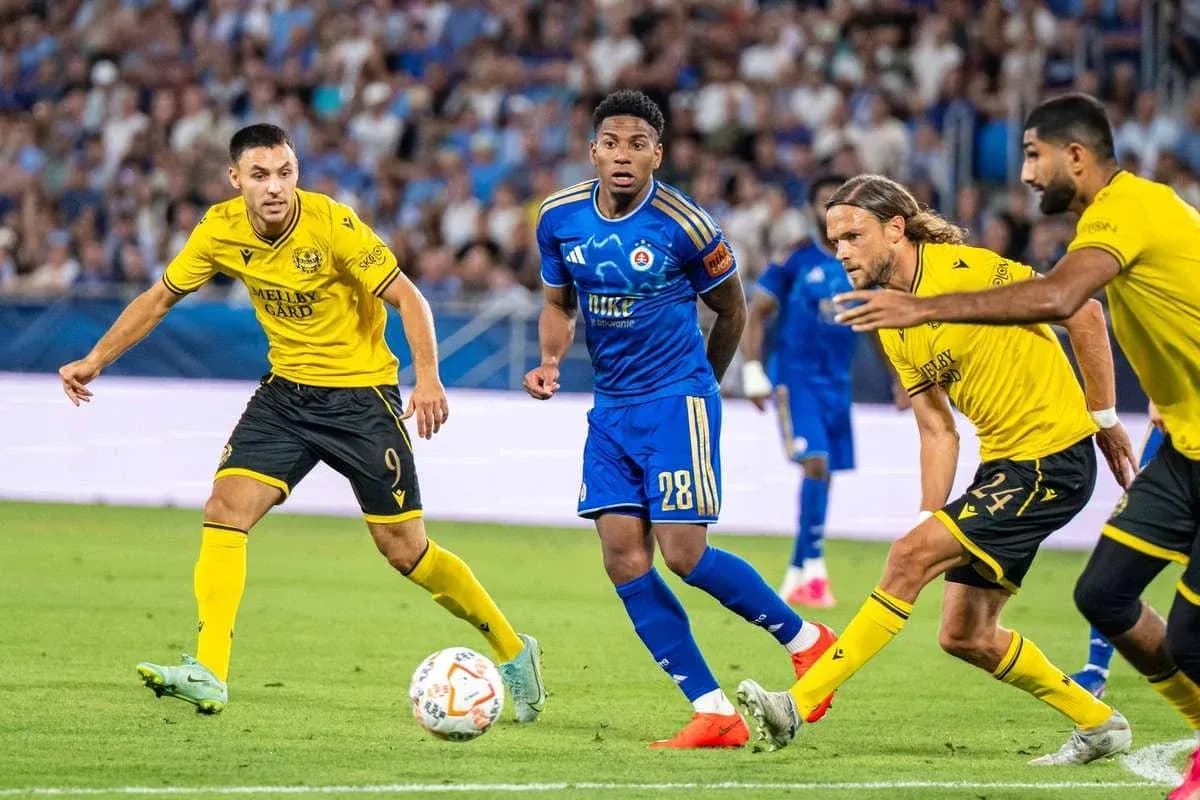
Slovan Bratislava’s Tactical Superiority in 2-0 Victory Over Mjallby AIF
Slovan Bratislava’s 2-0 win over Mjallby AIF at Tehelne Pole Stadion was built on clear structural superiority rather than sheer volume of chances. With possession split 50–50 and both sides registering modest shot totals (4 shots on goal for Slovan, 2 for Mjallby), the difference lay in how effectively Yaya Toure’s 4-1-4-1 manipulated Mjallby’s 3-4-3, especially after half-time. Slovan repeatedly created advantageous zones between Mjallby’s midfield and defensive lines, while the visitors’ front three rarely received the ball in threatening positions.
In Slovan’s 4-1-4-1, P. Pokorny anchored in front of the back four, allowing the advanced line of M. Kianga, A. Mustafic, R. Ibrahim and S. Camara to push high and wide. This structure aimed to pin Mjallby’s wing-backs and stretch their back three horizontally. Mjallby’s 3-4-3, with V. Granath and I. Hoffmann as wide midfielders and J. Kjaer, J. Bergstrom and A. Samuelsen up front, was designed to counter in transition, but the equal possession share shows they were often forced into more patient build-up than they would have preferred.
First Half
The first half was tactically cagey. Slovan’s 2 corner kicks to Mjallby’s 4 underline that the visitors initially found more set-piece territory, largely through direct balls into the channels that forced Slovan to defend deep. However, Mjallby’s 9 fouls against Slovan’s 15 reveal that Slovan were more aggressive in counter-pressing, repeatedly stopping transitions at source and accepting defensive fouls as a trade-off for territorial control. The late first-half yellow cards for Tom Pettersson (“Foul”) and Rahim Ibrahim (“Foul”) reflected that rising physical edge in central areas.
The match pivoted around Toure’s half-time adjustment. At 46', T. Barseghyan (IN) came on for M. Kianga (OUT), a like-for-like change on paper but with a different tactical intent. Barseghyan’s tendency to come inside from wide immediately added an extra playmaker between the lines, overloading Mjallby’s double pivot of J. Gustavsson and V. Gustafson. Within a minute of that structural tweak, Slovan broke through: at 47', S. Camara finished from an assist by S. Cruz, capping a move that typified Slovan’s plan—full-back Cruz advancing aggressively from the left of the back four to create a numerical advantage wide before delivering into the box.
Second Half
Mjallby’s response was to seek more thrust on the flanks and in the back line. At 56', A. Youssef (IN) came on for I. Hoffmann (OUT), and T. Miettinen (IN) replaced L. Svanberg (OUT), attempting to freshen the defensive and wing-back lanes. Yet Mjallby’s 3-4-3 still struggled to pin Slovan’s full-backs, and they finished with 0 blocked shots, a sign that they rarely managed to compress Slovan’s shooting zones or get bodies in front of efforts.
Slovan’s card profile underlined their front-foot approach. At 58', Suleiman Camara received a yellow card for “Simulation”, an indication of how often he was operating at the edge of Mjallby’s defensive block, looking to provoke contact or create separation. At 62', Alen Mustafić was booked for “Foul”, consistent with his role as an aggressive second-line presser from midfield. These moments show a Slovan side willing to take disciplinary risks to maintain territorial pressure.
The double substitution at 59' further sharpened Slovan’s control of central spaces. A. Yirajang (IN) replaced M. Kukharevych (OUT), and C. Martinez (IN) came on for R. Ibrahim (OUT). The effect was to inject fresh legs and vertical running from midfield while preserving the 4-1-4-1 shape. Yirajang’s timing of runs from deep became crucial: at 78', he arrived to score Slovan’s second, again from an assist by S. Cruz. That repeat combination highlighted how Slovan consistently targeted the left side of Mjallby’s back three, drawing them out with Cruz’s overlaps and then exploiting the gaps with late midfield arrivals.
Mjallby’s own substitutions at 72'—L. Tidstrand (IN) for V. Granath (OUT) and O. Lindberg (IN) for J. Kjaer (OUT)—and at 87', when M. Agnarsson (IN) replaced V. Gustafson (OUT), were attempts to add energy and directness. But with only 2 shots on goal and no blocked efforts, their 3-4-3 never translated into sustained penalty-area pressure. The front three were too often isolated, and Slovan’s single pivot plus compact back four were able to defend without overcommitting.
Discipline-wise, Mjallby finished with 2 yellow cards (Pettersson and Granath, both “Foul”), Slovan with 3 (Rahim Ibrahim “Foul”, Suleiman Camara “Simulation”, Alen Mustafić “Foul”). That 3–2 card split mirrors the foul count (15–9), reinforcing the picture of Slovan as the more aggressive, proactive side, especially in counter-pressing and central duels.
Statistically, the 50–50 possession underscores that this was not a one-sided territorial siege but a contest defined by structure and efficiency. Slovan converted their 4 shots on goal into 2 goals, a high conversion rate that speaks to the quality, not just the quantity, of their chances. Mjallby’s 2 shots on goal, 4 shots off target and 4 corners suggest sporadic threat, mostly from set plays and isolated attacks rather than sustained pressure.
With no recorded goalkeeper saves, passes, passing accuracy, xG or goals prevented, the tactical verdict must rest on shape, substitutions, and the distribution of shots and fouls. On that evidence, Slovan Bratislava’s 4-1-4-1, intelligently adjusted at half-time and reinforced with well-timed substitutions, consistently outmanoeuvred Mjallby AIF’s 3-4-3. The hosts controlled the key zones, used their full-backs—particularly S. Cruz—to decisive effect, and turned structural superiority into a clear 2-0 advantage in this UEFA Champions League 3rd Qualifying Round fixture.
Related News
Lamine Yamal Shares What Barcelona Must Do to Triumph in the Champions League
Luis Díaz Confident Bayern Munich Can Win Champions League
Insights from AFC Champions League Matchday One: K League Clubs’ Strategies
Vincent Kompany's Bayern Munich Future Not Tied Solely to Champions League Outcome
Barcelona's Camp Nou Chosen for 2029 Champions League Final, Munich Set for 2028
Allianz Arena to Host 2028 UEFA Champions League Final