
Slovan Bratislava and Celje Draw in UEFA Champions League Play-offs
Slovan Bratislava and Celje produced a tactically balanced 1-1 draw at Tehelne Pole Stadion in this UEFA Champions League Play-offs tie, a match where structure and discipline outweighed chaos. Both sides finished with identical 50% possession and near-identical passing efficiency (Slovan 465 passes, 380 accurate at 82%; Celje 487 passes, 402 accurate at 83%), underlining how evenly the contest was controlled rather than seized. The final score mirrored the underlying pattern: Slovan’s 4-3-3 trying to impose territorial pressure and shot volume, against Celje’s compact 4-2-3-1 that traded some attacking breadth for defensive stability and sharper final-third efficiency.
Slovan's Approach
Slovan’s 4-3-3 was built on a clear territorial brief: push the back four high, use the front three to pin Celje’s defensive line, and let the midfield three manage rest defence and circulation. With 14 total shots to Celje’s 8, and 9 of those attempts coming from inside the box, Slovan consistently managed to move the ball into advanced central areas. The full-backs, C. Blackman and S. Cruz, stepped into high lanes, helping to sustain pressure and create the platform for repeated entries into the final third. However, the quality of finishing and final action lagged behind the volume: only 2 shots on goal from 14 attempts betrays a lack of composure and clarity around the penalty area.
The midfield structure was pivotal. P. Pokorny anchored in front of the centre-backs, with A. Mustafic and C. Martinez positioned higher to connect with the front three. Martinez’s influence between the lines was evident in the 15th-minute breakthrough: his assist for R. Cerepkai reflected Slovan’s best pattern—finding the inside forward in a central pocket after sustained pressure. The front three of T. Barseghyan, Cerepkai and S. Camara offered vertical runs and width, but Celje’s double pivot often forced them to receive with their back to goal, limiting clean one-on-one situations.
Celje's Strategy
Celje’s 4-2-3-1, by contrast, was constructed to absorb and then break selectively. The double pivot of P. Daniel and M. Zabukovnik screened the back four effectively, contributing to Slovan having 6 blocked shots. Celje were happy to concede some territorial control but focused on ensuring that Slovan’s possession remained largely in front of them. When they did attack, they were more efficient: 8 total shots, 4 on goal, and 4 from inside the box show a side that picked its moments carefully rather than shooting on sight.
The equaliser on 41 minutes from M. Avdyli, assisted by M. Kvesic, encapsulated Celje’s offensive idea. From the left-back slot, Avdyli’s willingness to advance into high, aggressive positions exploited the spaces left when Slovan’s full-backs pushed on. Kvesic, starting as one of the three behind the striker, drifted into pockets to receive and then release runners into the channels. This pattern—attacking the space behind Slovan’s advanced full-backs—was Celje’s most dangerous route and forced Slovan’s centre-backs K. Bajric and S. Markovic into several recovery situations.
Goalkeepers' Performances
In terms of defensive execution, both goalkeepers were protected by their structures. D. Takac (Slovan Bratislava) faced 4 shots on goal and made 3 saves, reflecting Celje’s ability to generate relatively clear looks when they did break through. At the other end, Z. Leban (Celje) had a quieter but still decisive evening, needing just 1 save despite Slovan’s 14 attempts. That discrepancy—Slovan’s volume versus Celje’s efficiency—highlights how often Slovan’s attacks ended in blocked or off-target efforts against a well-organised block.
Substitutions and Tactical Adjustments
The substitutions in the second half were largely tactical refinements rather than structural overhauls. For Celje, the 57th-minute change saw B. Verbic (IN) come on for M. Ivansek (OUT), injecting fresh legs and experience into the attacking midfield band. One minute later, A. Kotnik (IN) replaced A. Kucys (OUT), maintaining the 4-2-3-1 shape but offering slightly different movement profiles between the lines. Later, at 77 minutes, A. Dionkou (IN) for P. Sirvys (OUT) and I. Calusic (IN) for P. Daniel (OUT) refreshed the right flank and the pivot, signalling Celje’s intent to stabilise the game and protect the draw.
Slovan’s changes were more aggressive and aimed at re-energising a tiring front line and midfield. At 62 minutes, A. Yirajang (IN) replaced R. Cerepkai (OUT), altering the profile of the central attacking presence and offering more direct running. The double switch at 70 minutes—D. Matsuoka (IN) for A. Mustafic (OUT) and M. Kianga (IN) for S. Camara (OUT)—retooled both midfield energy and the left side of the attack, seeking more dynamism against a deepening Celje block. In the 84th minute, R. Ibrahim (IN) for C. Martinez (OUT) and A. Sporar (IN) for T. Barseghyan (OUT) represented a final push: a more orthodox striker presence in Sporar and fresh legs in midfield, but without disrupting the 4-3-3 shell.
Discipline and Tactical Frameworks
Discipline played a subtle tactical role. Slovan’s 12 fouls and 2 yellow cards—K. Bajric at 45’ for “Roughing” and C. Blackman at 83’ for “Roughing”—reflected an aggressive approach in duels, particularly when counter-pressing after turnovers. Celje’s 13 fouls and 2 yellows—M. Avdyli at 59’ for “Roughing” and M. Zabukovnik at 86’ for “Tripping”—were more about breaking Slovan’s rhythm and disrupting central combinations. Neither side saw a red card, so the tactical frameworks remained intact for the full 90 minutes.
Statistical Overview
Statistically, the match underlines a classic contrast: Slovan as the volume side, Celje as the efficiency side. Slovan’s 14 shots, 9 inside the box, and 4 corner kicks show a team that managed to pin the opponent back but lacked precision in the final action. Celje, with 8 shots and no corner kicks, relied more on open-play transitions and carefully chosen attacks. The offsides count—Slovan 0, Celje 5—suggests Celje were more willing to gamble with high runs behind the line, consistent with their transition focus.
With xG and goals prevented values not specified, the clearest analytical takeaway lies in the distribution of shots and the passing data. Both teams circulated the ball at a high technical level, but Celje’s 4 shots on goal from 8 attempts versus Slovan’s 2 from 14 hints that, in pure chance quality, Celje may feel they extracted more from their phases of possession. Over two legs in a Play-offs context, Slovan’s capacity to generate volume and Celje’s ability to stay compact and punch selectively set up a finely poised tactical battle for the return fixture.
Related News

Lamine Yamal Shares What Barcelona Must Do to Triumph in the Champions League
Luis Díaz Confident Bayern Munich Can Win Champions League
Insights from AFC Champions League Matchday One: K League Clubs’ Strategies

Vincent Kompany's Bayern Munich Future Not Tied Solely to Champions League Outcome
Barcelona's Camp Nou Chosen for 2029 Champions League Final, Munich Set for 2028
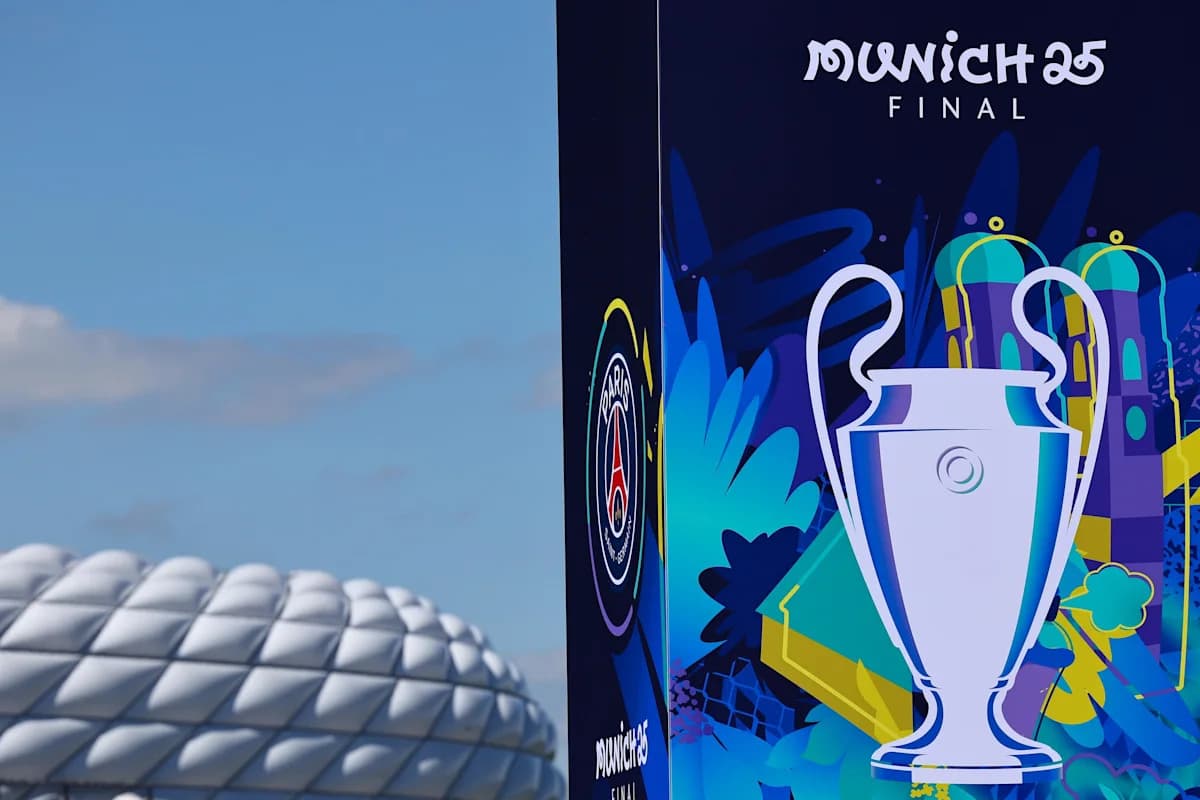
Allianz Arena to Host 2028 UEFA Champions League Final