
Sevilla vs Real Madrid: Tactical Analysis of 1-0 Defeat
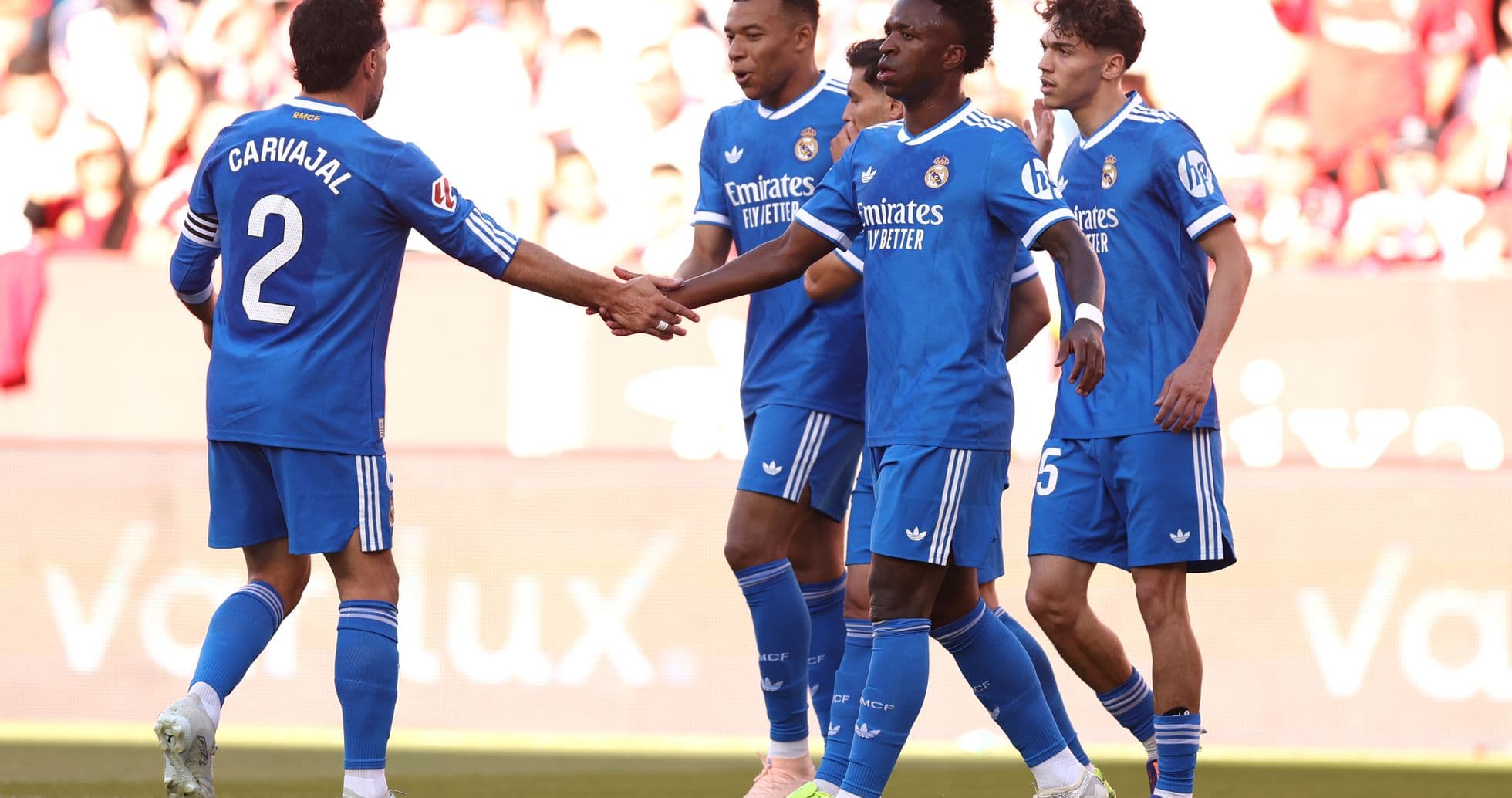
Sevilla’s 1-0 defeat to Real Madrid at Estadio Ramón Sánchez Pizjuán unfolded as a study in contrasting control: territorial and technical dominance from Alvaro Arbeloa’s 4-3-3 against Luis Garcia Plaza’s structurally disciplined but ultimately blunt 4-4-2. The numbers frame it clearly: Madrid owned 59% possession and a 1.03 xG to Sevilla’s 41% and 0.73 xG, yet required only a single on-target effort to decide the match, the early strike from Vinicius Junior.
Sevilla’s shape was orthodox: a flat back four of J. A. Carmona, Castrin, Kike Salas and G. Suazo, with N. Gudelj and Djibril Sow as the double pivot and R. Vargas and Oso wide, supporting the front pair of A. Adams and N. Maupay. Out of possession, this became a compact 4-4-2 mid-block, the front two tasked with screening passes into Jude Bellingham and A. Tchouameni rather than pressing Thibaut Courtois or the Madrid centre-backs aggressively. That conservative trigger allowed Madrid to build patiently, particularly through Antonio Rudiger stepping out with the ball and Ferland Garcia advancing on the left.
Madrid’s 4-3-3 was built around a central triangle of Tchouameni as single pivot, Bellingham as an advanced carrier, and T. Pitarch as the more conservative left-sided interior. Wide, Brahim Diaz and Vinicius Junior stretched Sevilla’s back line, with Kylian Mbappe operating as a flexible nine, dropping into the half-spaces to overload Gudelj and Sow. The early 15th-minute goal from Vinicius Junior crystallised that plan: Madrid manipulated Sevilla’s midfield line, pulled a centre-back out, and exploited the resulting channel. Even without an officially recorded assist, the pattern was clear – vertical progression through the inside-left lane and an immediate attack on the space behind Carmona and Castrin.
From that point, the game became about how well Sevilla could convert their defensive industry into meaningful attacking sequences. They generated 14 total shots to Madrid’s 12 and actually hit the target more often (6 shots on goal to Madrid’s 1), but their shot quality betrayed them. The 0.73 xG from 7 efforts inside the box and 7 from range underlines a reliance on low-probability attempts, often from Adams or Maupay receiving with their back to goal and forced to shoot under pressure, rather than clean, cut-back finishes.
Sevilla’s passing profile (355 passes, 285 accurate, 80%) reflects a side that rarely broke Madrid’s first line with ground combinations. Much of their progression came via Suazo’s and Carmona’s more direct balls into the channels or early crosses. When they did manage to pin Madrid back, their 4 corner kicks and 7 shots inside the box showed some territorial success, but the lack of a true link player between midfield and attack left Adams and Maupay isolated. The second-half substitutions – A. Sanchez (IN) came on for N. Maupay (OUT) on 53', C. Ejuke (IN) for R. Vargas (OUT) on 54', L. Agoume (IN) for N. Gudelj (OUT) on 54', J. Sanchez (IN) for J. A. Carmona (OUT) on 70', and I. Romero (IN) for Oso (OUT) on 78' – were a clear attempt to add ball-carrying and vertical threat, but they also disrupted the earlier defensive cohesion in central areas.
Madrid, by contrast, managed the game through control rather than volume of chances. Their 528 passes with 463 accurate (88%) show a side comfortable circulating under pressure, using Courtois and the centre-backs to reset and draw Sevilla’s block forward. Tchouameni’s role as a press-release valve was central; even after his withdrawal on 70' – E. Camavinga (IN) came on for A. Tchouameni (OUT) – the structure remained stable, with Camavinga offering more dribbling to escape Sevilla’s late-game press.
The substitutions on Madrid’s right – F. Mastantuono (IN) for T. Pitarch (OUT) at 70', T. Alexander-Arnold (IN) for B. Diaz (OUT) at 77', G. Garcia (IN) for Vinicius Junior (OUT) at 77', and A. Leiva (IN) for J. Bellingham (OUT) at 87' – gradually shifted the side from aggressive wing play to a more conservative, possession-focused setup. Alexander-Arnold tucked inside at times, helping secure central overloads and limiting Sevilla’s opportunities to counter into open lanes. With only 12 fouls committed and no yellow cards, Madrid’s defensive work was measured and positional rather than reactive.
Discipline and game state shaped the final half-hour. Sevilla’s 18 fouls and 4 yellow cards illustrate a team increasingly stretched. The bookings were all for Sevilla and must be read in sequence: 48' Nemanja Gudelj — Off the ball foul; 80' Alexis Sánchez — Argument; 84' Juanlu Sánchez — Foul; 90+4' Lucien Agoumé — Argument. The first, to Gudelj just after half-time, signalled Sevilla’s attempt to raise the physical temperature and disrupt Madrid’s rhythm between the lines. The later cards for Alexis Sánchez and Juanlu Sánchez came as Sevilla chased the game with more bodies ahead of the ball, leaving them vulnerable to Madrid transitions and forcing tactical infringements to halt counters. Agoumé’s late booking for Argument at 90+4' reflected frustration as Madrid calmly closed out the match.
In goal, the statistical story is stark. O. Vlachodimos made just 1 save with 0.46 goals prevented, which aligns with Madrid’s single shot on target – the Vinicius Junior goal – and underlines that the keeper was largely a spectator in terms of shot-stopping but still marginally outperformed the xG on target he faced. At the other end, Thibaut Courtois produced 6 saves and also posted 0.46 goals prevented, a critical figure in explaining how Madrid preserved their lead despite conceding more on-target efforts. Sevilla’s 6 shots on goal for only 0.73 xG highlight that many of those attempts were from suboptimal angles or distances, allowing Courtois to make relatively comfortable interventions.
Statistically, the verdict is of a match where Madrid’s superior overall form and technical security translated into territorial control and a narrow but deserved margin on xG, while Sevilla’s higher foul count and card load (Sevilla: 4 yellow cards, Real Madrid: 0, Total: 4) mirrored their increasingly desperate attempt to disrupt the visitors’ rhythm. Madrid did not overwhelm in chance volume, but their defensive index – 6 saves from Courtois, limited high-quality shots conceded, and zero cards – points to an elite game-management performance. Sevilla, despite their 14 total shots and moments of pressure, never fully solved Madrid’s compact 4-3-3 block or found a reliable mechanism to isolate their forwards in high-value zones, leaving Vinicius Junior’s 15' strike as the decisive tactical hinge of the evening.
Related News

LaLiga 2026-27 Season Schedule Released: Kickoff on August 15, Clásico on October 25
Atletico Madrid vs Real Madrid: Head-to-head Stats and Past Meetings
Real Madrid Dominates Rayo Vallecano in La Liga Clash
Atletico Madrid Dominates Real Sociedad 3-0 at Reale Arena
Barcelona Dominates Levante in High-Scoring Clash

Sevilla vs Barcelona Stats: Head-to-Head Record and Past Meetings