
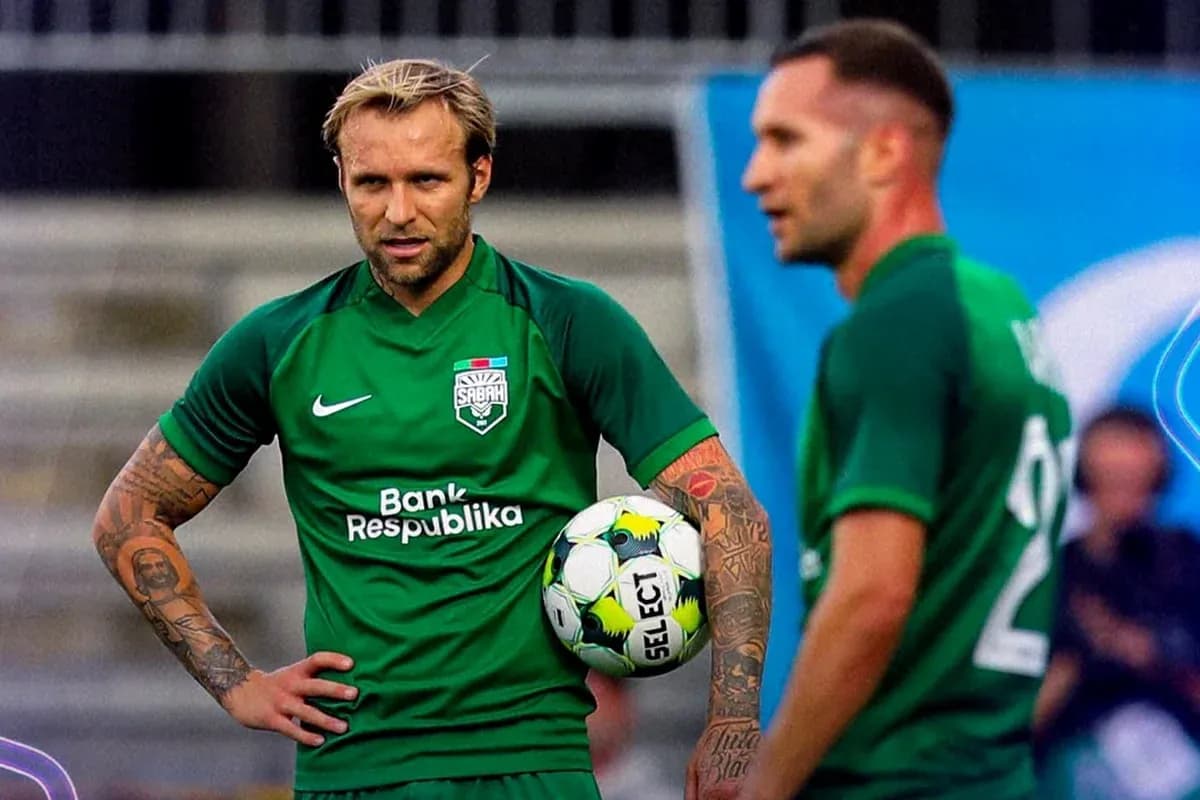
Sabah FA Dominates Aarhus 4-0 in UEFA Champions League Qualifiers
Sabah FA produced a tactically dominant 4-0 win over Aarhus at Bank Respublika Arena in the UEFA Champions League 3rd Qualifying Round, built on structural superiority rather than territorial control. Possession was perfectly balanced at 50%-50%, yet the home side converted that parity on the ball into a massive territorial and chance-creation edge, generating 29 total shots to Aarhus’ 14 and repeatedly pinning the Danish side back through intelligent use of width and second-line pressing.
Formation and Tactics
Valdas Dambrauskas’ 4-2-3-1 for Sabah FA functioned as an aggressive, front-foot structure. The back four of A. Zedadka, S. Solvet, R. Dashdamirov and T. Puchacz held a relatively high line, with double pivot U. Rakhmonaliyev and I. Lepinjica providing both protection and circulation. Ahead of them, the trio of V. Simic, A. Isayev and J. Mickels operated very narrow between the lines, constantly overloading the half-spaces around Aarhus’ single pivot J. Jonsson. With O. Mbina as the lone striker, Sabah FA’s shape often morphed into a 2-3-5 in settled possession, the full-backs advancing to pin Aarhus’ wing-backs.
Aarhus, under Jakob Poulsen, lined up in a 3-1-4-2 that in theory should have given them central stability and two high forwards to attack transitions. In practice, the structure was repeatedly stretched. The back three of E. Kahl, C. Rosler and J. Andersen were dragged wide by Sabah FA’s wide rotations, while the single screen of Jonsson struggled to cover horizontal spaces when Sabah FA circulated quickly through Rakhmonaliyev and Lepinjica. The nominal wing-backs, R. Carstensen and G. Links, were forced deep into a back five, which left the front two, T. Bech and J. Bogere, isolated.
Shot Profile
The shot profile underlines Sabah FA’s territorial grip: 23 of their 29 efforts came from inside the box, compared with Aarhus’ 8 from similar zones. That points to repeated penetrations into high-value areas, not speculative shooting. The hosts also forced 8 blocked shots, evidence of sustained pressure and Aarhus’ last-ditch defending around the penalty area. By contrast, Aarhus managed 14 total shots, but with only 5 on target and 4 blocked, their attacks were more sporadic and easier to read.
Second Half Adjustments
Crucially, Sabah FA transformed their structural superiority after the break. The first half ended 0-0 despite the hosts’ initiative, but the substitution at 58' — X. Severina (IN) came on for O. Mbina (OUT) — subtly changed the attacking dynamics. Severina’s tendency to drift wide and drop into pockets created an extra playmaker line, and within a minute Sabah FA broke through. At 59', V. Simic finished a move assisted by J. Mickels, capitalising on the numerical overloads Sabah FA had been building all game.
From that moment, Aarhus’ 3-1-4-2 began to unravel. Sabah FA’s second goal at 67', scored by centre-back S. Solvet from an A. Isayev assist, illustrated their superiority on set or second-phase situations, with a defender stepping into advanced zones untracked. Aarhus’ attempts to react with a flurry of substitutions (F. Emmery for G. Links at 64', M. Anderson for R. Carstensen at 65', J. Serra for M. Knudsen at 72', M. Camara for C. Rosler at 81', and S. Jorgensen for J. Jonsson at 82') were largely reactive and did not solve their structural issues: the midfield remained outnumbered and the back line kept being pulled apart by Sabah FA’s rotations.
Late Goals
Sabah FA’s third and fourth goals — J. Mickels at 78' and substitute X. Severina at 89', the latter assisted by right-back A. Zedadka — were the natural outcome of this tactical pattern. By then, Aarhus’ wing-backs were pinned so deep that the visitors’ front two received little service, and the midfield line could no longer compress space. Sabah FA’s later substitutions (C. Nwachukwu for A. Isayev at 82', R. Fernandes for J. Mickels at 90+3', T. Mutallimov for A. Zedadka at 90+4', and A. Khaybulaev for I. Lepinjica at 90+3') served primarily to maintain intensity and secure the clean sheet.
Defensive Performance
Defensively, Sabah FA were compact and disciplined. They committed 11 fouls to Aarhus’ 10, but drew three yellow cards from the visitors — Rasmus Carstensen (8', Foul), Jacob Andersen (32', Foul) and Eric Kahl (66', Foul) — while incurring none themselves. That disparity reflects how often Aarhus were forced into emergency defending against quicker combinations. Sabah FA’s back four controlled depth well enough that Aarhus’ 5 shots on target were largely manageable, and the hosts’ structure in front of the defence limited clear central entries despite Aarhus having identical possession and a comparable pass volume (366 passes for Sabah FA vs 372 for Aarhus).
Goalkeeping and Passing Data
In goal, M. Hedenstad (Aarhus) faced a barrage: Sabah FA put 10 shots on target, and despite his 5 saves, the pressure was relentless once the defensive line in front of him broke. On the other side, S. Pokatilov (Sabah FA) made 5 saves as well, matching Aarhus’ shots on goal. That symmetry in saves, despite the asymmetry in scoreline, underlines how efficiently Sabah FA converted their dominance in the box into goals, while simultaneously ensuring that Aarhus’ chances remained low-quality or from less dangerous positions.
The passing data completes the tactical picture. Aarhus actually posted slightly better passing metrics — 372 total passes, 321 accurate at 86% — compared with Sabah FA’s 366 passes, 311 accurate at 85%. Yet the home side translated similar possession and accuracy into far more threatening final-third actions, thanks to their superior spacing, layered attacking structure and better use of full-backs. Corner counts (7-4 to Sabah FA) and offside numbers (3-0 against Sabah FA) further indicate a home side pushing the last line repeatedly, while Aarhus struggled to establish sustained pressure.
Conclusion
With no xG or goals prevented values available, the clearest tactical verdict is drawn from volume and location of shots plus structural patterns: Sabah FA turned a balanced possession game into a comprehensive territorial and scoreboard victory through a well-drilled 4-2-3-1, intelligent in-game adjustment with Severina, and a defensive block that kept Aarhus’ 3-1-4-2 from ever functioning as an attacking platform.
Related News

Lamine Yamal Shares What Barcelona Must Do to Triumph in the Champions League

Luis Díaz Confident Bayern Munich Can Win Champions League

Insights from AFC Champions League Matchday One: K League Clubs’ Strategies

Vincent Kompany's Bayern Munich Future Not Tied Solely to Champions League Outcome
Barcelona's Camp Nou Chosen for 2029 Champions League Final, Munich Set for 2028
Allianz Arena to Host 2028 UEFA Champions League Final